
SCIOSPEC MULTIPLEXERS
Precision EIS multiplexing across 32 to 256+ connections.
Sciospec multiplexers route one impedance analyzer sequentially across many DUTs, sensors or electrode combinations.
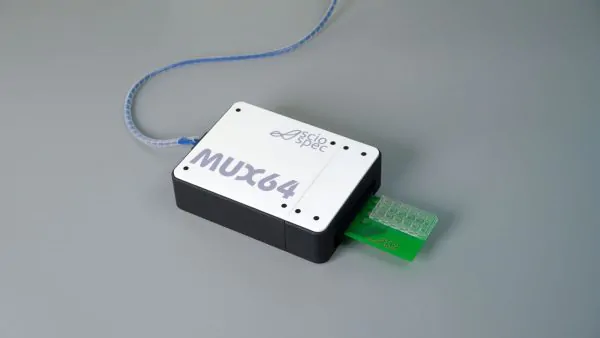
They are designed specifically for demanding impedance measurements, combining very high isolation, ultra-low parasitics and any-to-any routing for flexible 2-, 3- and 4-electrode configurations. Choose standard MUX32 or MUX64 external modules, scale to larger systems where required, or integrate multiplexing directly into selected Sciospec instruments.
- EIS-optimized switching with extremely low electrical loading
- Any-to-any routing for flexible 2-, 3- and 4-electrode configurations
- External MUX modules or integrated Sciospec system configurations
Tell us how many connections you need, how they must be switched and which analyzer you use – Sciospec or otherwise. We will recommend the simplest suitable MUX and interface route.
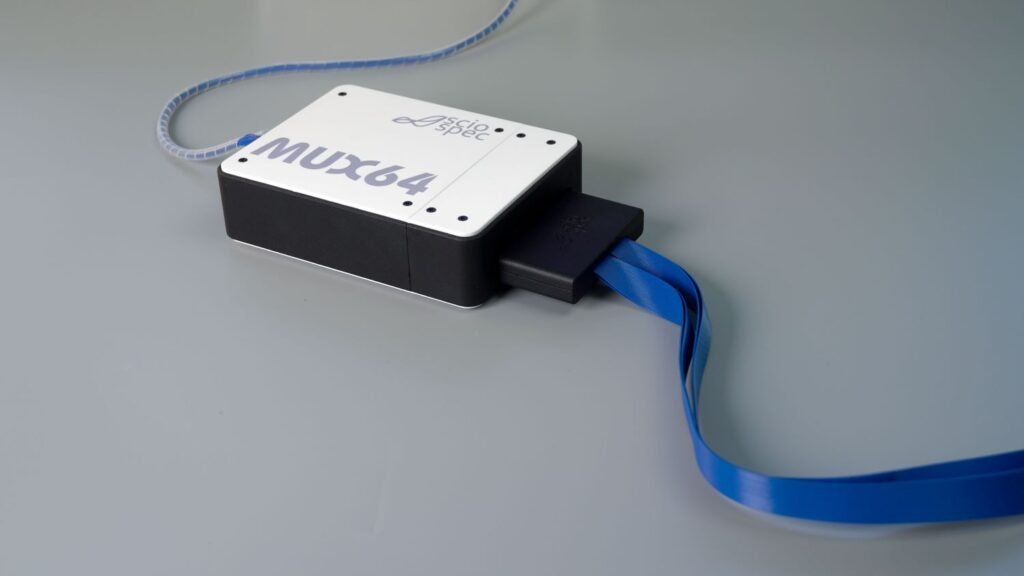
32–256+ Ports
SCALE THE CONNECTION COUNT
>10 TΩ | <0.7 pF
SWITCHING QUALITY
Any-to-any
ROUTING
External or integrated
DEPLOYMENT
Switching designed for precision impedance measurement.
Multiplexing keeps many DUTs, sensors or electrodes connected and routes the analyzer automatically between the required measurement positions.
For precision EIS, the switch matrix is part of the electrical measurement path. Disconnected channels can add leakage or capacitive coupling; active switches add resistance and capacitance. These effects become increasingly relevant at high impedance, small capacitance and higher frequency.
Sciospec multiplexers are designed to make the switching network as electrically unobtrusive as possible.
Keep disconnected channels out of the measurement
Isolation above 10 TΩ || 0.4 pF keeps unselected paths effectively separated from the active measurement.
This is particularly important when very high impedances or small capacitive signals make leakage and coupling visible.
Minimize the MUX contribution to the active path
With parasitic capacitance below 0.7 pF and maximum series resistance of 200 mΩ, the active switching path adds very little of its own impedance.
Specified zero on-state leakage and zero charge injection further reduce switching-related influence on demanding measurements.
Assign any measurement terminal to any MUX port
Many multiplexers use fixed channel assignments or switch one common connection across a predefined set of channels. The Sciospec MUX routes the analyzer terminals independently.
Any available MUX port can therefore be assigned to the required analyzer terminal, allowing flexible 2-, 3- or 4-electrode configurations without rewiring the setup.
Use the same connected setup for:
repeated measurements across many DUTs;
changing polarity;
moving excitation paths;
scanned sensing positions;
multi-terminal components;
changing injection and sensing patterns across electrode arrays.
Sciospec multiplexers are designed to make the switching network as electrically unobtrusive as possible.
Technical Specifications
Parameter
Specification
Details
CHANNELS & CONFIGURATION
Standard external configurations
MUX32 · MUX64
32 or 64 physical multiplexer ports
Larger configurations
128 · 256 · larger
Application-specific system configurations
Measurement architecture
Sequential multiplexing
One configured measurement path is routed at a time
Routing topology
Any-to-any
Any analyzer terminal can be assigned to any available MUX port
Electrode configurations
2-, 3- and 4-electrode
Supports changing terminal and electrode assignments
SWITCHING CHARACTERISTICS
Isolation
>10 TΩ || 0.4 pF
Power-off or software-selected cell disconnect
Parasitic capacitance
<0.7 pF
Low additional capacitive loading
Series resistance
max. 200 mΩ
Connected switching path
Leakage current
0 in on-state
Current product specification
Charge injection
0
Current product specification
SYSTEM INTEGRATION
Sciospec instrument connection
ExtensionPort
Carries measurement signals, supply and digital I/O
Application-side interface
SC98
Breakouts, adapters, carriers and custom interfaces
External Sciospec integration
ISX-3 · ISX-3mini · ISX-5
Current compatible ExtensionPort route
Integrated MUX options
ISX-3 · ISX-5
Multiplexing can be built into suitable instrument configurations
Sequential where scale matters. Parallel where timing matters.
“Multichannel” can describe two very different requirements.
The important question is whether the measurements need to happen at the same instant.
One analyzer. Many selectable paths.
Choose multiplexing when many DUTs, electrodes or terminal combinations can be measured one after another.
Typical reasons: automate measurements across many positions; avoid manual reconnecting; access larger sensor or electrode arrays; change electrode combinations through software; scale the setup without duplicating the complete analyzer.
Strong fit: many connections, sequential acquisition acceptable.
Several measurement engines. Simultaneous acquisition.
Choose a parallel architecture when several signals must genuinely be measured at the same time—for example when their dynamics need to be compared on one timeline.
Strong fit: simultaneous acquisition is part of the measurement requirement.
For true-parallel EIS, explore the ISX-5. For applications that combine parallel impedance or electrochemical measurements with integrated routing across many sensor contacts, the CSX-64 may be the better fit.
A conventional scanner or relay matrix can be entirely adequate when topology and electrical loading are uncritical.
The Sciospec MUX becomes especially interesting when the switching itself must preserve demanding impedance measurements, when the electrode assignments change, or when switching and analyzer control should operate as one coordinated system.
Three ways to use the Sciospec MUX.
Use it as an external ExtensionPort module, integrate it into selected Sciospec instruments, or ask us to review compatibility with measurement equipment you already use.
Extend a Sciospec analyzer with an external MUX
ISX-3 / ISX-3mini / ISX-5 → ExtensionPort → MUX → SC98 → sensor / DUT / fixture
Use an external MUX when you want to add or change multiplexing independently from the instrument, or extend an existing compatible Sciospec analyzer.
ExtensionPort carries the measurement terminals, supply and digital I/O between analyzer and MUX, with switching controlled as part of the Sciospec system.
Good fit for: retrofits, modular laboratory systems and setups that may change.
Integrate multiplexing directly into the instrument
ISX-3 / ISX-5 with integrated MUX → SC98 → sensor / DUT / fixture
Choose an integrated configuration when multiplexing is a permanent part of a new system and you want the most compact Sciospec solution.
The analyzer and switching are configured together and operated as one system.
Good fit for: compact dedicated setups and new systems with a defined multiplexing requirement.
Using another analyzer? Ask us to check compatibility
Sciospec multiplexers are designed to work seamlessly with Sciospec measurement hardware and software. If you already use another analyzer, that does not automatically rule out the MUX.
Third-party use may be possible, depending on the instrument and measurement setup.
Compatibility depends on the instrument's electrical connections and control interface, as well as your switching topology and measurement range. We review these setups individually rather than presenting the MUX as a universal plug-and-play accessory.
For a first compatibility check, send us:
which instrument you use;
what you are measuring;
how many connections are required;
which terminals need to be switched;
the relevant frequency and impedance range.
We can then assess whether a suitable integration route is available.
Typical situations for multiplexed impedance measurements.
The applications vary, but the reason for multiplexing is usually simple: many connected positions or terminal combinations need to be measured sequentially with the same analyzer.
Scan many DUTs or samples automatically
Keep components, sensors or samples connected and scan them sequentially instead of manually changing cables between measurements. Useful for development comparisons, repeated checks and automated characterization.
Switch excitation and sensing across electrode arrays
Use any-to-any routing when excitation and sensing positions need to change across a larger electrode map.
Because individual electrodes can take different roles from one measurement step to the next, the MUX supports more than simple sequential channel scanning.
Change terminal combinations without rewiring
Switch between different 2-, 3- or 4-terminal configurations on the same connected device.
Useful when different current paths, sense points or polarity assignments form part of the experiment.
Integrate switching into automated test setups
Replace manual reconnection or custom relay boards with controlled switching designed for impedance measurement.
Combine the MUX with SC98 interfaces, external control and application-specific fixtures where the setup must become repeatable.
Connect the MUX to your sensor, fixture or DUT.
SC98 provides the application-side interface between the MUX and the sensor, fixture or DUT.
Use simple breakout cabling for individual access, adapter cards or sensor carriers for defined formats, and custom interfaces where the application needs something else.
Access individual MUX ports directly
Use coaxial breakout cabling when straightforward individual access is useful.
Connect established formats with adapters or carriers
Use SC98 adapter cards or PCB sensor carriers where the application already has a defined connector or electrode format.
Create a dedicated interface for your sensor
For proprietary chips, fixtures, cartridges or contact maps, Sciospec can develop a dedicated interface—or customers can design their own interface using available SC98 design information.
Add extension or signal conditioning where needed
SC98 can also support extension cables and application-side circuitry such as filtering, protection or AC coupling where required.
Send us a pinout, contact map or connector drawing. We will recommend the simplest suitable route from the MUX to the application.
Configure your multiplexer
Pick channel count, external or integrated form factor, SC98 carrier type and add-ons — cables, AC coupling, custom carriers, EIT option and training.
Loading configurator…
Frequently Asked Questions
What does a Sciospec multiplexer do?
A Sciospec multiplexer lets one impedance measurement path access many DUTs, sensors or electrode combinations sequentially.
Instead of manually reconnecting the analyzer—or providing a complete analyzer channel for every physical connection—the switching system selects the required path automatically.
What is the difference between a MUX port and a measurement channel?
Each port can be assigned to any electrode role (work / sense / counter / reference) on the fly. You can build arbitrary 2-, 3- or 4-electrode configurations, switch polarities, scan potentials and realise EIT-style injection patterns — all from software, without rewiring.
Why use a Sciospec MUX instead of a generic scanner?
> 10 TΩ ‖ 0.4 pF isolation at power off or selected cell disconnect, parasitic capacitance < 0.7 pF, max. 200 mΩ series resistance on, zero leakage current and zero charge injection — no distortion, no noise beyond thermal noise.
What does any-to-any routing mean?
Yes. Available as an external unit on any ExtensionPort-compatible Sciospec analyzer, or integrated with the ISX-3 / ISX-5 in a single enclosure.
How many ports are available?
SC98 is open by design. Pick stock connectors, design your own carrier (we share the design data), or have Sciospec build a custom carrier with AC coupling, filtering or application-specific routing.
Can the multiplexer be integrated directly into a Sciospec instrument?
Yes — 4 digital IOs with flexible functions through the Sciospec InterfacePort standard, for triggering, syncing and controlling external instrumentation.
Can I add a MUX to an existing Sciospec analyzer?
Yes — 4 digital IOs with flexible functions through the Sciospec InterfacePort standard, for triggering, syncing and controlling external instrumentation.
Can I use the Sciospec MUX with another manufacturer’s analyzer?
Yes — 4 digital IOs with flexible functions through the Sciospec InterfacePort standard, for triggering, syncing and controlling external instrumentation.
Does adding a multiplexer affect EIS accuracy?
Yes — 4 digital IOs with flexible functions through the Sciospec InterfacePort standard, for triggering, syncing and controlling external instrumentation.
Can I connect a custom sensor or electrode array?
Yes — 4 digital IOs with flexible functions through the Sciospec InterfacePort standard, for triggering, syncing and controlling external instrumentation.
PRODUCT FRONT — C / R / WS / W measurement interface: the four BNC measurement terminals that make configurable 2-/3-/4-electrode measurement tangible.
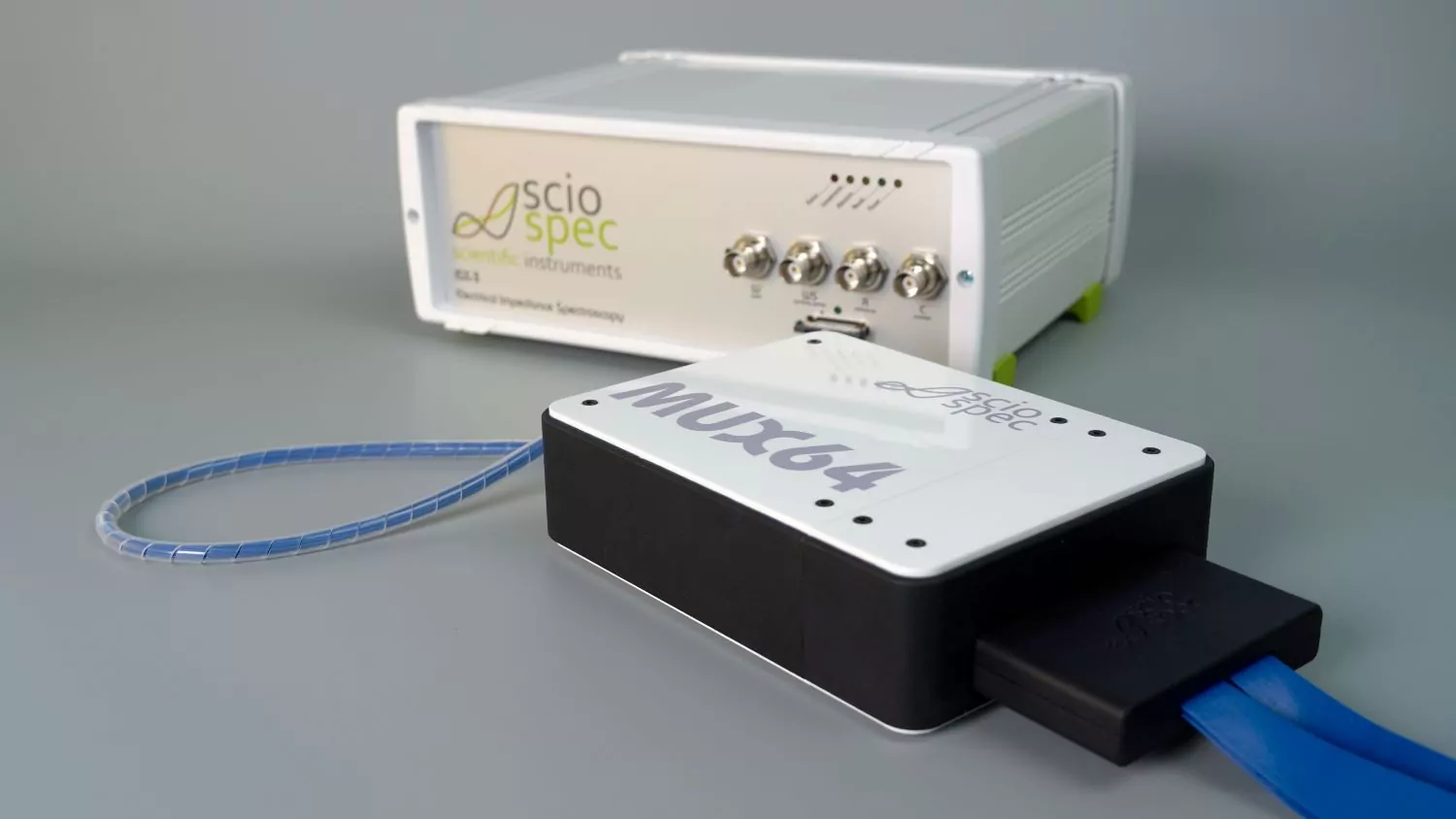
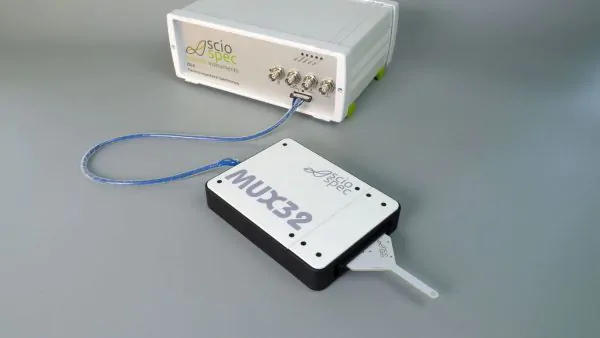
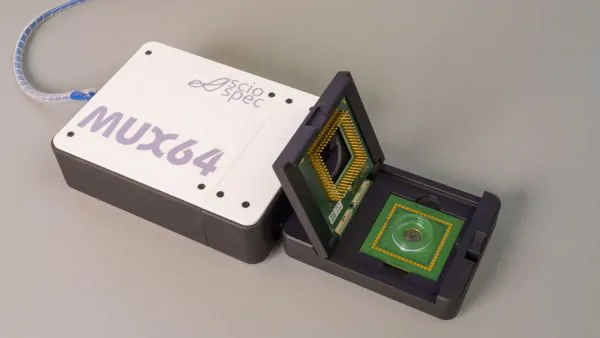
APPLICATION INTERFACE — ISX-3 + real adapter/frontend: MEArack proves that application adaptation is real hardware, not a promise.
Choose the next step for your MUX setup.
Configure a MUX setup
Choose the required port count, deployment format and application interface. We will confirm the configuration and prepare the next technical or commercial step.
Check MUX compatibility
Already have an analyzer you want to keep using? Send us the instrument model, measurement range and switching requirement. We will review whether a suitable integration route is available.
Get a setup recommendation
View technical documentation · Explore ISX-3 · Explore parallel EIS with ISX-5 · Explore CSX-64 · View adapters & test fixtures
Get in touch with us
Phone
Headquarters
Sciospec Scientific Instruments GmbH
Leipziger Str. 43b
04828 Bennewitz, Germany
Open in Google Maps