
Built around your sensor.
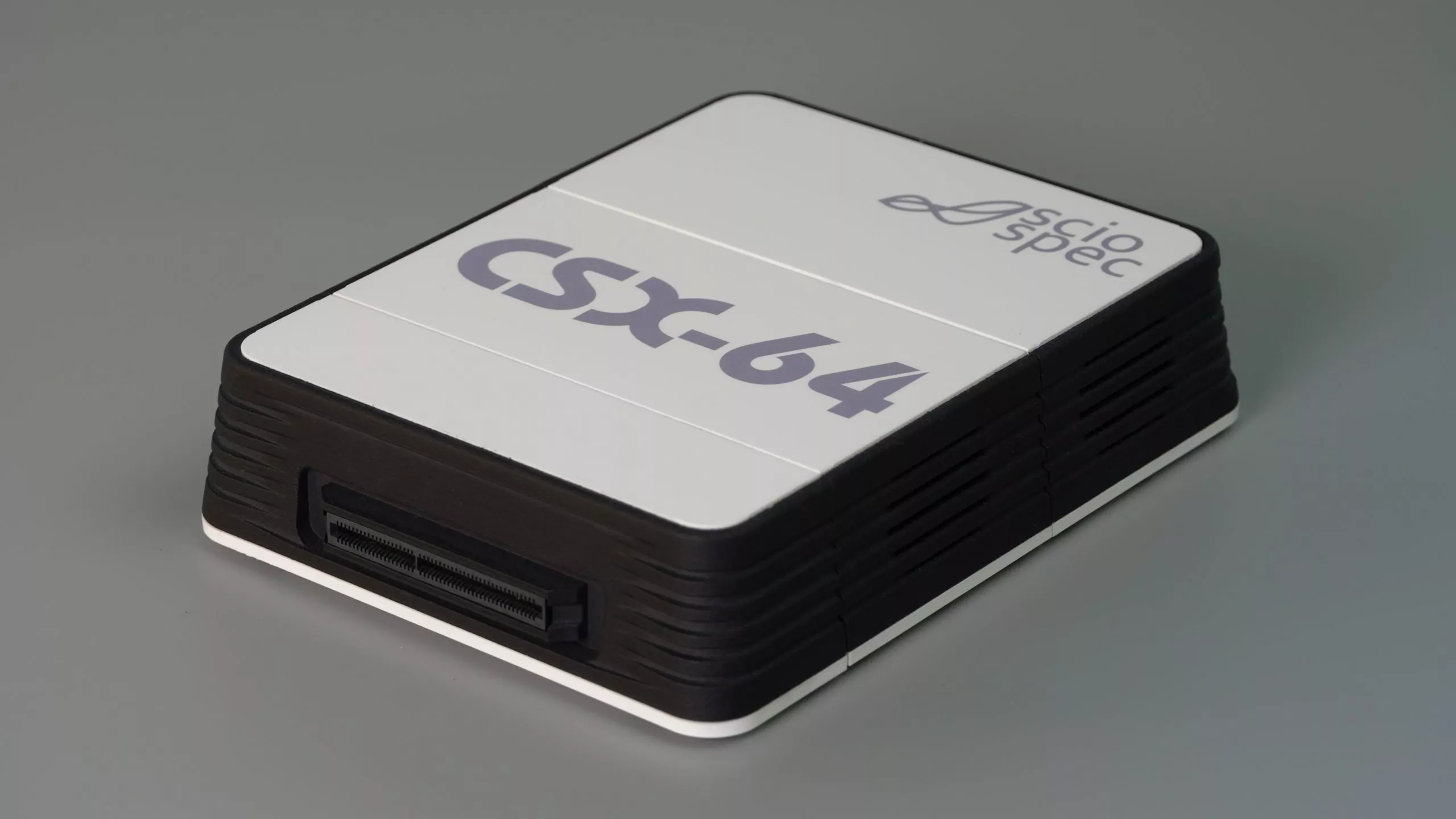
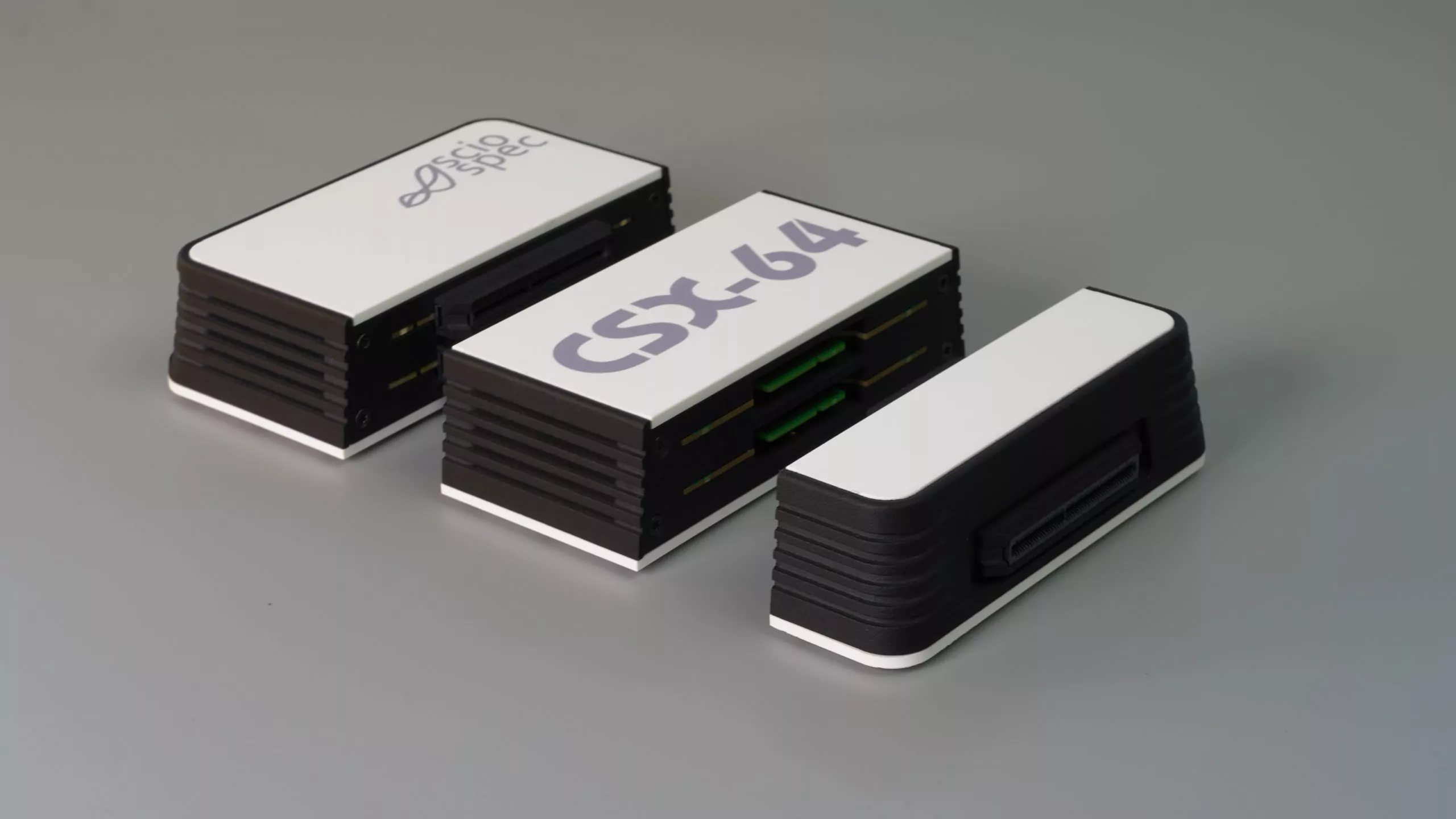
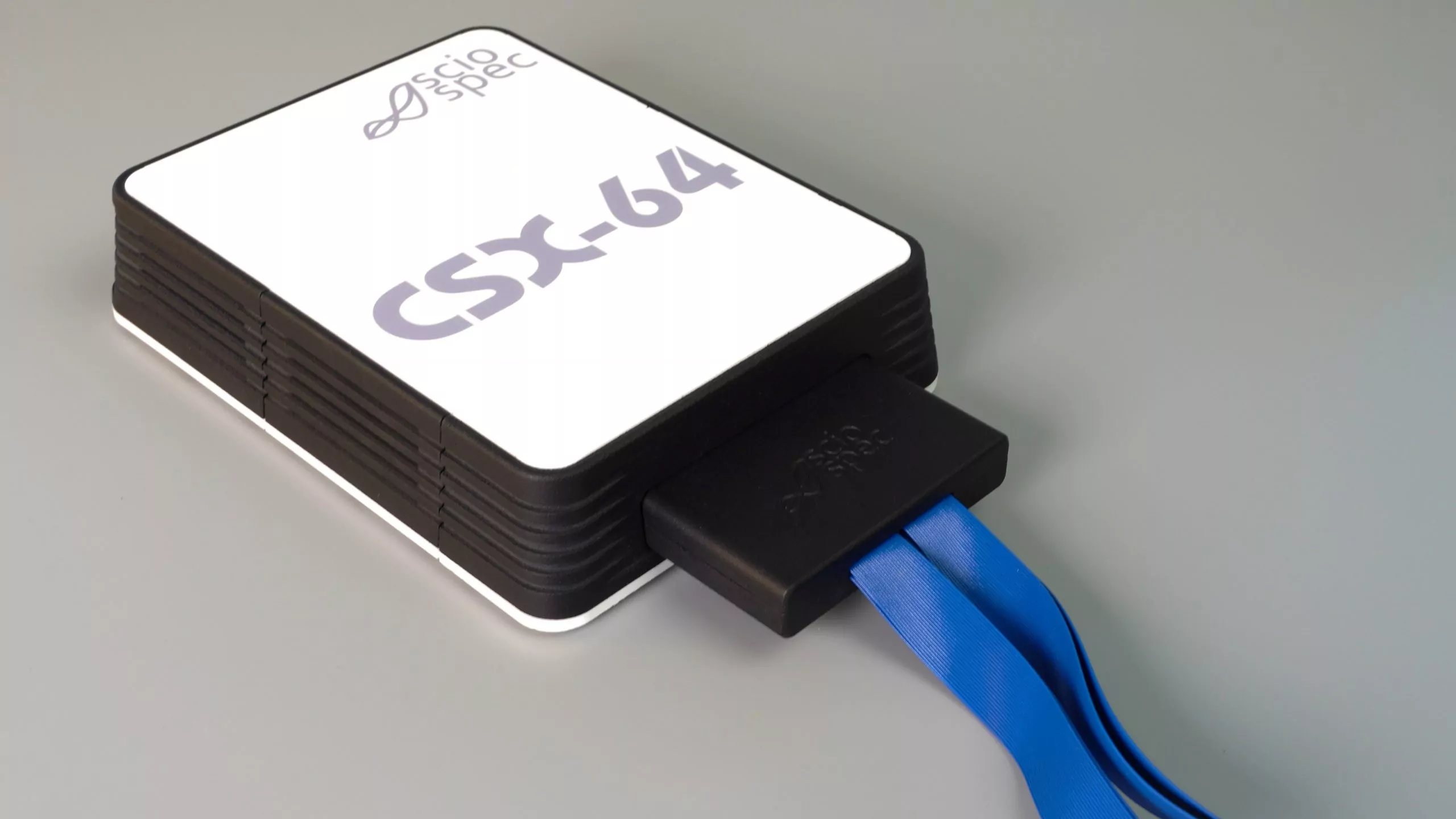
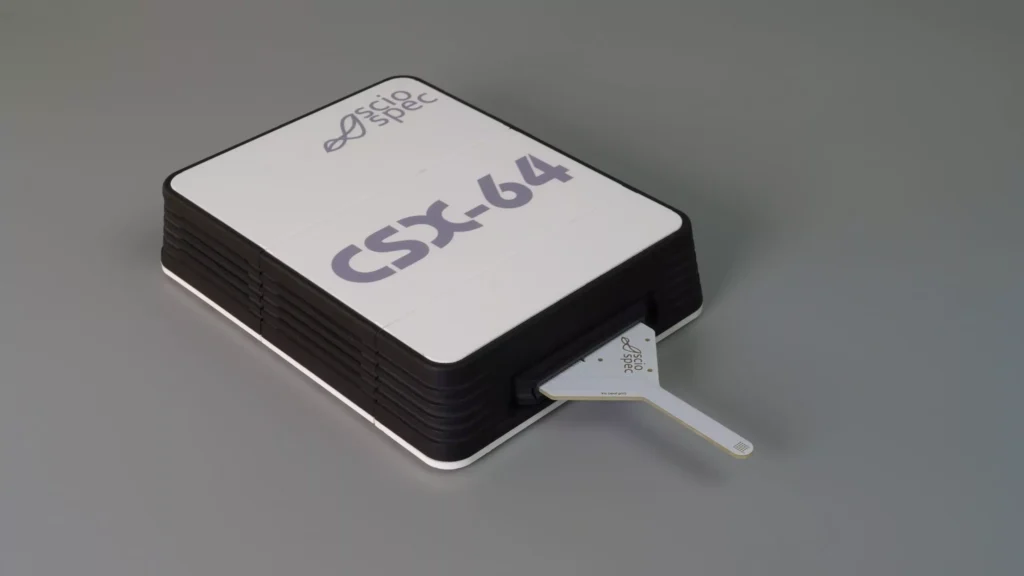
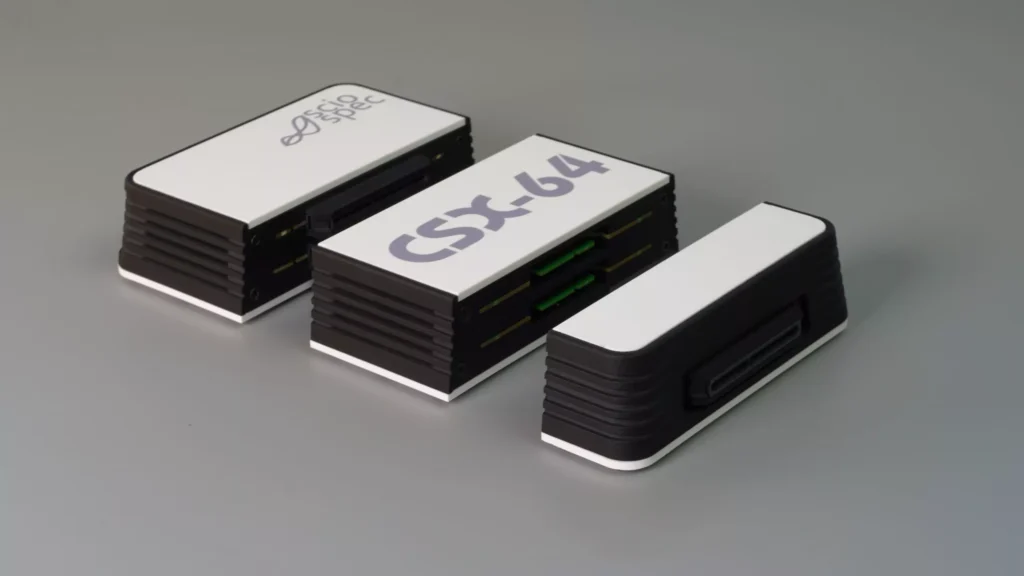
The CSX-64 combines eight individually configurable potentiostat/galvanostat banks for simultaneous electrochemical or impedance measurements, with integrated routing across 64 sensor contacts.
Use it for EIS and LCR-style impedance readout, multipotentiostat and polypotentiostat configurations, and sensors whose contact map or electrode topology does not fit a standard instrument. Instead of rebuilding the readout around every new sensor revision, adapt the connection and measurement configuration around the sensor.
- Up to 8 measurements in parallel
- Integrated routing across 64 sensor contacts
- From EIS and LCR-style readout to multipotentiostat and polypotentiostat configurations

8 parallel measurement banks
Individually configurable potentiostat/galvanostat frontends
64 physical sensor ports
Integrated routing for larger and changing contact maps
Broad measurement scope
EIS, CV, CA, DPV, LCR-style readout, TEER and more
Flexible sensor interfaces
From direct cabling to adapters and application-specific carriers
8 parallel measurement banks. 64 flexible sensor contacts.

Measurement core
Up to 8 simultaneous measurements
EIS · LCR · TEER · CV · CA · DPV · more
8 individually controlled analogue banks
Potentiostat/ galvanostat control and measurement paths
Integrated 64-port routing
Configurable C / R / WS / W assignments
Additional positions can be sequenced
Connect your sensor
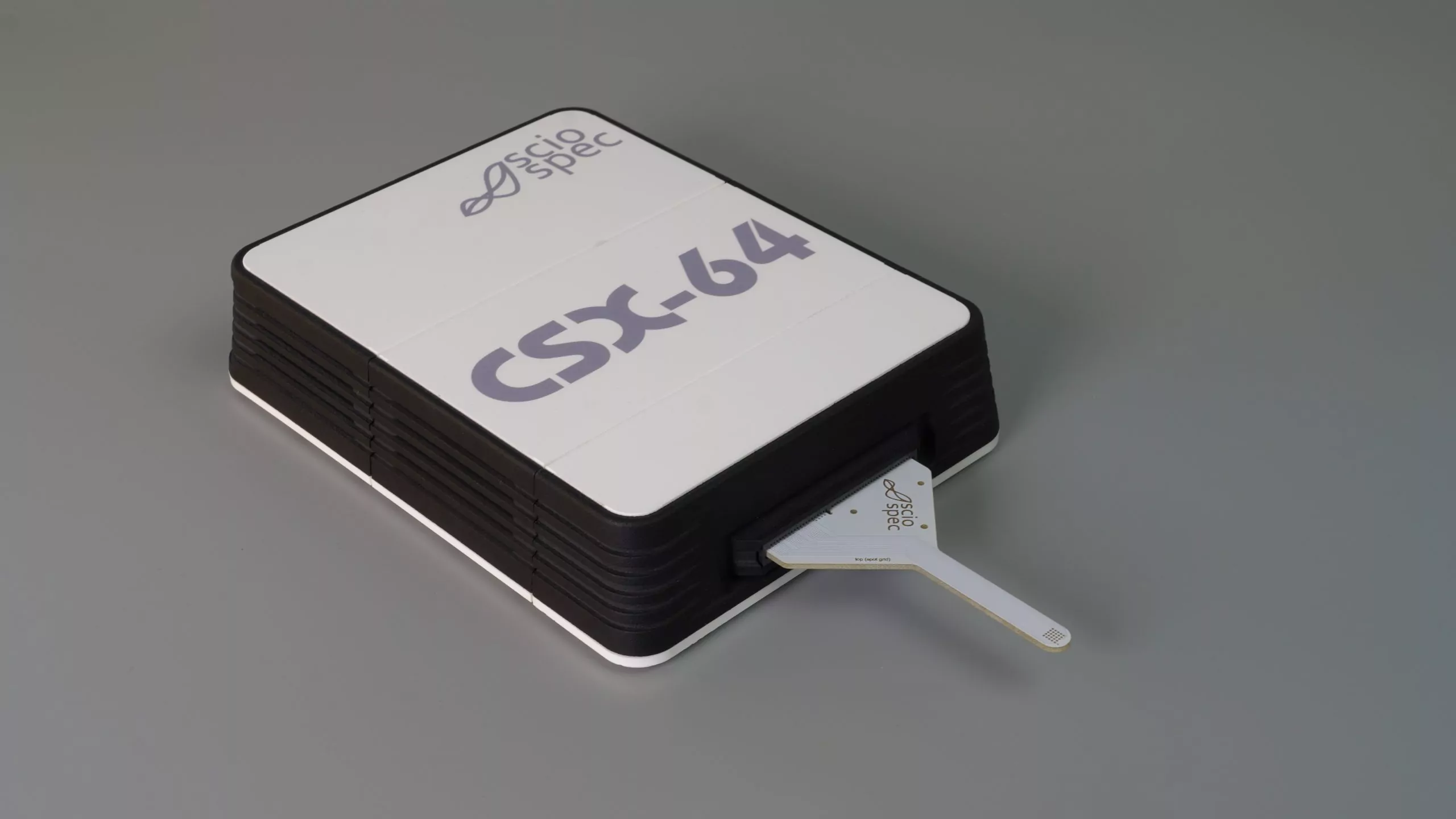
Flexible SC98 interface
Direct cabling
Adapters
Edge-card carriers
Custom interfaces
Parallel control
Control multiple cells, compare changes directly and shorten readout times
Use the eight individually controlled potentiostat/galvanostat banks to control and measure cells, sensors or regions at the same time. Time-critical changes are captured on one timeline, while parallel acquisition reduces the time required for larger setups.
Flexible routing
Reach more positions without additional hardware
Route measurement functions across 64 contacts and combine parallel measurements with sequential steps. This supports dense arrays, shared electrodes and changing contact maps without dedicating a complete instrument channel to every position.
Adaptable sensor interface
Connect the sensor you have—and adapt as it evolves
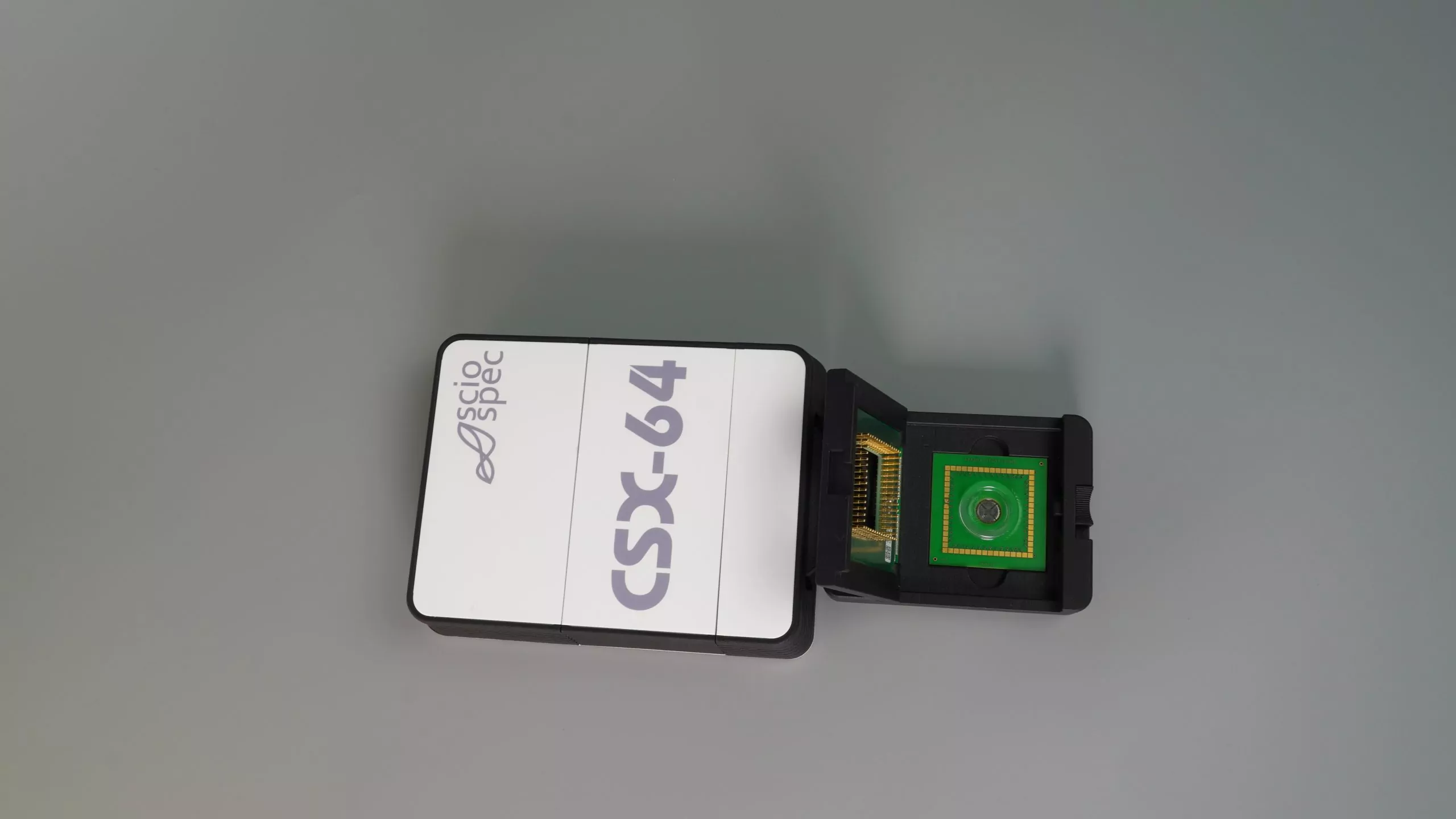
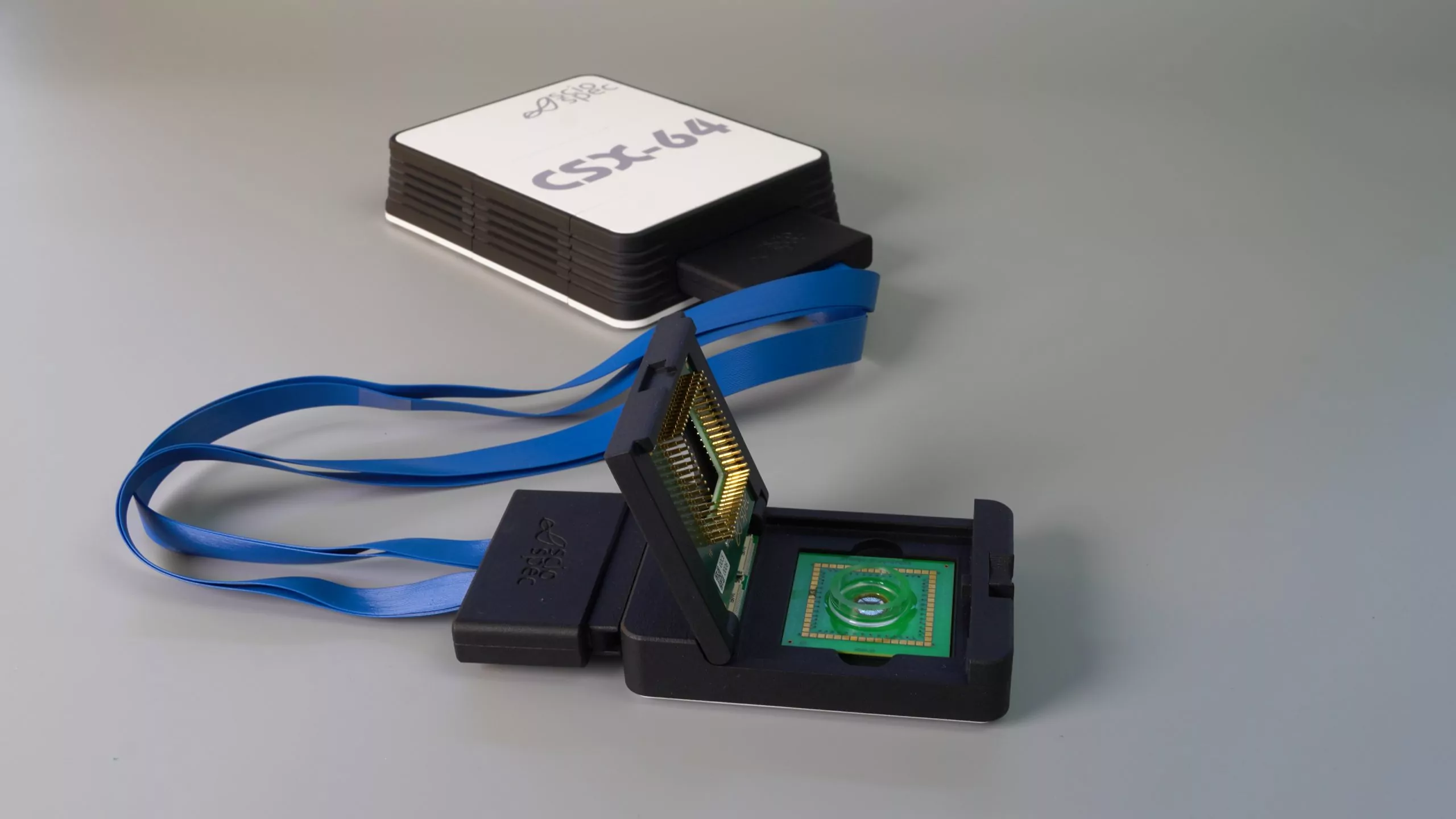
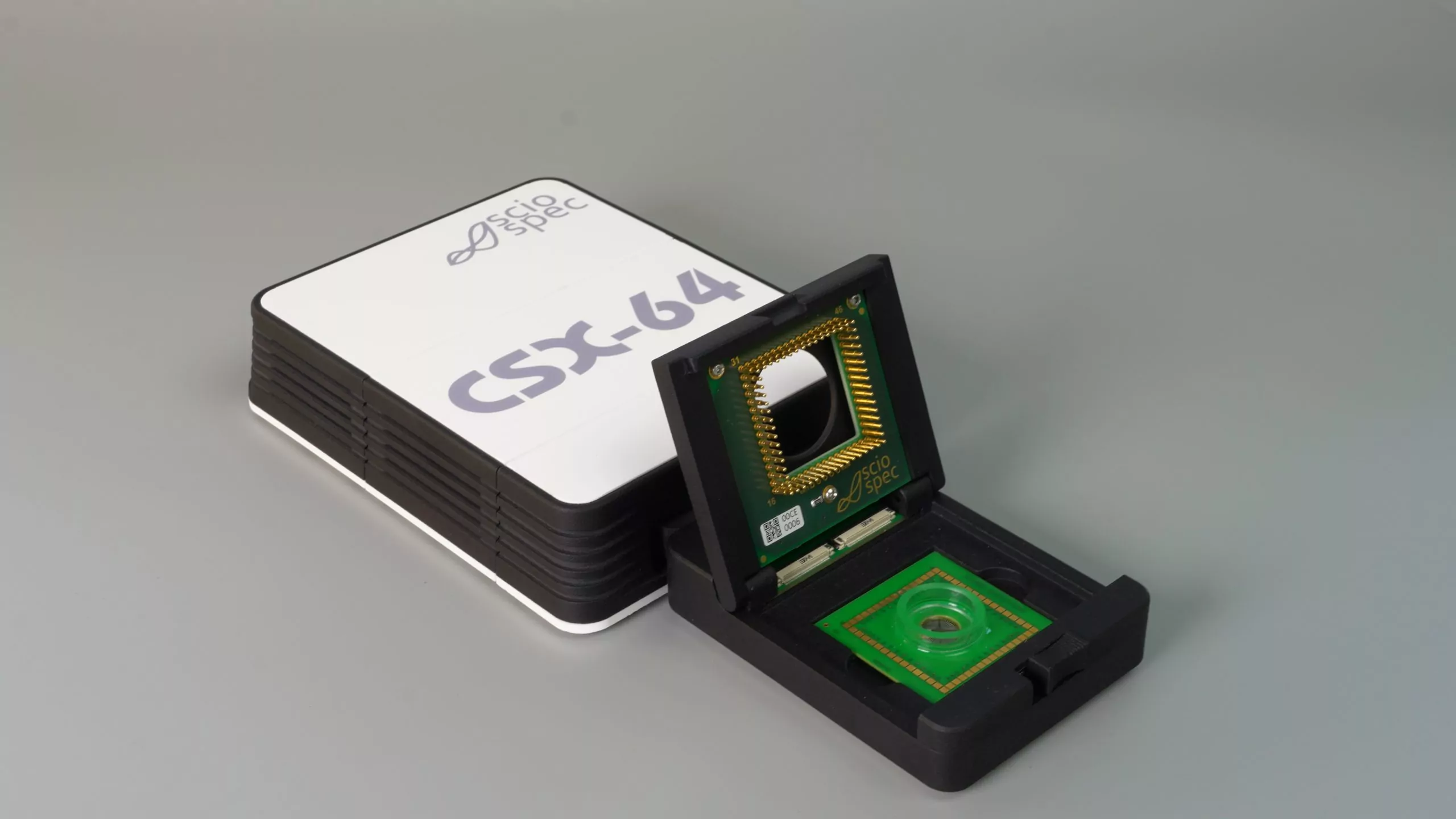
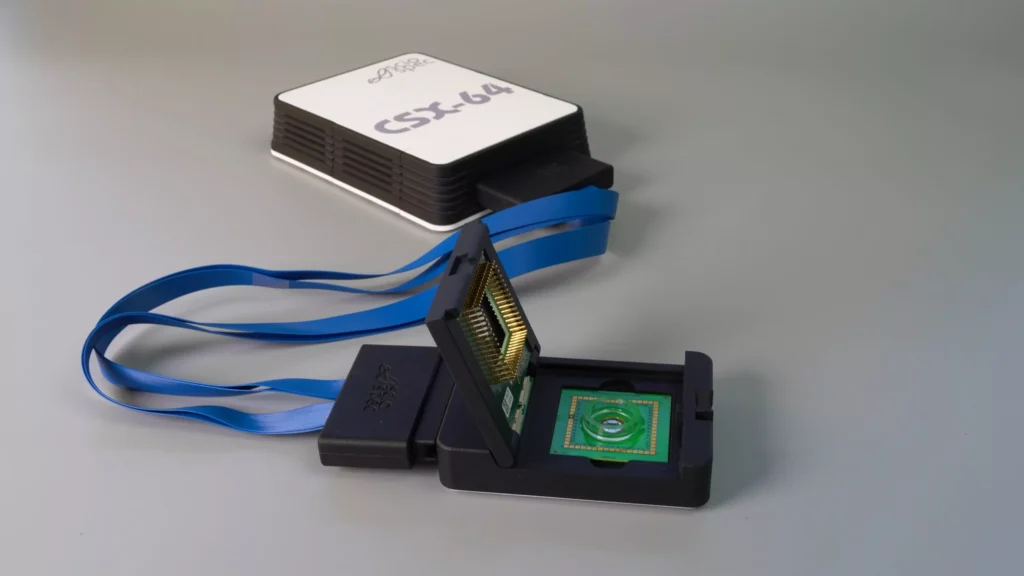
Use direct cabling, adapters, edge-card carriers or custom interfaces to connect cells, chips, plates and fixtures. Keep the instrument side stable while the sensor, connector or application changes.
More Insights: How banks, ports and measurement steps work
Each bank is an analogue potentiostat/galvanostat frontend with its own control and measurement path. This enables independent potential or current control and simultaneous measurement across all eight banks.
Through the integrated routing architecture, each bank can access eight physical ports. A port combination defines which contacts are used for one measurement path and which electrode roles they perform. Depending on the sensor and measurement configuration, this may involve two, three or four electrode functions.
The CSX-64 therefore provides 64 physical sensor contacts—not 64 independent potentiostats. Up to eight measurement paths can run simultaneously, normally one per bank. Further port combinations are arranged in additional measurement steps and measured sequentially.
All valid combinations within one measurement step are measured together. This allows parallel measurement where timing matters and sequential routing where additional contact coverage is required.
The routing architecture supports conventional configurations such as one individual cell or sensor per bank, as well as multi-sensor sequences, dynamic reassignment of electrode functions, bipotentiostat and polypotentiostat configurations with multiple working electrodes, and other application-specific port assignments.
Although the banks can be controlled individually, requirements involving completely unrelated methods, programmes or setpoints running at the same time should be reviewed against the shared system resources.
Technical Specifications
Detailed electrical parameters and supported measurement protocols for the CSX-64 base setup.
Parameter
Specification
Notes
ARCHITECTURE & SENSOR ACCESS
Measurement architecture
8 individually controlled analogue banks
Potentiostat/galvanostat control and measurement path per bank; up to 8 measurements simultaneously
Physical sensor contacts
64
Integrated routing for parallel and sequential measurement configurations
Electrode configurations
2-, 3- and 4-electrode
Separate cells, shared electrodes, bipotentiostat and polypotentiostat configurations
MEASUREMENT CAPABILITIES
Methods and readouts
EIS · LCR · CV · CA · DPV · TEER · more
Electrochemical, impedance, resistance and capacitance-based measurements
EIS frequency range
10 mHz to 100 kHz
Parallel impedance measurement across the active banks
Potential measurement ranges
±10 mV to ±10 V
Four selectable ranges
Current measurement ranges
±1 nA to ±10 mA
Eight selectable ranges
Published EIS accuracy
0.1% magnitude / 0.1° phase
See datasheet for complete conditions and specification context
Acquisition
Up to 1000 points/s per channel
Fully simultaneous sampling across active channels
Image gallery
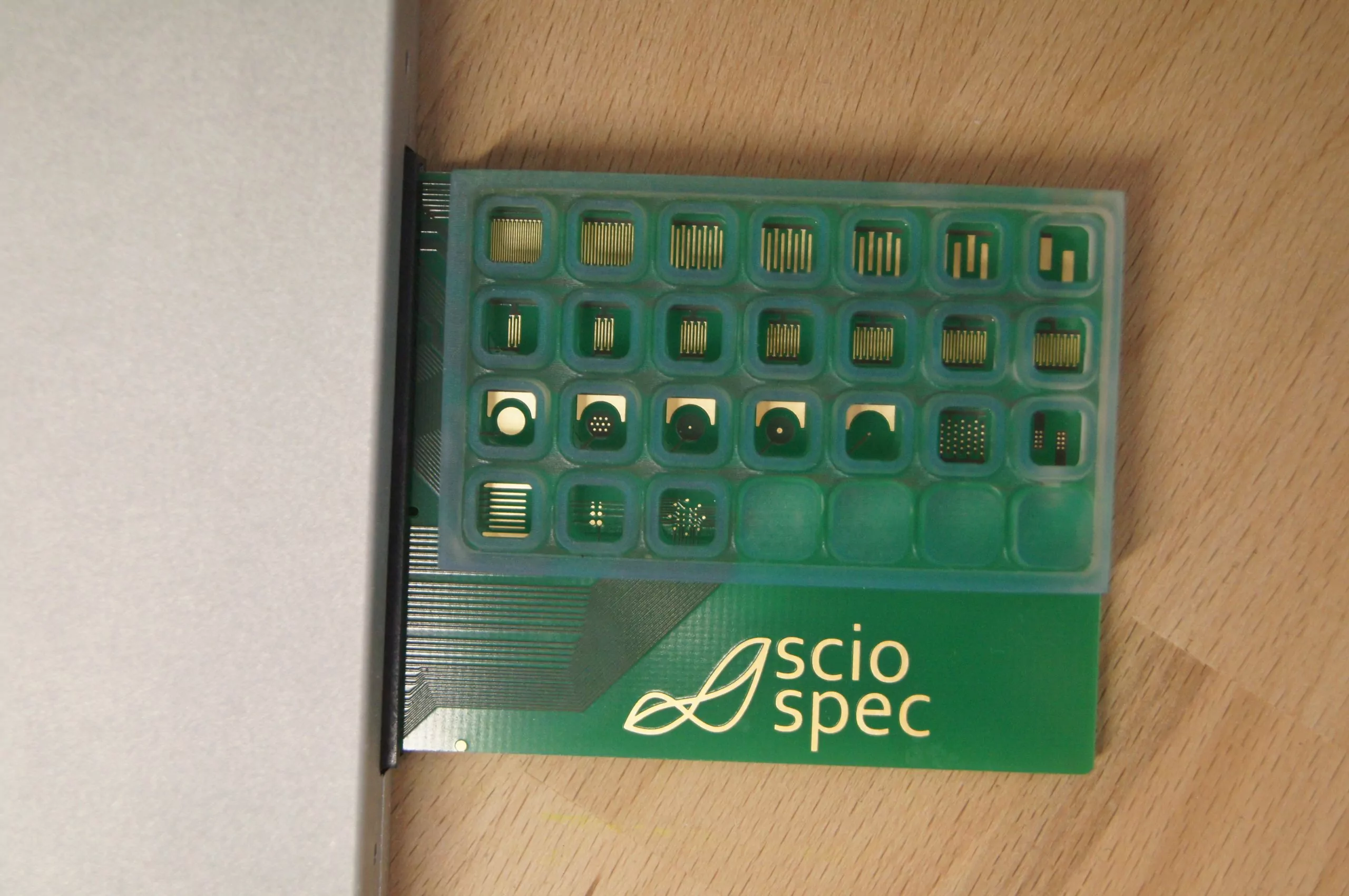
Biosensing, electrochemistry, component test and beyond
The CSX-64 becomes especially useful when an application combines simultaneous measurements, many sensor contacts, changing electrode assignments or a non-standard interface. Its flexible architecture supports sensor development, repeatable assay workflows, parallel testing and the development of dedicated measurement systems.
Sensor and electrode development
Compare electrode materials, geometries and readout conditions across several prototypes. Reassign contacts and adapt the interface as the design changes, while parallel measurement keeps time-critical comparisons on the same timeline.
Parallel electrochemistry
Run electrochemical experiments across multiple cells and electrodes. Measure time-critical samples simultaneously and sequence additional positions through the integrated routing.
Bioanalytics and cell-based assays
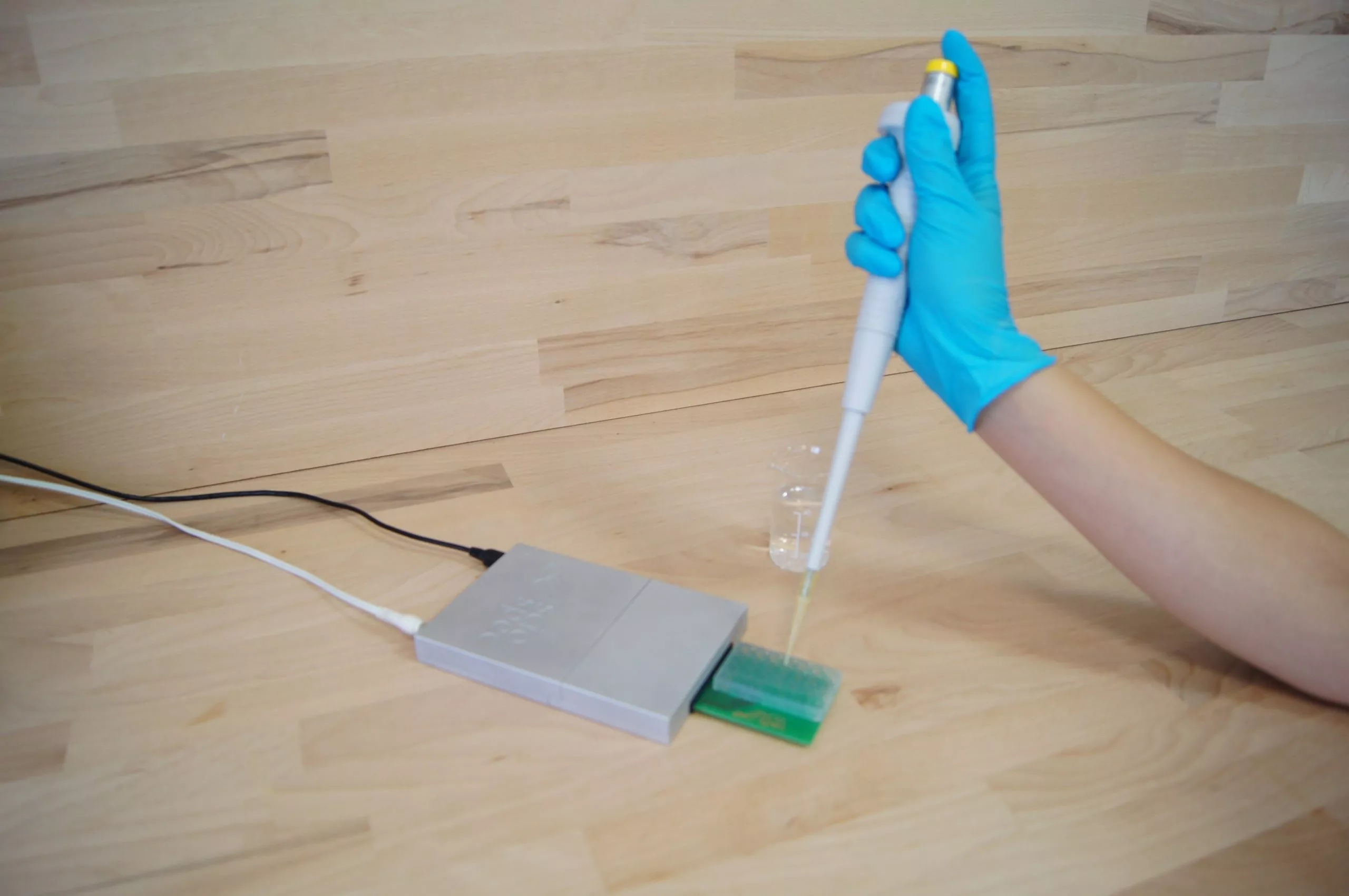
Measure TEER, barrier integrity, cell impedance or electrochemical responses across wells, chips and sensor regions. Parallel measurement supports synchronized comparisons, while the 64-port routing accommodates custom electrode layouts and shared-electrode configurations.
Working on another sensor or measurement concept?
Configure your CSX-64
Build your ideal setup. Select channel count, cable sets, and required accessories.
Loading configurator…
How the CSX-64 compares to other options
The CSX-64 combines eight individually controlled potentiostat/galvanostat banks, integrated routing across 64 sensor contacts and a flexible interface for non-standard sensors. The comparison below shows how this differs from common alternatives—and which requirements usually determine the better choice.
Compared with...
What the alternative does well
What the CSX-64 adds
Several independent potentiostats
Maximum separation between experiments, including galvanic isolation
Eight coordinated potentiostat/galvanostat banks in one compact system, with simultaneous acquisition, shared software and far less duplicated cabling
A potentiostat or impedance analyser with an external multiplexer
Sequential measurement across many positions using an existing instrument
Up to eight measurements in parallel, integrated 64-contact routing and one coordinated configuration instead of separate switching hardware and control logic
A dedicated LCR meter or high-end impedance analyser
Specialist single-channel metrology, broader frequency ranges or advanced analysis functions
Parallel impedance measurement combined with electrochemical control, flexible electrode assignments and application-specific sensor interfaces
A conventional multipotentiostat or polypotentiostat
Fixed-channel measurement of a defined number of cells or working electrodes
More physical contacts than simultaneous paths, integrated sequencing and flexible routing for changing, shared or non-standard electrode topologies
A closed application-specific reader
A complete workflow for one stable sensor, cartridge or assay format
Freedom to change the sensor, contact map, measurement method and interface while the application is still evolving
The CSX-64 is strongest when parallel control, many physical contacts, flexible electrode assignments and an adaptable sensor interface are needed in the same setup.
Connect cells, chips and fixtures through one flexible interface
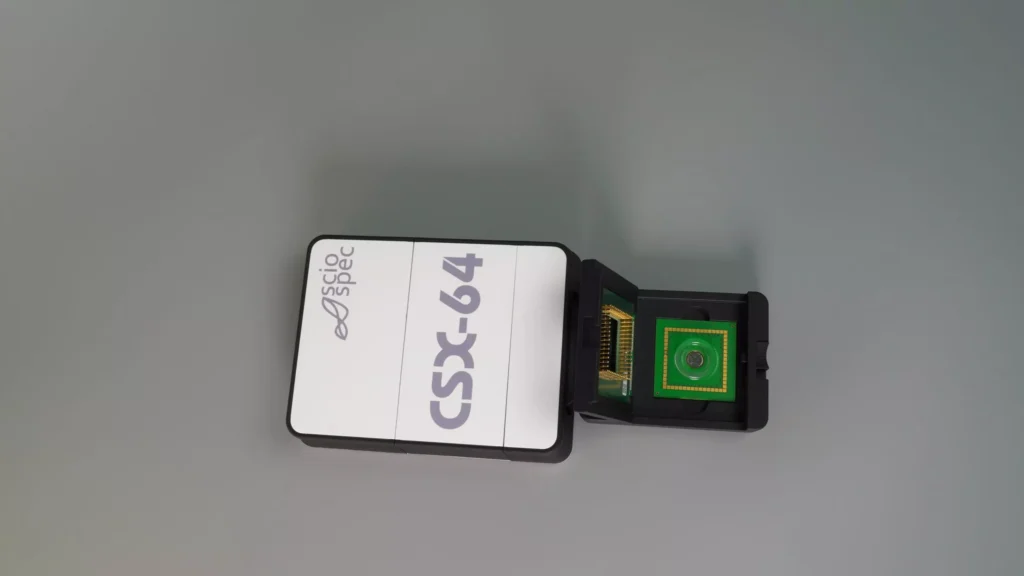
Direct cabling
Connect conventional cells and early prototypes
Use a discrete-wire harness for direct access to the measurement ports. This is the simplest route for conventional electrodes, separate cells and early sensor-development setups.
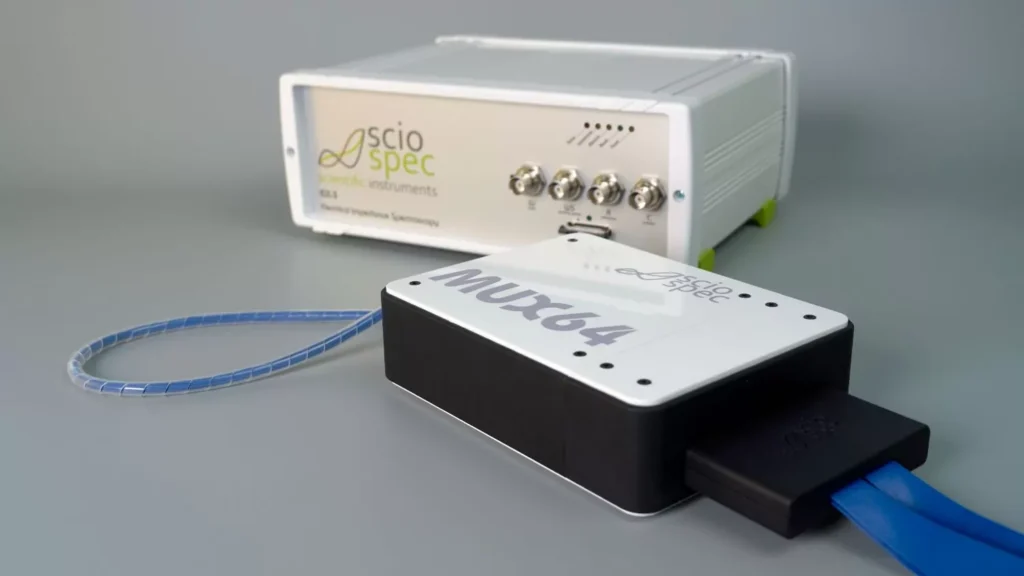
Adapters and edge-card carriers
Use a defined connection for established sensor formats
Connect compatible arrays, chips or electrode formats through available Sciospec adapters and edge-card carriers. The MEArack is one example within a broader interface concept.
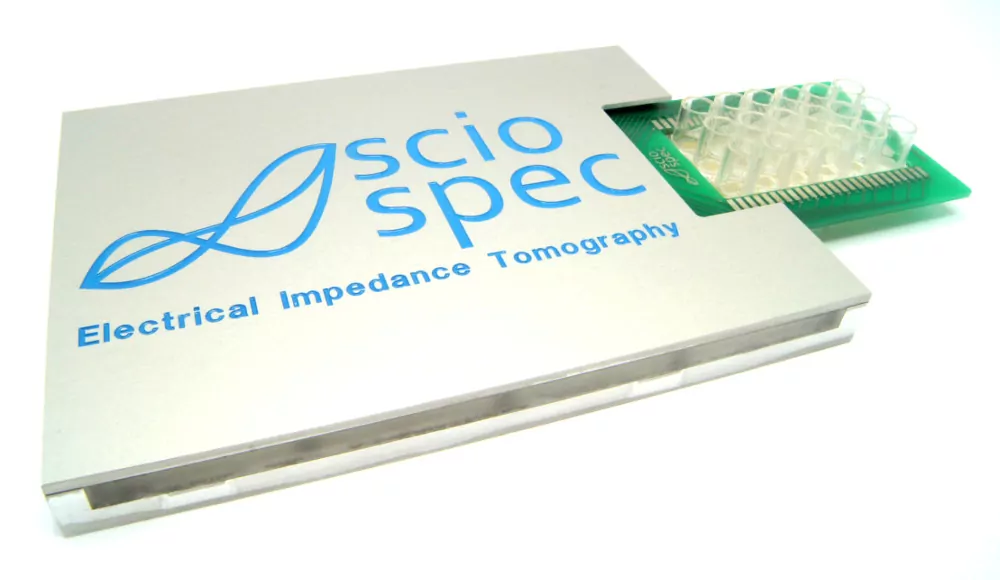
Application-specific interfaces
Build the connection around your sensor
Connect proprietary chips, cartridges, plates and test fixtures through a dedicated carrier or adapter. Sciospec can evaluate and develop the interface, or your team can design around the documented SC98 connector system.
Send us a sketch, pinout or connector drawing. We will recommend the most suitable cabling, adapter or carrier route.
Configure the setup, run the measurement and integrate the CSX-64
Intuitive Measurement Controls
Configure banks, ports and electrode roles
Choose your Method

Automate measurements and connect custom software

Keep measurement data structured
Develop the measurement first. Build the system around proven requirements.
The CSX-64 gives you a flexible professional platform while the sensor, electrode topology and workflow are still evolving. Configure the measurement, connect the application and establish what the final system actually needs to do.
As the application matures, Sciospec can support the next steps—from a repeatable laboratory setup and automated workflow to an application-specific reader or OEM system.
Establish the signal, method and electrode configuration
Use the CSX-64 to determine the required ranges, measurement methods, simultaneous paths and sensor connection.
Define the interface, procedure and control
Add the carrier, fixture, software and automation needed to turn the experiment into a reliable working setup.
Develop the system for its intended use
When the requirements are clear, Sciospec can scope and develop the dedicated electronics, software, mechanics and application interface.
From Prototype to Product —
A Platform that Scales
The CSX-64 doesn’t just power research — it lays the foundation for real-world innovation. Whether you start with a single electrode in a petri dish or a basic benchtop assay, the CSX-64 gives you the infrastructure to grow and keep growing.
Add more channels, swap sensors, move between electrode configurations, or split the system between experimental setups. With its SC98 modular front-end and open architecture, transitioning between use cases is precise and fully supported.
And when it’s time to move from prototype to product, we help migrate your CSX-64 setup into a custom OEM solution. Dedicated electronics, tailored firmware, and application-specific front-ends: the foundation stays the same, the product becomes your own.
- 01
Lab Protocol & Proof of Concept
Start with standard CSX-64 benchtop setups to validate your assay.
- 02
Multichannel Expansion
Scale seamlessly using the SC98 interface for high-throughput.
- 03
Embedded OEM Integration
Migrate the core architecture into your custom commercial product.
High-accuracy capacitance measurement—built around the sensor
- We’re thrilled to partner with Sciospec. This will allow us to create transformative diagnostic tools that will have a profound impact on healthcare
Dr. Xin Liang, CEO of XOrigin
XOrigin develops flexible microsensor technology for next-generation bioelectronic and diagnostic applications. They needed more than a standard LCR instrument to move beyond the existing proof of concept setup in their research lab. The measurement had to deliver exceptional capacitance accuracy while connecting reliably to multiple specialised sensors and remaining useful as the application developed.
Together, Xorigin and Sciospec built the complete measurement solution around that requirement: the flexible CSX-64 as the precision measurement core, a dedicated adapter engineered for the sensor and a close development partnership that continues as the product evolves.
A demanding sensor application
The Xorigin sensor required highly accurate capacitance measurement in a configuration that did not fit the standard form factors and was still evolving.
The CSX-64 as the measurement core
The CSX-64 was configured for the required measurement, providing the performance and flexibility needed during sensor development.
A dedicated adapter for the real sensor
Sciospec developed a sensor-specific adapter to create a controlled and practical connection between the Xorigin sensor and the CSX-64.
Capacitance accuracy in the target setup
With this setup the teams created highly stable measurements with precision in the low femto farad range on baselines between single digit pico farad to nano farad at <100 ms time resolution.
A development partnership beyond the instrument
The collaboration did not end with the delivery of a measurement device. Xorigin and Sciospec continued to develop the measurement, interface and system requirements together. This gives Xorigin a partner who already understands the sensor, the signal and the application—and creates a credible route from laboratory development toward automation, application-specific electronics and OEM integration as the product requirements mature.
Frequently Asked Questions
What is the difference between the eight banks and the 64 ports?
Up to eight measurement paths can run simultaneously, normally one per bank. Further contact combinations can be measured in subsequent steps.
Can all eight banks be controlled independently?
Can the CSX-64 combine parallel and sequential measurements?
Yes. Use the eight banks for cells, sensors or regions that must be measured at the same time, then sequence additional contact combinations through the integrated routing.
Can the CSX-64 be used as a multipotentiostat, bipotentiostat or polypotentiostat?
Which measurement methods does the CSX-64 support?
Can the CSX-64 perform LCR measurements?
Yes. The CSX-64 can measure impedance, resistance and capacitance across up to eight paths in parallel. It is particularly useful when accurate LCR measurement must be combined with multiple sensors, changing contact maps or a custom physical interface.
How can I connect a custom sensor, chip or electrode array?
Can I control the CSX-64 from my own software?
Can a CSX-64 laboratory setup later become a dedicated reader or OEM system?
When would another instrument be more suitable?
Not sure how your sensor fits the eight-bank architecture?
Turn your measurement requirement into the right setup
Not sure how your sensor fits?
Send us a sketch, pinout or contact map. We’ll review the measurement task and recommend the simplest suitable setup—or another instrument where it fits better.
Ready to configure your CSX-64?
Select the measurement, interface and accessory options for your application and use the result as the basis for technical review and quotation.
Planning a custom reader or OEM system?
Discuss how the measurement, sensor interface and workflow can be developed into an application-specific instrument or integrated OEM solution.
Get in touch with us
Phone
Headquarters
Sciospec Scientific Instruments GmbH
Leipziger Str. 43b
04828 Bennewitz, Germany
Open in Google Maps