
MEDICAL RESEARCH ISX-3
High-performance EIS for medical research
The Medical Research ISX-3 combines the broadband impedance-measurement capabilities of the ISX-3 with medical grade safety features and configurable electrode interfaces developed specifically for research measurements on human subjects.
Configure 2-, 3- or 4-electrode EIS, voltage or current excitation, AC- and DC-coupled measurement paths, MUX32/64, isolated communication and I/O, medical grade push-pull connectors and dedicated electrode cable sets around the research protocol – without first engineering the complete isolation and interface architecture around a conventional impedance analyzer.
- 100 mHz to 10 MHz standard EIS with mΩ-to-GΩ specified impedance range and high measurement accuracy
- Medical grade safety features specified in accordance with DIN EN 60601-1:2013-12
- Configurable AC/DC coupling, MUX32/64, isolated interfaces, medical grade connectors and dedicated electrode cable sets
RESEARCH INSTRUMENT – NOT A MEDICAL DEVICE — The Medical Research ISX-3 is intended for research and is not intended for diagnosis or treatment. The complete experimental setup and its use with human subjects remain subject to the applicable institutional, ethical and technical review.
100 mHz–10 MHz
BROADBAND EIS
100 mHz – 10 MHz
Frequency Range
0.01 %
Base Precision
up to 3 h
Battery Runtime
100 mHz–10 MHz
BROADBAND EIS
mΩ–GΩ
WIDE MEASUREMENT RANGE
MEDICAL GRADE
SAFETY FEATURES
AC/DC PATHS · MUX32/64
CONFIGURABLE MEASUREMENT PATH
Medical grade safety features in a research instrument
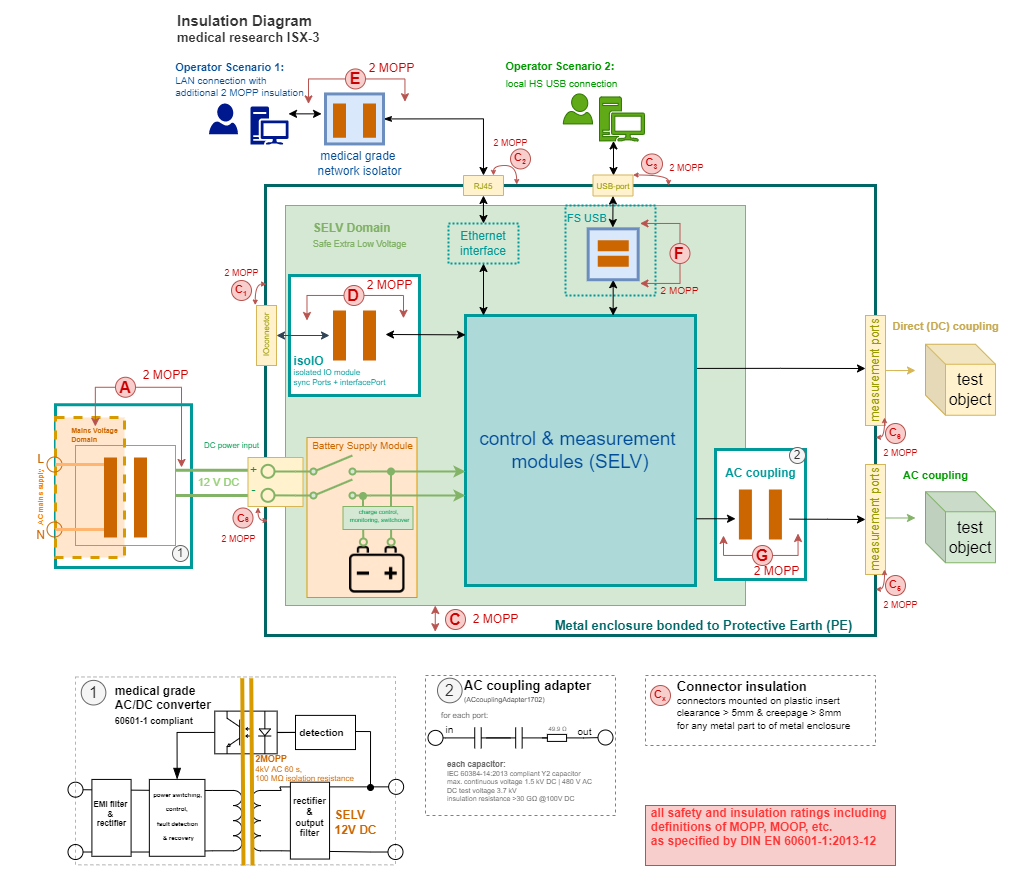
Power, computer communication, synchronization lines, auxiliary equipment, electrode cabling and DC paths to the subject can all become part of the electrical-safety concept. With a conventional impedance analyzer, these paths have to be assessed and, where necessary, isolated around the instrument.
The Medical Research ISX-3 addresses these paths with dedicated medical grade safety features. This gives research teams a technically appropriate starting point for human-connected EIS without having to build every instrument-side isolation measure from external add-ons.
Prevent contact, shield the frontend and provide mechanical protection
Prevents contact between internal electrical circuitry and external equipment or humans, provides mechanical safety and shields the measurement frontend to reduce interference.
Isolated 12 VDC supply with optional stand-alone battery operation
An external isolated AC/DC converter supplies the instrument with 12 VDC. Stand-alone battery operation is also possible, including software-controllable electromechanical switch-off of the DC input lines.
Keep instrument control and data readout isolated
The isolated Full Speed USB port provides instrument control and data transfer from a PC through a dedicated isolated communication path.
Use standard Ethernet with medical grade external isolation
The standard RJ45 Ethernet interface is not internally isolated. An external medical grade network isolator, included with the corresponding offer, can be inserted in the communication path to provide the required isolation ratings.
Synchronise and communicate with external equipment through isolated I/O
Provides hardware synchronization and flexible programmable I/O, including UART, SPI and I2C, for use with other external equipment without bypassing the intended isolation concept.
Block DC current and galvanically isolate the measurement path
The external AC-coupling module blocks DC currents, adds a high-pass filter characteristic that limits low-frequency currents and galvanically isolates the instrument from the measurement object or patient interface.
Configure the measurement path for your research protocol.
Use the topology the physiology and electrode arrangement require
Configure direct 2-electrode bioimpedance measurements, add a reference electrode where needed or separate current injection from voltage sensing with a 4-electrode setup.
Choose the excitation mode around the measurement
Use controlled voltage or current excitation and select the amplitude around the tissue, electrode and impedance range being investigated.
Make both coupling modes available where the study needs them
On request, configure separate AC-coupled and DC-coupled measurement ports in the same instrument. AC coupling blocks DC and limits the low-frequency path; a DC-coupled route preserves access where the protocol requires it.
Keep many electrode positions connected
Build the Medical Research ISX-3 with sequential multiplexing for multi-site or multi-electrode studies. Selected MUX paths can be configured with AC coupling according to the required channel architecture.
Use connectors suited to medical research environments
Configure robust push-pull connector systems and avoid building the complete electrode connection around ordinary laboratory BNC wiring.
Connect directly to established electrode interfaces
Use medical trunk cables and dedicated cable sets matched to standard electrode interfaces in medical environments, or define a custom cable set around the research hardware.
High-performance EIS with safety and interface options for medical research.
Parameter
Specification
Details
IMPEDANCE SPECTROSCOPY
Frequency range
100 mHz ... 10 MHz standard
Higher-frequency configurations can be reviewed where the complete research interface supports them.
Frequency points
1 ... 2048 per sweep
Linear, logarithmic and block-wise frequency programmes.
Impedance range
mΩ ... GΩ specified
Use the accuracy contour for the actual impedance/frequency operating region.
Magnitude accuracy
0.1% specified
Broad central reference region reaches 0.01% under documented reference conditions.
Phase accuracy
0.1°
Specified phase accuracy for EIS.
Voltage excitation
1 mV ... 1 V peak
Controlled voltage excitation.
Current excitation
10 µA ... 10 mA peak
Controlled current excitation.
Electrode configurations
2-, 3- and 4-electrode
Software-configurable topology.
DC bias
±1 V on DC-coupled measurement path
Combined excitation/bias limits apply; AC-coupled paths block DC.
Compensation
Open / short / load
Compensates cables, fixtures and connection parasitics in the configured path.
MEDICAL RESEARCH SAFETY & INTERFACES
Medical grade safety features
Specified in accordance with DIN EN 60601-1:2013-12
Dedicated instrument-side isolation, power, communication and measurement-path measures for medical research.
Power
External medical grade isolated AC/DC supply
Optional battery operation available for measurements without an active mains connection.
USB
Isolated Full Speed USB
PC control and data transfer through an isolated USB path.
Ethernet
10/100 Ethernet + external medical grade network isolator
Use the external isolator where Ethernet is part of the research setup.
IsoIO
Isolated digital I/O / low-level communication
For synchronization and coordination with external equipment without bypassing the intended isolation path.
Measurement coupling
AC-coupled and DC-coupled configurations
Split AC/DC ports available on request; AC coupling introduces a high-pass characteristic.
Multiplexing
MUX32 / MUX64 configurations
Sequential multi-position measurement; AC-coupled MUX paths configurable according to system architecture.
Electrode interface
BNC or medical grade push-pull / application-specific connector options
Dedicated medical-research cable sets and custom electrode interfaces available.
High accuracy across a wide EIS measurement range.
Check the actual impedance/frequency region
Show the released ISX accuracy contour and highlight the region relevant to the study.
Review the complete measurement chain
Where AC coupling, MUX or specialised cabling is used, document the resulting transfer path and relevant low-frequency limits.
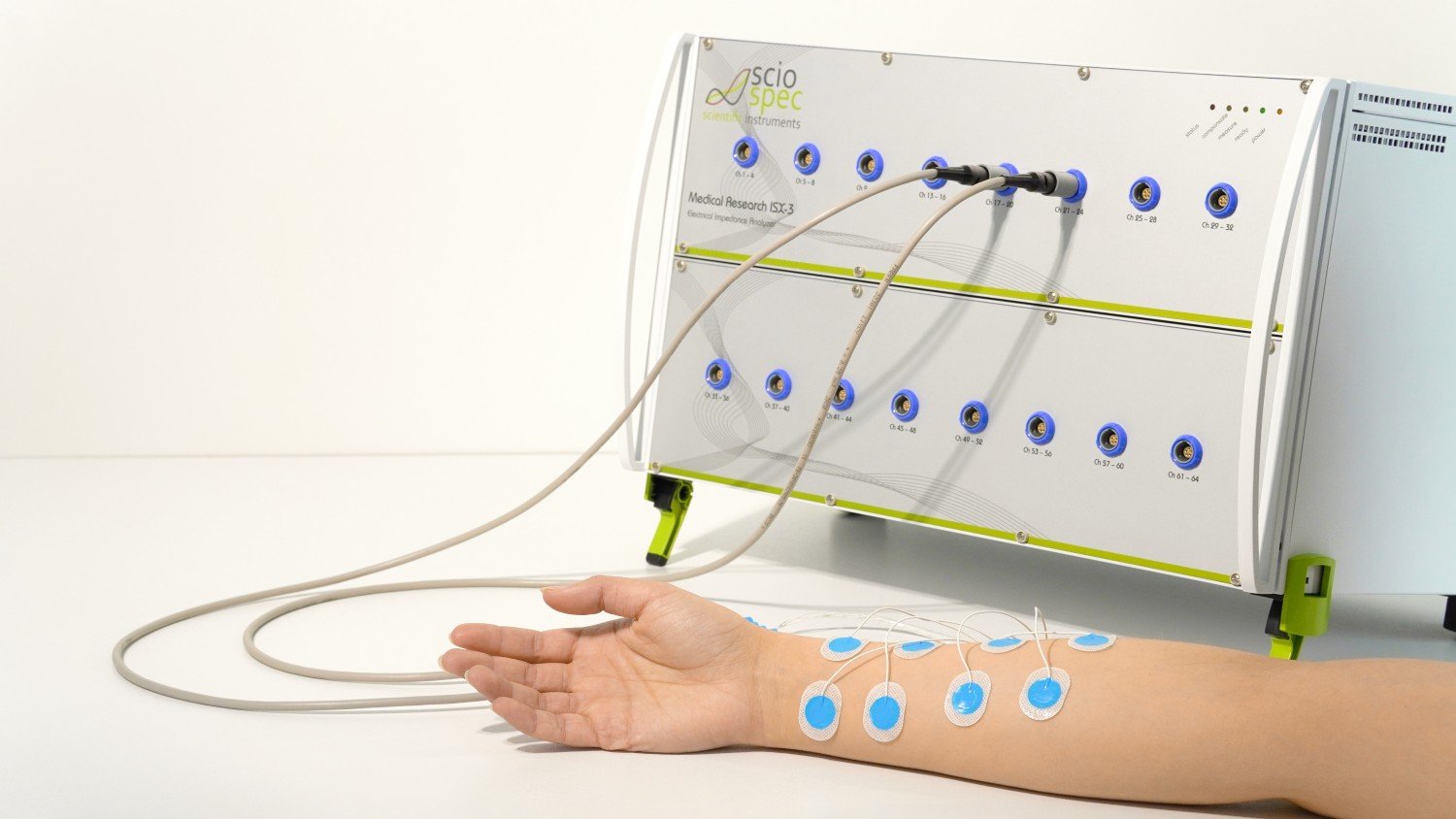
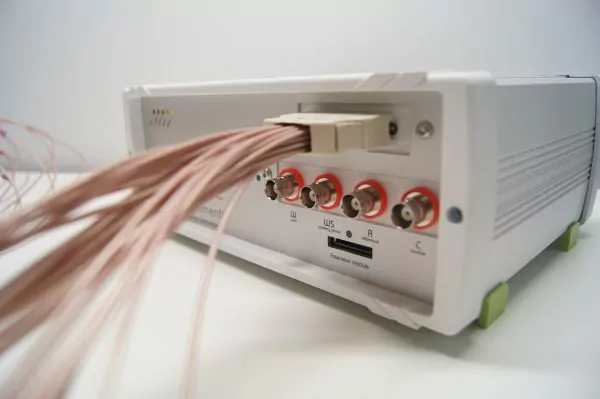
INSTRUMENT — Medical Research ISX-3. Show the analyzer as a complete professional EIS instrument, not as a compliance box.
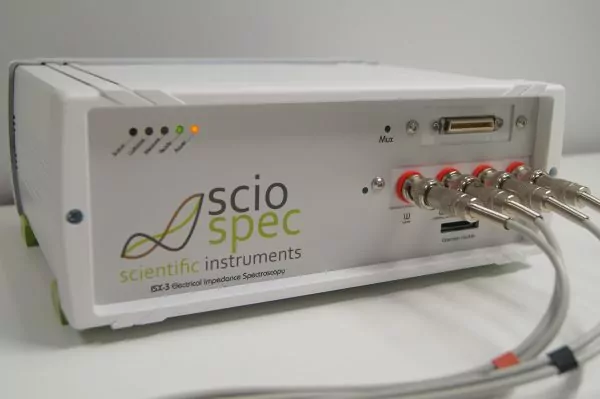
COUPLING — AC- and DC-coupled measurement paths. Show the coupling hardware and clearly identify which subject-side path is AC coupled.

Medical research applications for Electrical Impedance Spectroscopy.
Measure frequency-dependent tissue and body impedance
Use 2- or 4-electrode configurations to investigate impedance spectra of tissue and body segments under controlled excitation.
Track impedance changes during controlled activity
Use repeated or time-resolved EIS to study changes associated with movement or other experimentally controlled physiological conditions.
Characterise the subject-electrode interface
Investigate electrode, skin-contact and interface behaviour where connection impedance itself is part of the research question.
Route many electrode positions through one analyzer
Use MUX32/64 configurations when many sites or electrode combinations can be measured sequentially within the protocol.
Develop human-connected sensors with a professional EIS reference
Use the analyzer to establish useful frequency ranges, excitation levels and electrode configurations before committing to dedicated measurement electronics.
Coordinate EIS with other experimental equipment
Use isolated communication, IsoIO and application-specific interfaces when impedance measurement is one part of a larger research platform.
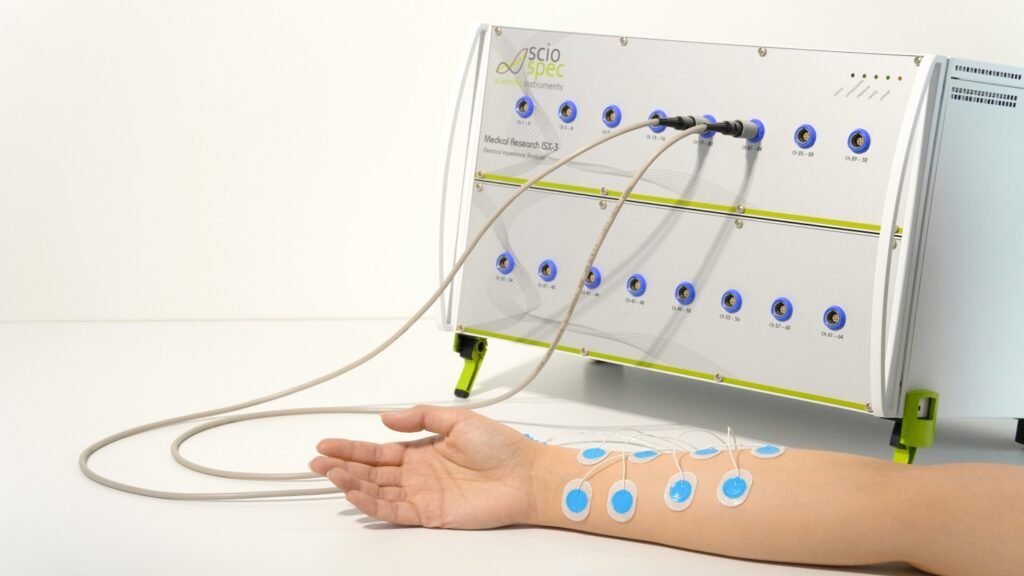
Example application: bioimpedance during hand movement.
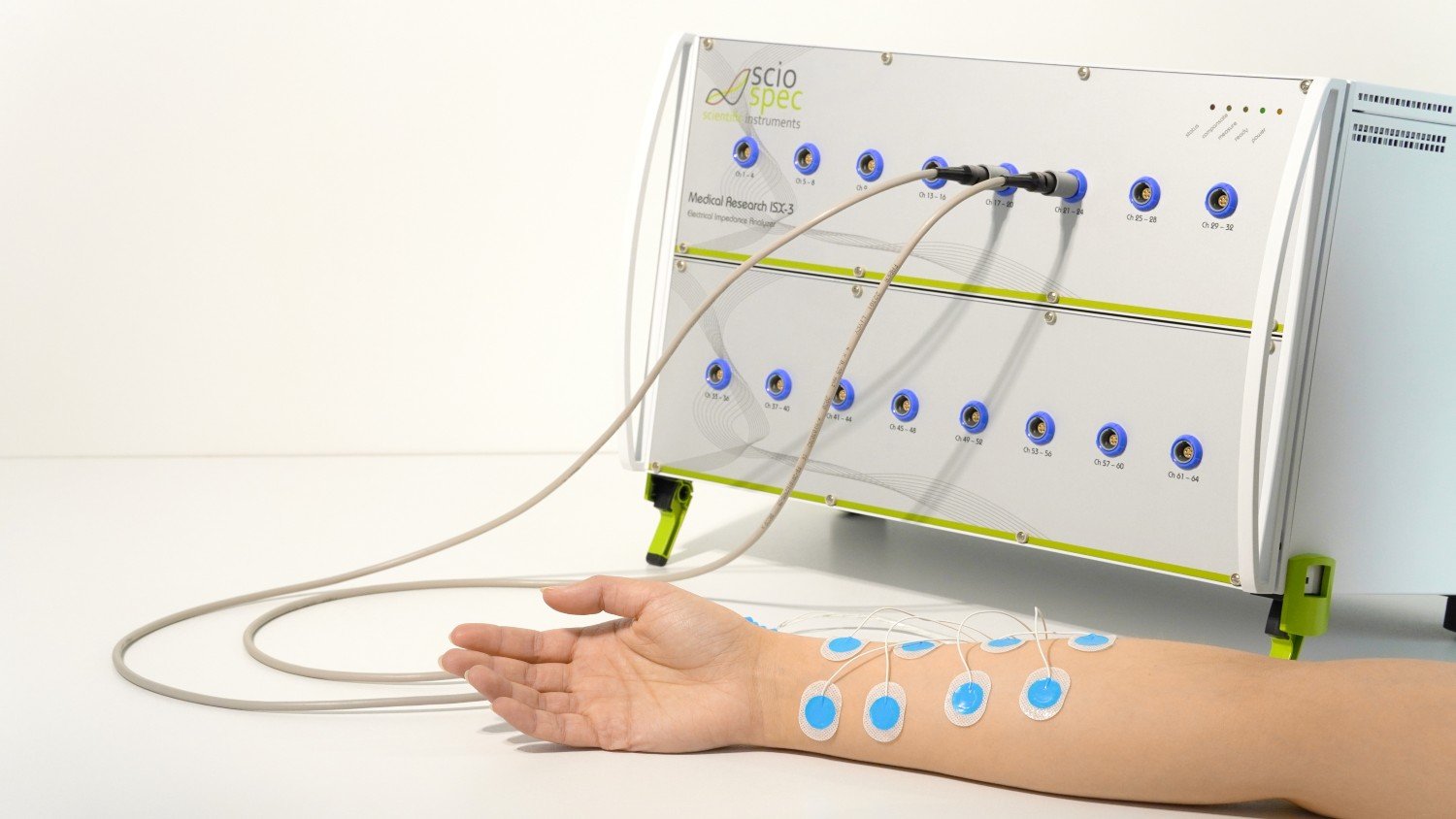
IMPEDANCE MEASUREMENT OF A FOREARM
Why not use a standard impedance analyzer?
Parameter
Specification
Details
SETUP QUESTION · CONVENTIONAL ANALYZER APPROACH · MEDICAL RESEARCH ISX-3 APPROACH
Power path
Add and document suitable isolation around the analyzer.
Medical grade isolated supply; optional battery operation.
PC / network control
Assess USB/Ethernet paths and add isolation where needed.
Isolated USB; Ethernet route with external medical grade network isolator.
Subject-side DC path
Design the required blocking/isolation externally.
AC-coupled measurement path available; DC-coupled path can be retained where the study requires it.
Multichannel measurement
Add scanner/multiplexer and then evaluate its effect on the complete safety concept.
Medical Research ISX-3 available with MUX32/64 and configurable AC-coupled paths.
Electrode connection
Build subject-side cabling around laboratory connectors.
Medical grade push-pull connector options and dedicated electrode cable sets.
External equipment
Ensure synchronization/I/O does not bypass the intended isolation concept.
IsoIO route for isolated synchronization and low-level communication.
Configure your Medical Research ISX-3
Loading configurator…
EIS measurement, MUX routing and external control.
Configure and run the spectrum
Set frequency range, excitation, precision and topology; inspect the resulting impedance data in Bode, Nyquist and time-based views.
Route the real electrode setup
Assign C, R, WS and W roles across direct and multiplexed paths in software.
Integrate the analyzer into the protocol
Use the Sciospec Communication Interface over the appropriate isolated control path when acquisition is driven by external software.
Coordinate with other research equipment
Use IsoIO where external triggers, digital I/O or low-level communication must be integrated without bypassing the intended isolation route.
From medical research to the final application
Establish the measurement
Define useful frequency range, impedance region, excitation, topology, coupling and electrode interface with the configurable research analyzer.
Stabilise the research setup
Fix the connector system, MUX map, isolated control paths, mechanics and software workflow around the study.
Build dedicated hardware where justified
Use the validated requirements to scope separate electronics, firmware, software and mechanics for a dedicated research or OEM system.
A transition toward a regulated medical device is a separate development and regulatory path; it is not implied by the Medical Research ISX-3 configuration.
Medical Research ISX-3 FAQ
Is the Medical Research ISX-3 a medical device?
What do the medical grade safety features include?
Why use the Medical Research ISX-3 instead of a standard ISX-3?
Choose the Medical Research configuration when measurements on human subjects make isolated power, communication, I/O, AC/DC coupling and dedicated electrode interfaces part of the experiment. It provides the same core EIS capabilities as the ISX platform while reducing the amount of safety and interface engineering that otherwise has to be built around a conventional analyzer.
What frequency and impedance range does it cover?
What is the difference between AC-coupled and DC-coupled measurement paths?
Can one instrument provide both AC- and DC-coupled ports?
Can I measure many electrode positions?
Can Sciospec provide the electrode connectors and cables?
Can I connect a PC and other instruments?
Does the Medical Research ISX-3 make a human study automatically safe or approved?
Can the setup later become a custom or OEM system?
What do you need for your research setup?
Review the complete setup
Tell us the electrode arrangement, measurement range, coupling requirements, channel count and every other instrument electrically connected to the subject. We will recommend the appropriate Medical Research ISX-3 configuration.
Build the instrument configuration
Select the analyzer, AC/DC path, MUX, isolated interfaces, electrode connector and cable options and send the configuration for review and quotation.
Discuss application-specific integration
Use this route when the measurement is becoming part of a dedicated research instrument, automated platform or OEM system.
Download user manual · Compare with standard ISX-3 · Explore medical & healthcare research applications
Get in touch with us
Phone
Headquarters
Sciospec Scientific Instruments GmbH
Leipziger Str. 43b
04828 Bennewitz, Germany
Open in Google Maps