
ISX-3
High-performance EIS. Ready for almost any measurement challenge.
The ISX-3 is Sciospec’s flagship impedance analyzer for demanding Electrical Impedance Spectroscopy.
With 100 mHz to 10 MHz standard bandwidth, optional 40/100 MHz analyzer configurations, a specified mΩ-to-GΩ impedance range, high accuracy and fast acquisition, it covers an exceptionally broad range of EIS work across research and development.
Just as importantly, it does not force the experiment into one fixed setup. Configure 2-, 3- or 4-electrode measurements, choose voltage or current excitation, add multiplexers, fixtures and established sensor adapters, automate the measurement or use the ExtensionPort for an application-specific frontend.
From a straightforward impedance spectrum to a multiplexed or application-specific setup, the ISX-3 is designed to cover the EIS work most labs actually encounter.
- 100 mHz to 10 MHz standard, with optional 40 / 100 MHz analyzer configurations
- mΩ-to-GΩ specified impedance range with a broad high-accuracy operating region
- 2-/3-/4-electrode measurement, MUX32/64, fixtures, adapters, ExtensionPort and automation options
100 mHz –10 MHz
BROADBAND EIS Optional 40 / 100 MHz analyzer configurations
mΩ–GΩ
WIDE IMPEDANCE RANGE From milliohms to gigaohms in one analyzer
0.1% SPECIFIED
HIGH ACCURACY Broad central reference region reaching 0.01%
~100 µs CLASS
FAST ACQUISITION Fast settings for short measurement times per frequency point
High-end EIS with the freedom to fit the experiment.
The performance figures establish the ISX-3 as a high-end impedance analyzer. What makes it especially useful in practice is how much of the real measurement can be adapted without changing the instrument. Start with direct EIS, then change electrode topology, excitation or compensation when the measurement physics demands it – and add multiplexing, fixtures, adapters or automation as the setup grows.
Separate what should not be part of the result
Use a simple 2-electrode connection when it is sufficient. Add a reference electrode where one interface should be observed separately, or use 4-electrode measurement to separate current injection from voltage sensing when lead and contact impedances matter.
Match the stimulus to the DUT
Choose controlled voltage or current excitation and set the amplitude around the electrical behaviour of the sample or interface.
Choose speed or additional measurement stability
Adjust the precision setting when the experiment needs shorter measurement time or lower measurement spread.
Compensate the real measurement path
Include cables, fixtures and connection parasitics in the compensation instead of letting them distort the result.
Technical Specifications
Parameter
Specification
Details
IMPEDANCE SPECTROSCOPY
Frequency range
100 mHz ... 10 MHz standard; optional 40 / 100 MHz analyzer configurations
Broadband EIS from very slow processes into the MHz range.
Frequency points
1 ... 2048 per sweep
Supports detailed linear, logarithmic and block-wise frequency programmes.
Acquisition speed
~100 µs-class per frequency point at fast settings
Practical measurement time depends on frequency, sweep settings and selected precision.
Impedance range
mΩ ... GΩ specified
Use the accuracy contour for expected performance at the actual impedance/frequency operating point.
Impedance accuracy
|Z|/Z: 0.1% specified
Broad central reference region reaches 0.01% magnitude accuracy under documented conditions.
Phase accuracy
0.1°
Specified phase accuracy for impedance spectroscopy.
AC voltage excitation
1 mV ... 1 V peak
Controlled voltage excitation.
AC current excitation
10 µA ... 10 mA peak
Controlled current excitation.
Electrode configurations
2-, 3- and 4-electrode
Software-configurable measurement topology.
DC bias
±1 V
Available on the main measurement port; combined excitation and bias limits apply.
Compensation
Open / short / load
Compensates cables, fixtures and parasitics across the real measurement path.
Ranging
Automatic
Measurement range is selected around the DUT.
Measurement quality
Adjustable precision settings
Trade acquisition speed for lower measurement spread according to the experiment.
CONNECTION & CONTROL
Main measurement interface
C / R / WS / W via 4 BNC connectors
Direct 2-, 3- or 4-electrode measurement.
Computer interface
Isolated USB 2.0 Full Speed · 10/100 Ethernet
Routine PC operation and programmatic control.
Application interface
Sciospec ExtensionPort
Measurement terminals, power and configurable digital I/O for application-specific frontends.
Multiplexing
MUX32 / MUX64
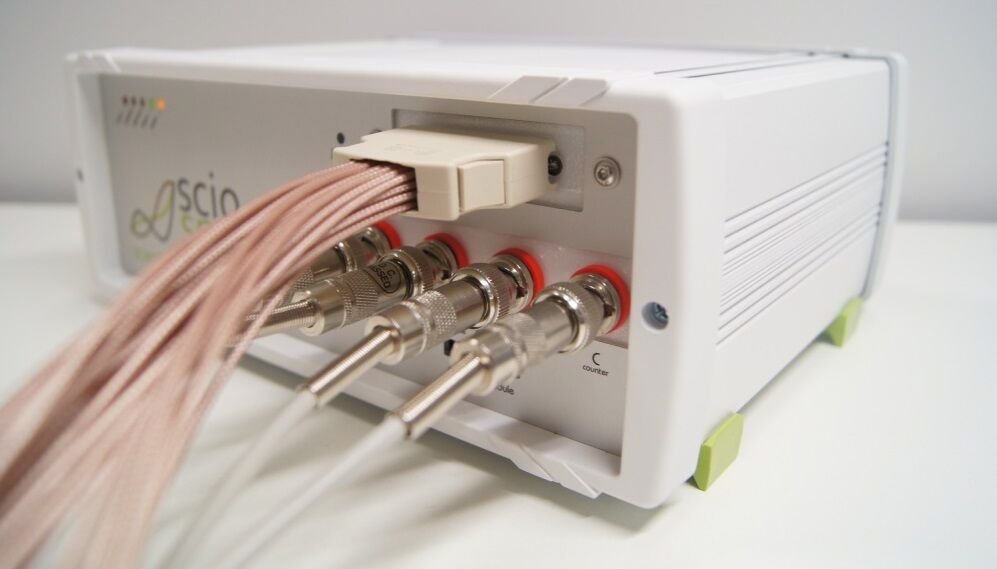
Keep 32 or 64 positions connected and route C/R/WS/W roles sequentially through the analyzer.
Application adapters
MEArack · ECISadapter · test fixtures
Established routes for multi-electrode arrays, ECIS formats, components, dielectric samples and other DUTs.
PHYSICAL
Form factor
Desktop instrument · approx. 249 x 97 x 190 mm · approx. 2.5 kg
Compact laboratory instrument; ISX-3mini serves applications where a substantially smaller form factor is decisive.
High accuracy across a wide EIS measurement range.
A useful impedance analyzer is not accurate at only one convenient point. The ISX-3 maintains strong measurement performance across a broad combination of impedance and frequency ranges, so the relevant question is where your actual measurement sits within that operating region.
The ISX-3 specifies 0.1% magnitude accuracy and 0.1° phase accuracy for impedance spectroscopy. The accuracy contour adds the more useful engineering view: under the documented reference conditions, a broad central operating region reaches 0.01% magnitude accuracy.
As with any precision impedance measurement, the complete setup matters. Cables, fixtures, contacts, electrodes and the DUT itself can become part of the error budget.
See the high-accuracy operating region
Locate the expected accuracy region at the impedance and frequency that matter to the experiment.
Choose speed or additional stability
Use faster settings when timing matters; increase precision when lower measurement spread is more important.
Product showcase
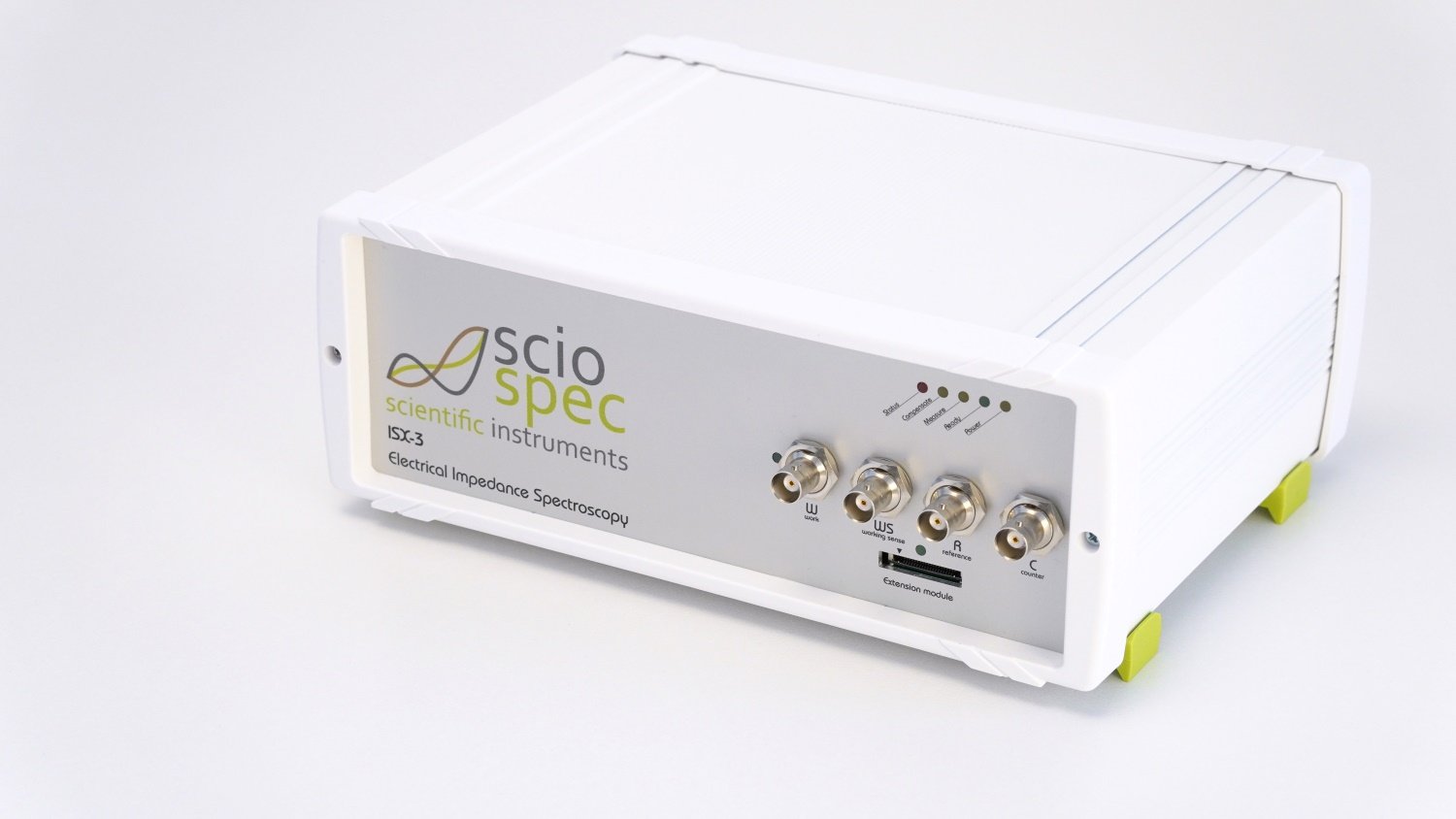
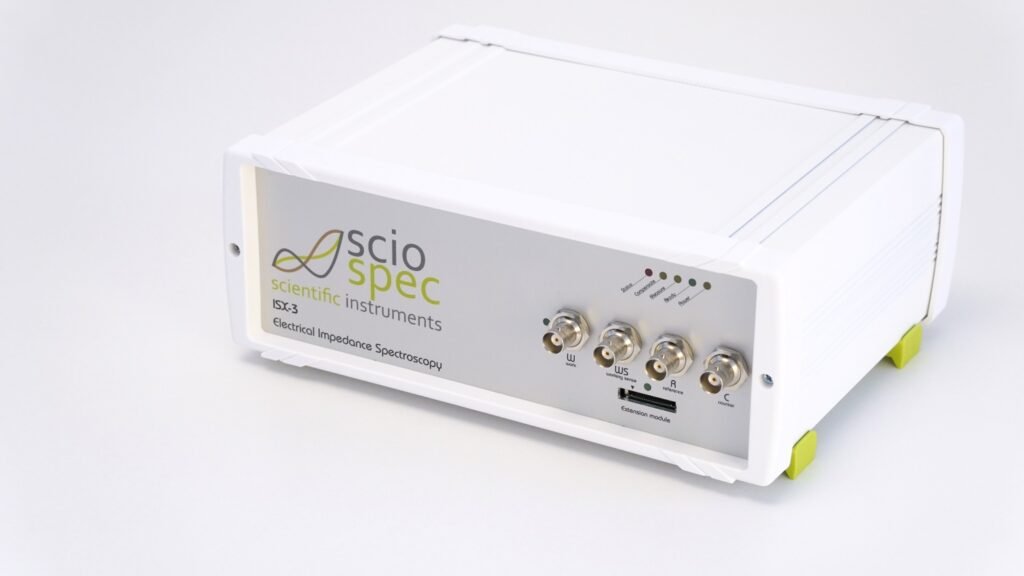
PRODUCT FRONT — C / R / WS / W measurement interface: the four BNC measurement terminals that make configurable 2-/3-/4-electrode measurement tangible.
One analyzer across very different EIS problems.
The ISX-3 is deliberately not tied to one scientific domain. What carries across applications is the need for detailed frequency-dependent impedance information – with enough freedom in topology, connection and workflow to fit the object being measured.
Resolve frequency-dependent material behaviour
Characterize dielectric properties, conductivity, polarization and relaxation across frequency. Use dedicated fixtures and compensation where sample geometry and connection parasitics influence the result.
Characterize the sensor without redesigning the readout
Measure impedance-based sensors, electrodes, MEMS and transducers with the excitation, topology and physical interface that suit the sensor. Move from direct cabling to fixtures, carriers or an application-specific frontend when necessary.
Detailed EIS when the interface itself matters
Use 3-electrode configurations where a reference electrode is part of the experiment, and combine controlled excitation with DC bias where appropriate. If a broad electrochemical method catalogue or substantial current/power dominates, a dedicated electrochemical workstation may be the better tool.
From simple electrodes to complex biological sensor formats
Use EIS for cell cultures, tissue, biochips and other biological samples, with MEA/ECIS interface routes and multiplexing when more positions are required. For electrically human-connected research, use the Medical Research ISX-3.
See what a single R, L or C value hides
Use full impedance spectra to examine frequency-dependent component behaviour, parasitics and resonances. When the task is straightforward LCR measurement rather than spectroscopy, the LCR family is the simpler route.
Keep the measurement while the workflow grows
Add MUX32/64 when many samples or electrode combinations can be measured sequentially. Use external control, I/O and synchronization when the measurement becomes part of a larger experiment or test system.
Resolve frequency-dependent material behaviour
Characterize dielectric properties, conductivity, polarization and relaxation across frequency. Use dedicated fixtures and compensation where sample geometry and connection parasitics influence the result.
Choose speed or additional stability
Use faster settings when timing matters; increase precision when lower measurement spread is more important.
Build the measurement around the DUT.
The measurement object does not always end in four convenient BNC cables. The ISX-3 can stay simple when the DUT is simple – and expand in deliberate steps when the application needs a different fixture, more positions or a custom interface.
Start with direct measurement
Use the C / R / WS / W terminals for conventional 2-, 3- or 4-electrode measurements with the appropriate cable set.
Give the sample a repeatable physical interface
Use component, SMD, dielectric, liquid and other fixtures where geometry and repeatability matter.
Keep many positions connected
Add 32 or 64 physical multiplexer channels and assign C, R, WS or W roles as the measurement topology changes. Acquisition is sequential; use ISX-5 if several EIS channels truly need to be measured at the same time.
Use established routes into specialised sensor formats
Connect compatible multi-electrode arrays or ECIS sensors through existing Sciospec adapter systems instead of starting from individual breakout wiring.
Adapt the interface when the standard connection is not enough
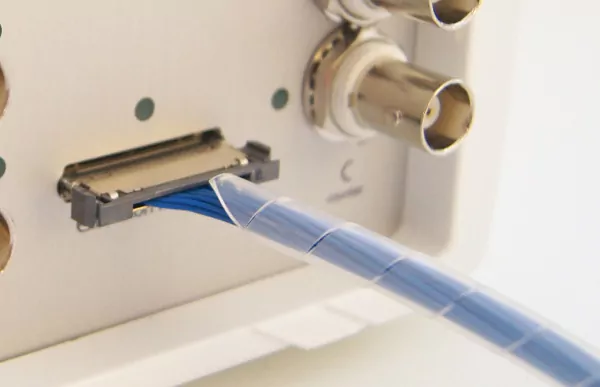
The ExtensionPort exposes the measurement terminals together with supply and configurable digital I/O for application-specific frontends. Use an existing interface, develop a compatible frontend or let Sciospec design the application-side electronics.
MEArack + platinum microelectrode array
A documented ISX-3 / MEArack measurement spans 100 Hz to 1 MHz on a platinum microelectrode array in PBS using 80 logarithmic frequency points and 100 mV excitation - a real example of analyzer, adapter and sensor working as one measurement chain.
Configure your ISX-3
Start with the standard analyzer and add only the options the measurement actually needs.
Loading configurator…
Straightforward EIS. Full control when you need it.
Configure a spectrum in a few steps, inspect Bode, Nyquist or time-domain data, route more complex electrode setups in software and control the ISX-3 externally when the measurement becomes part of a larger workflow.
Configure and run the spectrum
Set frequency range, excitation, precision and measurement configuration, then run the EIS measurement.
Inspect the result in the form that answers the question
Use spectral and time-based views to examine magnitude, phase and complex impedance behaviour.
Route the actual electrode setup in software
Configure C, R, WS and W roles for direct measurements or across available MUX paths.
Integrate the analyzer into your workflow
Use the Sciospec Communication Interface through USB or Ethernet, with I/O and synchronization where the analyzer must coordinate with other equipment.
High-end EIS with much more freedom around the measurement.
The ISX-3 does what you expect from a high-end broadband impedance analyzer: wide frequency and impedance coverage, high accuracy, dense sweeps, fast acquisition, automatic ranging and established EIS analysis workflows.
Its additional strength becomes apparent when the setup goes beyond a straightforward two-terminal DUT: configurable 2-/3-/4-electrode measurement, integrated MUX routes, application adapters, custom frontends and automation – at a highly competitive instrument price.
More freedom without leaving high-end EIS behind
A conventional premium analyzer is a strong choice when a specific metrology ecosystem, fixture family or specialist high-frequency requirement defines the lab. ISX-3 becomes especially compelling when the same project also needs flexible electrode topology, integrated MUX options, application adapters, custom frontends or a lower instrument investment.
When EIS itself is the main task
A potentiostat/workstation is the natural choice when broad electrochemical methods, substantial current/power, battery cycling or corrosion workflows dominate. ISX-3 is the cleaner fit when detailed EIS, general impedance range, topology and interface freedom are the priority.
When the spectrum matters
For straightforward R/L/C characterization, a dedicated LCR meter is the simpler tool. ISX-3 is the better fit when frequency-dependent impedance behaviour and richer experimental control are part of the question.
When switching should be part of the measurement system
An external switch matrix can work perfectly well. ISX-3 + MUX becomes attractive when relay boxes, cabling, channel mapping and control have grown into a recurring part of the measurement problem.
When the experiment - not the acquisition electronics - is the project
Custom acquisition electronics offer maximum freedom when developing them is part of the research. ISX-3 is the more direct route when the component, material, sensor or biological system is what you actually want to investigate.
When the experiment has outgrown the surrounding setup
If the current analyzer fits the measurement and workflow, keep using it. ISX-3 becomes interesting when the next step requires more bandwidth, easier availability, multiplexing, interfacing, automation or a more economical way to expand the setup.
When a more specialised instrument fits better.
The ISX-3 covers an exceptionally broad range of EIS applications. A few requirements point naturally to a specialist instrument: compact deployment, genuinely simultaneous multichannel EIS, human-connected research or combined EIS/EIT.
When size and deployment dominate
Choose the compact 12 V platform when the normal ISX-3 enclosure is the problem - portable systems, tight rigs or near-sensor placement.
When several EIS measurements must happen together
Choose true-parallel EIS when the signals change fast enough that sequential measurement would distort the comparison. If the samples can be measured one after another, ISX-3 + MUX is usually the simpler route.
When a human subject is electrically connected
Use the dedicated research configuration when isolation and the complete human-connected measurement setup become part of the requirement.
When spatial information and deep spectroscopy belong in the same experiment
Choose ISX-3 EIT when detailed impedance spectra remain central but the experiment also needs 32/64-port spatial measurements. If EIT frame rate dominates, choose a dedicated EIT system.
From custom interfaces to dedicated OEM systems.
The ISX-3 does not have to remain a standard bench setup. Start with cables, fixtures and existing adapters. Add a custom frontend, multiplexing or automation when the application requires it. And when the measurement is ready to leave the laboratory, the validated method can become the technical starting point for a dedicated reader or OEM system.
Start with the flexible analyzer
Establish the measurement using the ISX-3, standard cabling and the appropriate fixture.
Fit the measurement to the application
Add MUX, a sensor adapter, custom frontend, I/O or application-specific mechanics where the standard setup is no longer enough.
Turn the experiment into a workflow
Combine the validated measurement, interface, automation and software into a stable application-specific setup.
Engineer the reader or OEM product
Use the established frequency range, signal levels, topology, contact map and workflow as the technical basis for separately engineered electronics, firmware, software and mechanics.
What carries forward is the validated measurement concept and Sciospec’s understanding of the application. Dedicated product hardware remains a separate engineering step.
ISX-3 FAQ
What is the ISX-3?
What frequency and impedance range does the ISX-3 cover?
How accurate is the ISX-3 across its measurement range?
Why does the ISX-3 support 2-, 3- and 4-electrode measurement?
Can I measure many samples with one ISX-3?
Can I connect a custom sensor or electrode array?
Can the ISX-3 apply DC bias?
Can I automate the ISX-3?
When should I choose an LCR meter instead?
When should I choose another ISX model?
Can an ISX-3 setup later become a dedicated or OEM system?
What do you need next?
Build your ISX-3 setup
Choose the analyzer configuration, multiplexer, adapter, fixture and system options you need and send the result for a concrete quotation.
Get a setup recommendation
Use this route when the decision depends on impedance/frequency range, electrode topology, a difficult fixture, multiplexing or an unusual sensor interface. We will recommend the most plausible ISX-3 setup – or tell you if another measurement architecture fits better.
Discuss the next system stage
Use this route when the measurement is becoming part of an automated system, recurring instrument or product and the next question is no longer just which lab analyzer to buy.
Supporting links: Download user manual · View measurement accessories · Explore ISX applications
Get in touch with us
Phone
Headquarters
Sciospec Scientific Instruments GmbH
Leipziger Str. 43b
04828 Bennewitz, Germany
Open in Google Maps