
LCR-1
High-performance LCR measurement. Made compact.
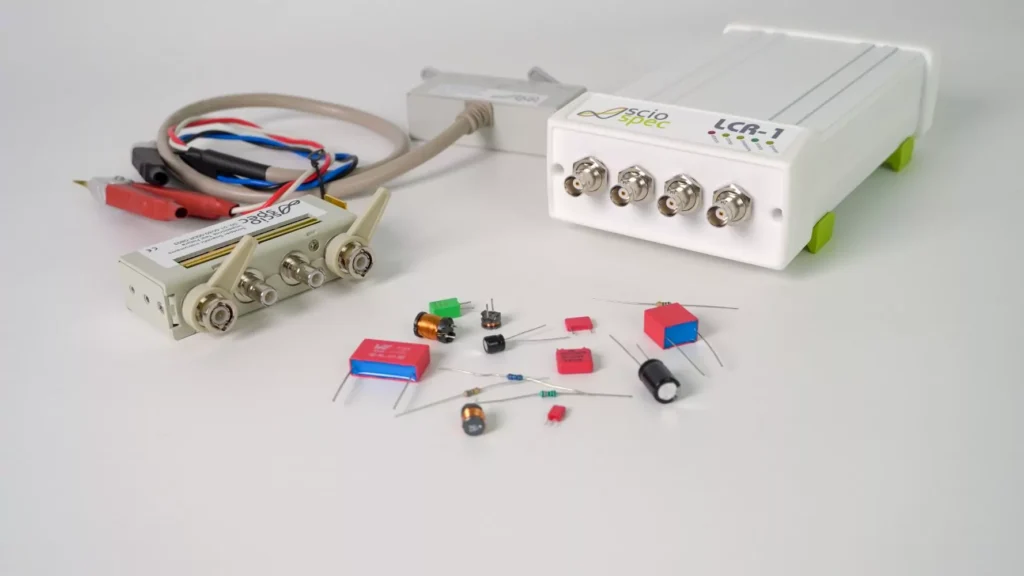
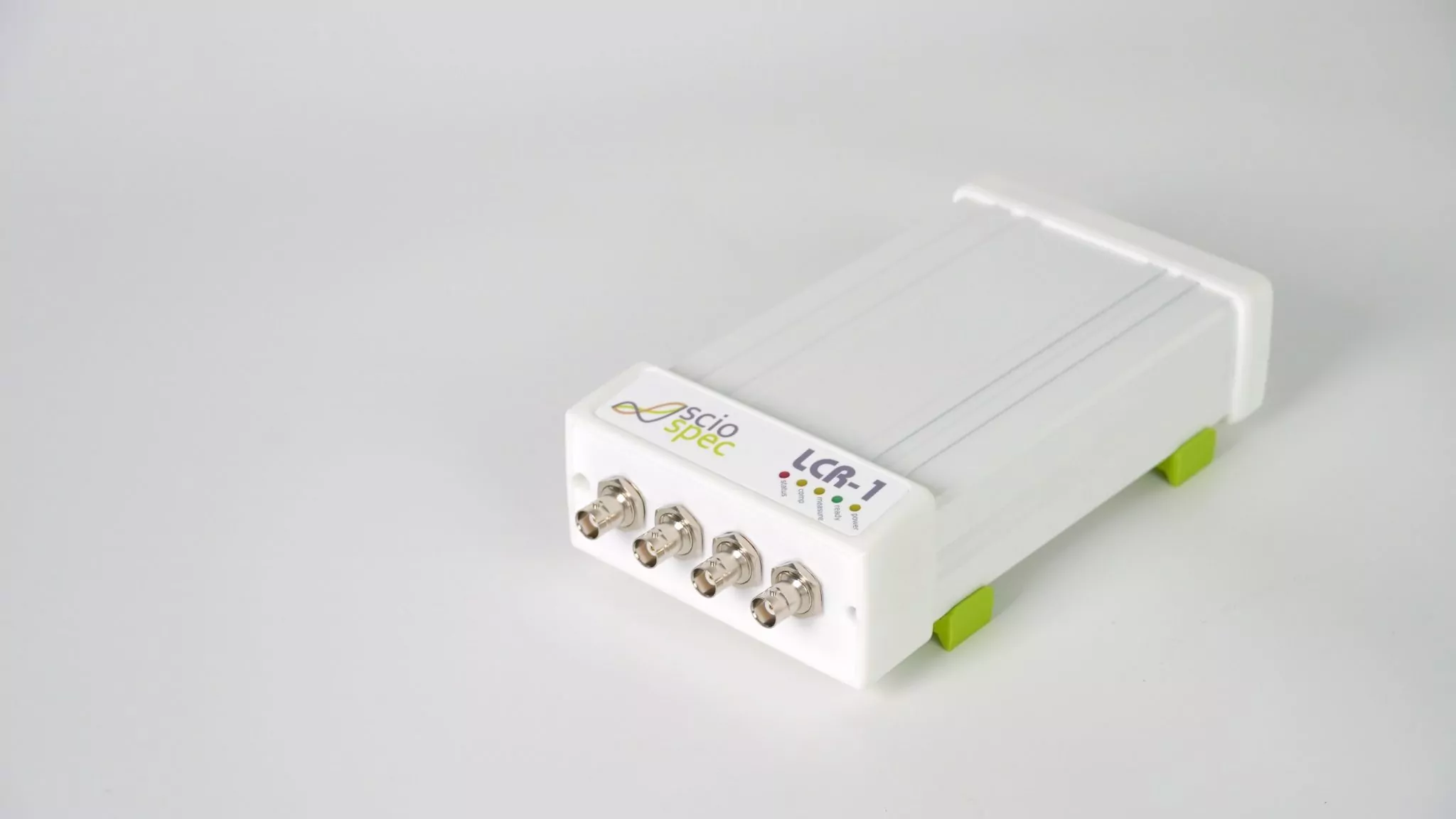
The LCR-1 combines the measurement engine used in Sciospec impedance analyzers with a dedicated LCR workflow.
The result is a compact one-channel meter with up to 0.01% base accuracy, measurement times down to 0.5 ms per point and frequency options up to 40 MHz.
Use it for component development, quality checks, troubleshooting, sensors, films and liquids – wherever fast, precise LCR measurements and a wide measurement range matter.
- Fast single-channel component and impedance measurements
- Wide frequency and impedance coverage
- Fixtures for components, SMDs, films, dielectrics and liquids
0.01%
BASE ACCURACY
High precision across a broad central operating region
0.5 ms
PER POINT
Fast measurements for rapid checks and time-resolved work
100 mHz-40 MHz
FREQUENCY
1 MHz standard; optional extension to 40 MHz
1 mΩ-1 TΩ
IMPEDANCE / R
From low-impedance components to very high-impedance samples
Technical Specifications
Key specifications for first technical qualification. Detailed electrical characteristics, frequency precision, measurement ranges and environmental data are available in the datasheet.
Parameter
Specification
Details
MEASUREMENT & CONNECTION
Channels
1
Compact one-channel LCR meter
Measurement connections
4 BNC connectors
2-, 3- and 4-port measurement configurations
Test frequency
100 mHz ... 1 MHz
Optional 40 MHz frequency extension
Excitation voltage
10 mV ... 1 V peak
0.1 mV resolution
Excitation current
10 µA ... 10 mA peak
1 µA resolution
Base accuracy
Up to 0.01%
See accuracy contour below
Measurement speed
Up to 0.5 ms/point
Depends on frequency and selected measurement-quality setting
Compensation
Open-short-load
Compensates parasitic effects from the fixture and connection path
EQUIVALENT CIRCUIT MODELS & RANGES
Supported models
|Z|/θ · Zreal/Zimag · |Y|/θ · G/B · L/Q · C/D · R/Q · Rp-Cp · Rp-Lp · Rs-Cs · Rs-Ls
Extendable to 40 MHz
Resistance / |Z|
1 mΩ ... 1 TΩ
Typical
Capacitance
10 fF ... 1 kF
Cp and Cs models
Inductance
1 nH ... 1 TH
Lp and Ls models
Admittance / conductance
1 pS ... 1 kS
Auto / manual ranging
Phase
-90° ... +90°
Configurable per workflow
SOFTWARE & CONTROL
Measurement software
LCR view · time trace · model selection · table view
Two models can be visualized in parallel in time trace
External control
SCPI
Via isolated full-speed USB 2.0
Dimensions / weight
113.1 × 58.4 × 210.1 mm · 1.0 kg typ.
Compact desktop format
Accuracy and speed across the operating range
The LCR-1 combines a broad 0.01% accuracy region with selectable measurement-quality settings. The plots below show how accuracy changes with impedance and frequency, and how measurement time changes with frequency and quality setting.
A broad central region reaches 0.01% base accuracy, with defined transitions toward 0.1%, 1%, 10% and >10% toward the limits.
Measurement time reaches 0.5 ms/point at the fastest setting; higher-quality settings trade speed for additional measurement stability.
Built on the same measurement engine as Sciospec impedance analyzers.
From milliohms to teraohms
Measure from 1 mΩ to 1 TΩ, 10 fF to 1 kF and 1 nH to 1 TH - covering ordinary passives as well as measurements far toward the low- and high-impedance ends of the range.
Down to 0.5 ms per point
Fast acquisition supports rapid component checks, prototype comparisons and time-resolved measurements while selectable quality settings remain available when more measurement stability is required.
Compensate the complete connection path
Use 2-, 3- or 4-port configurations together with open-short-load compensation and selectable excitation to reduce the influence of leads, contacts and fixtures on the result.
Fast setup for routine measurements
Direct-access presets, model selection and automatic operation keep everyday LCR work quick. Manual controls remain available when the component or setup requires more deliberate adjustment.
Reference image from the released datasheet.
Applications
See how the component behaves where your circuit operates.
Measure R, L, C, ESR, Q, D, phase and impedance across frequency. Compare prototypes, suppliers and component variants, and use the optional 40 MHz range when frequency-dependent losses, parasitics or resonance become part of the design question.
Fast, repeatable checks for development and QA.
Use direct presets, repeatable fixtures and measurement times down to 0.5 ms/point for incoming inspection, engineering QA, maintenance, fault finding and component verification.
A precise reference for sensor development.
Characterize capacitive, resistive and impedance-based sensors independently from the dedicated reader electronics. Compensation, selectable excitation and SCPI control help create a stable reference setup while the sensor or product electronics evolve.
LCR measurement beyond conventional components.
Dedicated dielectric and liquid fixtures extend the same measurement platform to foils, thin films, dielectric materials and liquid samples where geometry and connection are part of the method.
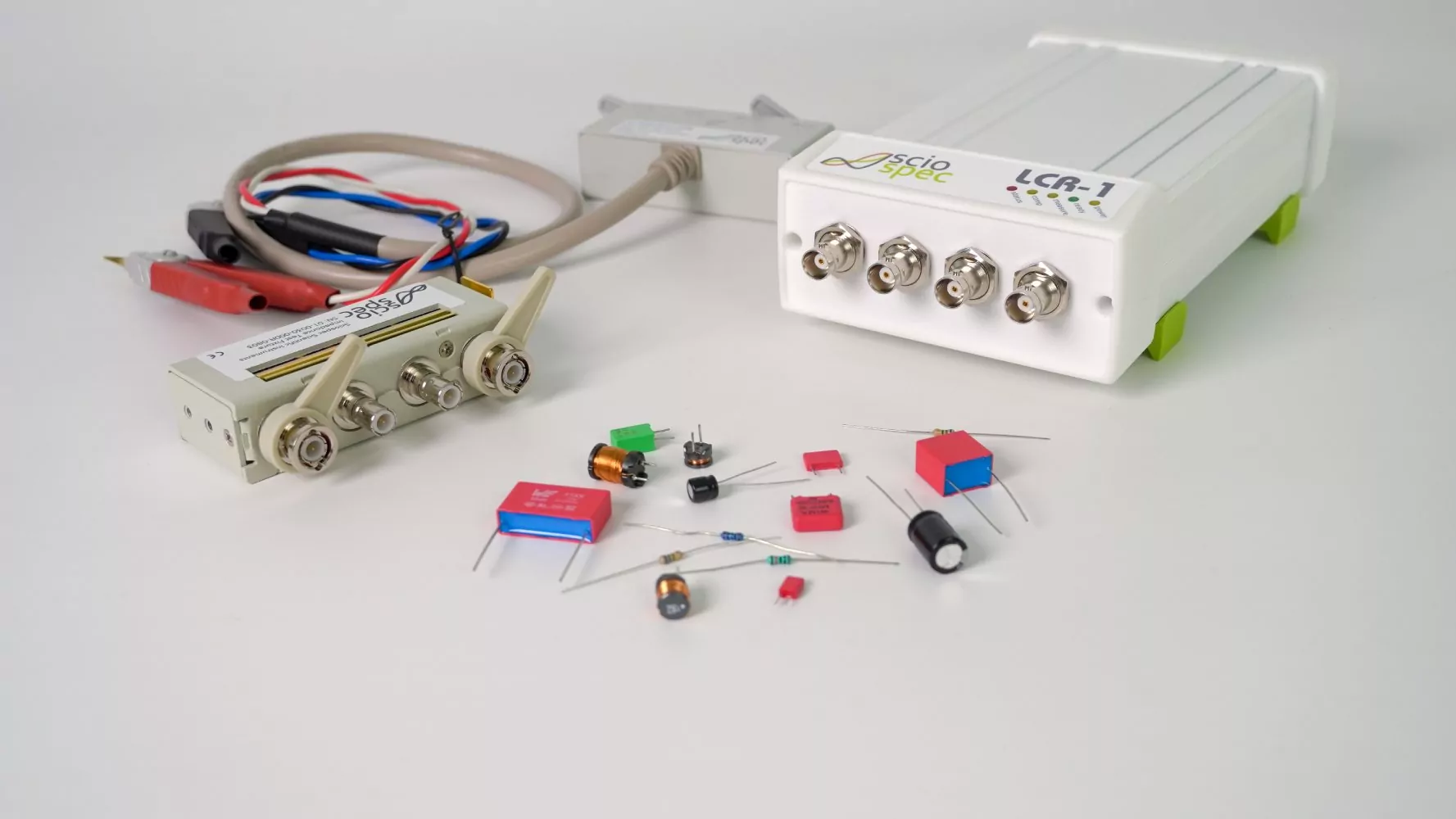
Fixtures for components, SMDs, films and liquids
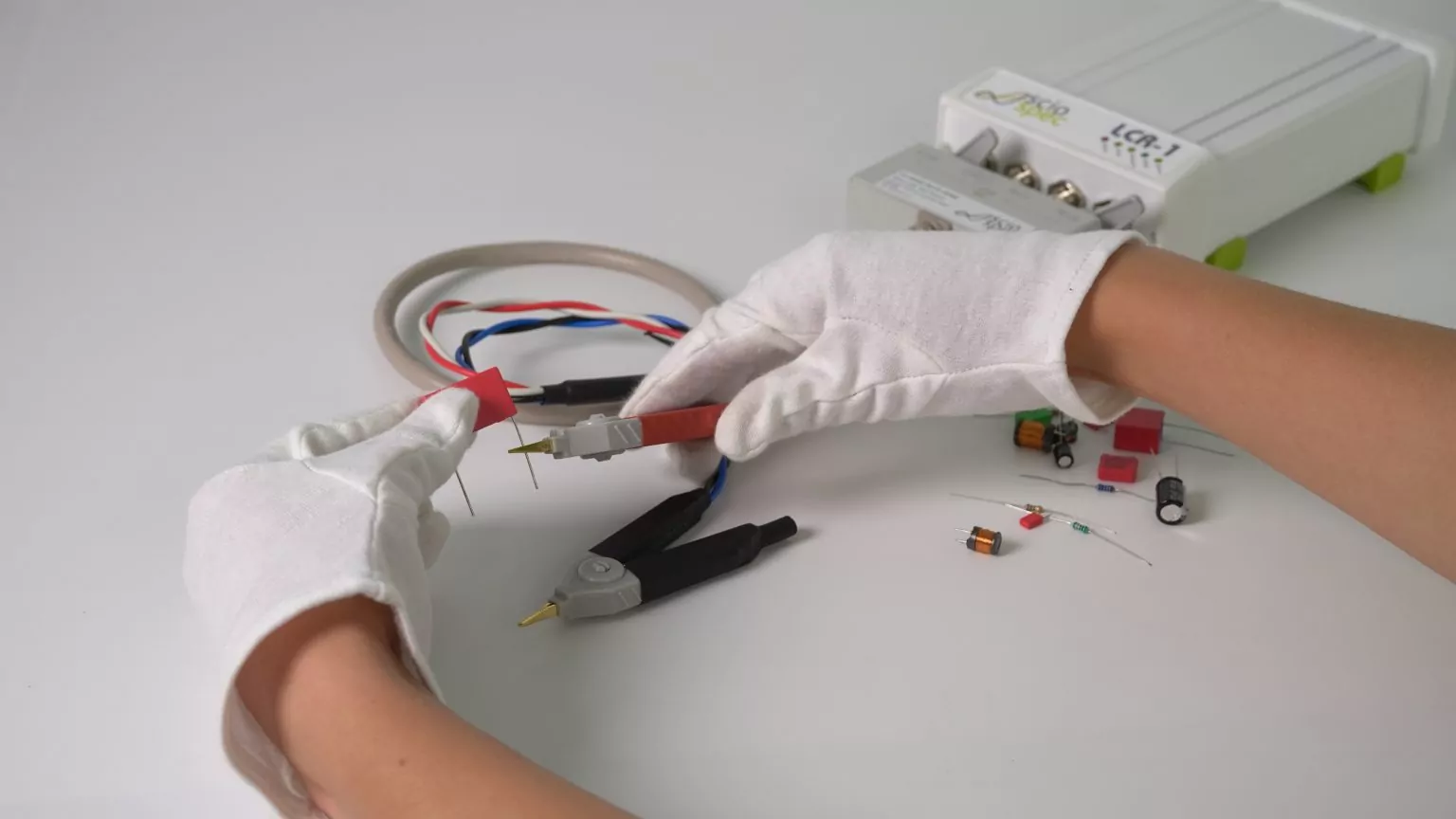
Kelvin clips
Flexible connection for conventional components and measurements where lead and contact resistance need to be controlled.
SMD test fixture
A defined connection for surface-mount components without improvised leads or tweezers.
Component test fixtures
Dedicated component fixtures in 10 MHz and 30 MHz versions for repeatable characterization at higher frequencies.
Dielectric & liquid fixtures
Defined geometries for foils, thin films, dielectric samples and liquids where the fixture is part of the measurement method.
Impedance test fixture
A practical fixture for general impedance and component measurements.
Compensation kit
Supports open-short-load compensation of the measurement setup.
Configure your LCR-1
Choose the frequency range and the adapters that match your day-to-day tests — components, foils, thin films or liquids.
Loading configurator…
LCR software, time trace and SCPI control
Choose the equivalent-circuit model, set the measurement conditions and read the result in the LCR App. Track changes over time, inspect values in table view and integrate the LCR-1 into automated setups through SCPI over the isolated USB interface.
Released LCR-1 software views: LCR view, model selection, time trace and table view.
Two models at a glance
Display two electrical models in parallel and keep the primary component parameters visible during the measurement.
Choose the equivalent circuit
Select from the released R, L, C, impedance and admittance models directly in the LCR App.
Track changes over time
Visualize two models in parallel for repeated or time-dependent measurements.
Control the LCR-1 externally
Use SCPI over USB for integration into automated test and measurement workflows.
LCR-1, LCR-3 or ISX-3?
Compact one-channel LCR measurement
For component characterization, inspection, troubleshooting, sensors and materials when one measurement channel is the right fit.
Scalable LCR testing
For many components or positions, multiplexing, repeated switching, batch work and larger automated test setups.
LCR plus advanced EIS
The ISX-3 includes the LCR App and adds advanced impedance spectroscopy for detailed frequency-dependent analysis and broader experimental flexibility.
Frequently Asked Questions
What does the LCR-1 measure?
What frequency range does the LCR-1 cover?
How fast is the LCR-1?
What does 0.01% base accuracy mean?
What are 2-, 3- and 4-port measurements used for?
Which components and samples can I connect?
Can the LCR-1 compensate for cable and fixture parasitics?
Can I control the LCR-1 from my own software?
When should I choose the LCR-3 instead?
When should I choose the ISX-3 instead?
When might another instrument be more suitable?
Next steps
Configure and request a quote
Select the frequency version, fixtures and quantity. Send the configuration directly for a concrete quotation.
Check technical fit
If accuracy, frequency, very low/high impedance or the fixture is decisive, send the component or sample, expected value and test conditions for a focused technical review.
Compare the Sciospec platforms
Move to LCR-3 for multiplexed or larger-scale LCR testing, or to ISX-3 when advanced impedance spectroscopy should be added to the LCR workflow.
Get in touch with us
Phone
Headquarters
Sciospec Scientific Instruments GmbH
Leipziger Str. 43b
04828 Bennewitz, Germany
Open in Google Maps