
ISX-3mini
High-performance EIS in a compact form factor.
The ISX-3mini brings the ISX impedance-analysis platform into a compact, lightweight 12 VDC form factor for laboratory and technical setups where space, placement or system integration matter.
Use it as a compact EIS analyzer on the bench, place it close to the DUT, or integrate it into experimental, automated or application-specific systems.
Broadband EIS, a wide impedance range, high accuracy, configurable 2-, 3- and 4-electrode measurements, voltage or current excitation and full software control give the ISX-3mini the measurement depth to handle demanding EIS work across domains.
- 100 mHz to 10 MHz EIS with up to 2048 frequency points per sweep
- mΩ-to-GΩ specified impedance range with 0.1% magnitude and 0.1° phase accuracy
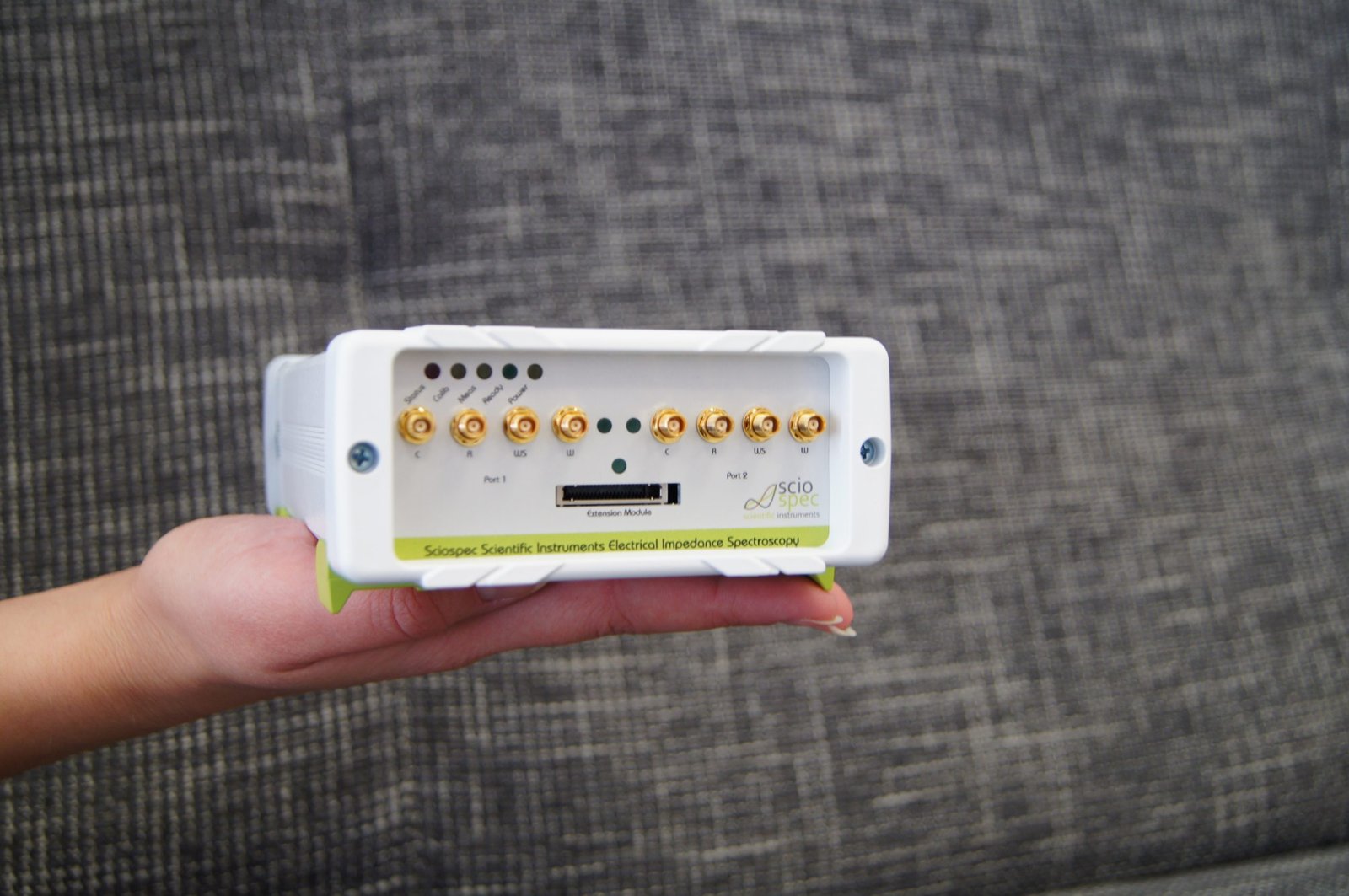
- 184 × 55 × 113 mm, approx. 1 kg and 12 VDC / 15 W max.
100 mHz–10 MHz
BROADBAND EIS Detailed impedance spectroscopy from slow processes into the MHz range.
mΩ–GΩ
WIDE MEASUREMENT RANGE 0.1% specified magnitude accuracy and 0.1° phase accuracy.
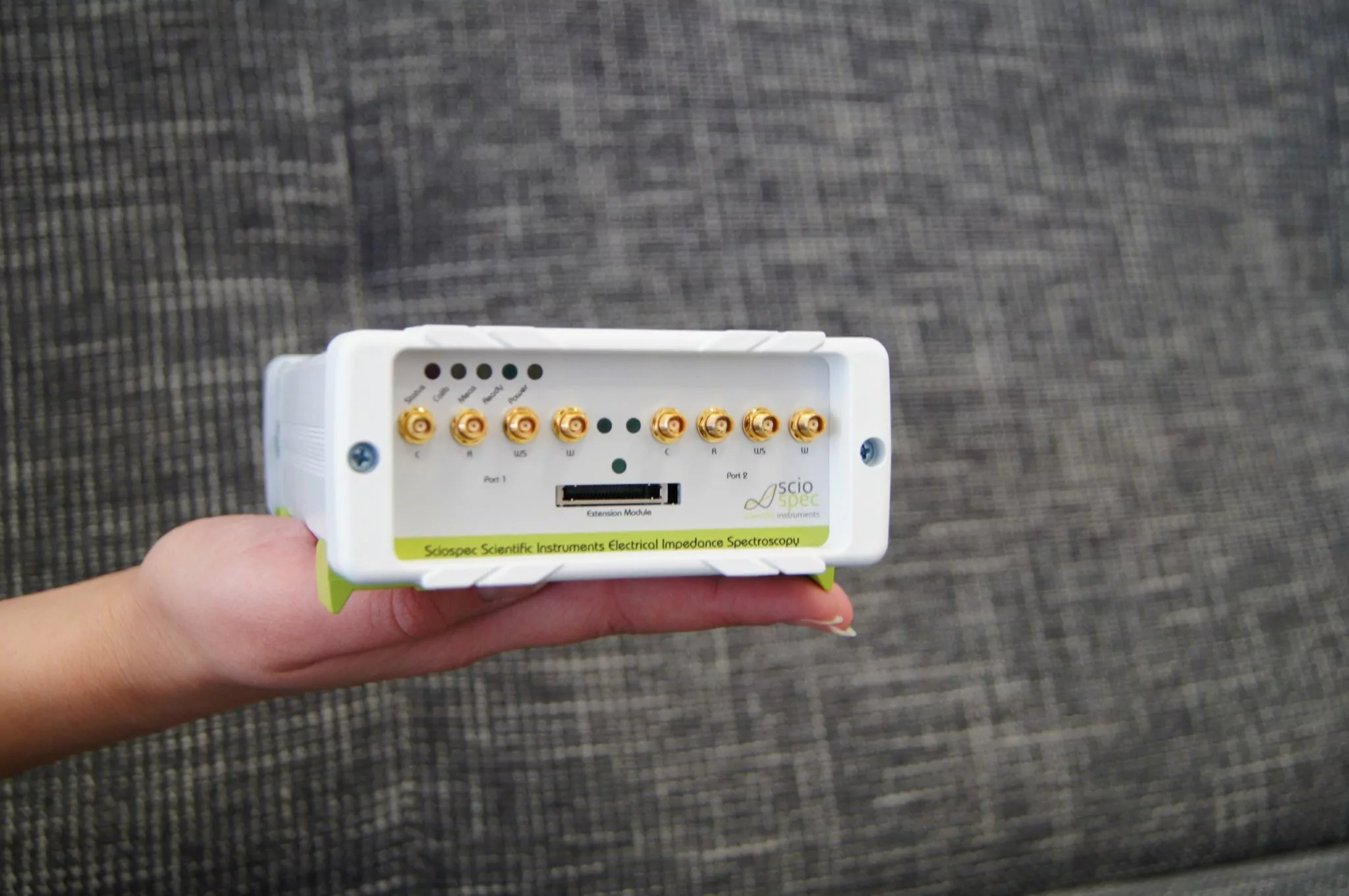
184 × 55 × 113 mm · ~1 kg
COMPACT FORMAT A professional impedance analyzer that takes up little space in the setup.
12 VDC · 15 W max.
DC POWERED Straightforward integration into compact experimental and automated systems.
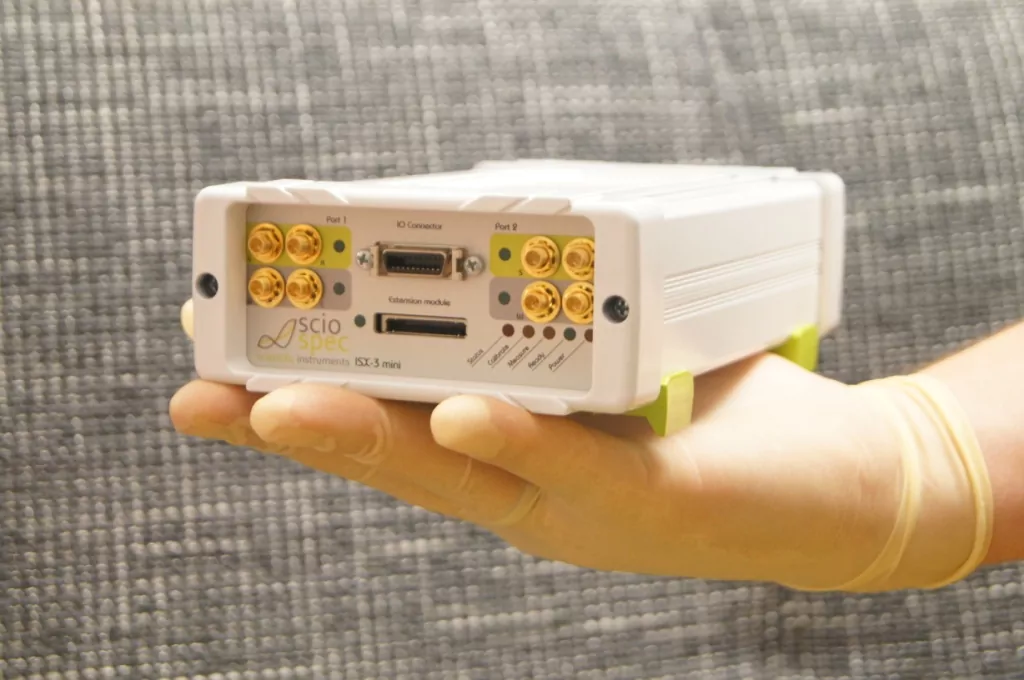
A palm-sized analyzer with the full ISX-3 measurement core
The ISX-3mini condenses the IF frontend, ExtensionPort and Sciospec software stack into an ultra-portable form factor — ideal for field setups, mobile rigs and embedded research where bench instruments don’t fit.
IF frontend
mΩ … TΩ COVERAGE
Full ISX-class performance in an ultra-compact chassis
The ISX-3mini IF frontend covers 100 mHz to 10 MHz out of the box and can be extended to 40 MHz. It supports 2-, 3- and 4-electrode setups with mΩ to TΩ measurement range, 300 dB dynamic range and ± 1 V DC bias.
ExtensionPort
USER-ACCESSIBLE INTERFACE
A direct path for application-specific front-ends
The fully user-accessible ExtensionPort carries 2/3/4-electrode signals, supply rails and digital IOs (optionally I²C or UART) — so you can build custom front-ends or attach Sciospec adapters such as the MEArack or ECISadapter.
Sciospec software
SUITE + COM API
Control and automate from any environment
The Sciospec software suite handles measurement setup, data export and analysis. The COM interface integrates the ISX-3mini with Java, C, Python, LabVIEW, MATLAB and similar environments for automated workflows.
High-performance EIS that fits naturally into the setup.
The compact form factor creates additional freedom around where the analyzer sits and how it becomes part of the experiment.
Place it beside the DUT, fit it into crowded setups, integrate it into a 12 V system or move it easily between measurement locations.
Fit EIS into crowded setups
Place the analyzer alongside prototypes, fixtures, microscopes, fluidics, environmental hardware, robotics or other instruments without reorganising the whole bench around one enclosure.
12 VDC, USB/Ethernet and ExtensionPort
The small enclosure, DC supply and standard control interfaces make the ISX-3mini easier to include in experimental and automated systems.
Put the analyzer close to the measurement
Place the analyzer near the sensor, fixture or device when local placement makes the overall setup simpler and more direct.
Move EIS between measurement locations
Relocate the analyzer between lab stations, demonstrators and compact technical setups without dedicating a full desktop instrument at each location.
Compact format. High-performance EIS.
The ISX-3mini uses the ISX impedance-analysis platform in a substantially smaller 12 VDC instrument. The exact configuration should be selected around the physical setup, measurement range and required interfaces.
Parameter
Specification
Details
IMPEDANCE SPECTROSCOPY
Frequency range
100 mHz ... 10 MHz
Broadband EIS from slow processes into the MHz range.
Frequency points
1 ... 2048 per sweep
Dense linear, logarithmic and block-wise frequency programmes.
Impedance range
mΩ ... GΩ specified
Very broad DUT range; verify the actual Z/f point with the accuracy contour.
Magnitude accuracy
0.1% specified
Broad central reference region reaches 0.01% under documented conditions.
Phase accuracy
0.1°
Specified phase accuracy for EIS.
Acquisition
~100 µs-class at fast settings
Practical timing depends on frequency, sweep settings and precision.
Voltage excitation
1 mV ... 1 V peak
Controlled voltage excitation.
Current excitation
10 µA ... 10 mA peak
Controlled current excitation.
Electrode configurations
2-, 3- and 4-electrode
Adapt topology to the DUT and connection effects.
DC bias
±1 V
Within documented combined excitation/bias limits.
Compensation
Open / short / load
Compensate cables, fixtures and connection parasitics.
FORMAT & SYSTEM
Dimensions
184 × 55 × 113 mm
Fits into compact and crowded setups.
Weight
Approx. 1.0 kg
Easy to relocate and integrate.
Power
12 VDC · 15 W max.
DC-powered technical setups.
High accuracy across a wide EIS measurement range.
The useful performance of an impedance analyzer is determined by the combination of frequency and DUT impedance, not by one best-case accuracy number.
The ISX-3mini specifies 0.1% magnitude and 0.1° phase accuracy. The reference accuracy contour shows where the strongest measurement region lies across the wider impedance/frequency space and reaches 0.01% magnitude accuracy across a broad central region under documented conditions.
Check your actual measurement range
Visual: released Z/f contour. Caption: find the expected accuracy region at the impedance and frequency that matter to the application.
Choose speed or additional stability
Adjust the precision setting according to whether acquisition time or lower measurement spread matters more.
PRODUCT FRONT — C / R / WS / W measurement interface: the four BNC measurement terminals that make configurable 2-/3-/4-electrode measurement tangible.
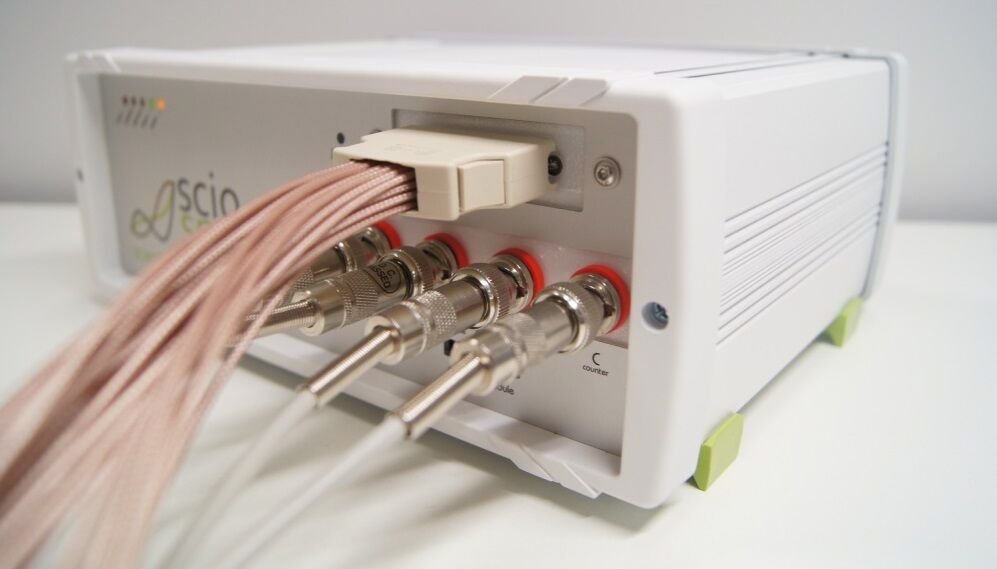
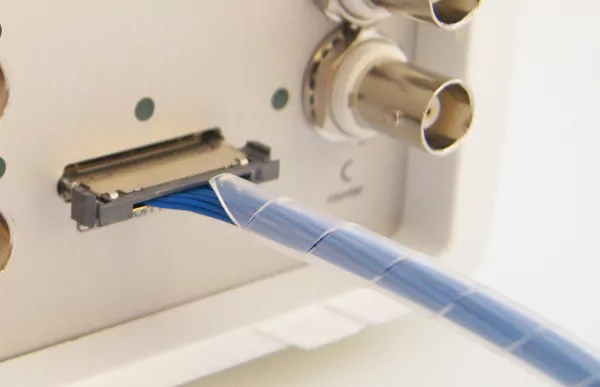
APPLICATION INTERFACE — ISX-3 + real adapter/frontend: MEArack proves that application adaptation is real hardware, not a promise.
High-performance EIS where space, power or placement matters.
The underlying EIS applications remain broad. The reason to choose ISX-3mini is how the measurement hardware has to fit into the setup.
Keep the analyzer beside the prototype
Measure sensors, electrodes, MEMS and prototype devices with a compact instrument that can sit next to evolving fixtures and electronics. Use direct cabling first; add fixtures, MUX or a frontend when the interface becomes more specific.
Full EIS without taking over the bench
Use broadband impedance spectroscopy on benches already occupied by fixtures, thermal setups, microscopes or other instrumentation. The mini form factor keeps the analyzer present without turning it into the centre of the workspace.
Fit around microscopes, fluidics and sensor platforms
Place EIS closer to biological samples, chip holders, electrode arrays or compact measurement environments. For human-connected research, use the Medical Research ISX route instead.
Add EIS as one element of a larger station
12 VDC operation, USB/Ethernet control and optional synchronisation or I/O make the ISX-3mini attractive when impedance measurement is integrated into a test stand or automated workflow.
Move the analyzer between measurement points
At about 1 kg, the ISX-3mini is practical for shared setups, demonstrations and technical systems that move between workspaces.
Use a complete analyzer before designing one
Establish the frequency range, signal level, excitation, topology and interface while the application is still evolving. Dedicated hardware can follow once the requirements are mature.
Compact form factor. Flexible measurement interfaces.
Start with direct 2-, 3- or 4-electrode measurement. Add a fixture, MUX or application-specific frontend where the DUT or workflow requires it.
Connect the DUT cleanly
Use configurable 2-, 3- or 4-electrode measurement with the appropriate cable set or fixture for components, materials, liquids or sensors.
One compact analyzer, many connected positions
Use multiplexing when many samples or electrode combinations can be measured sequentially. If results must represent the same instant, use ISX-5 instead.
Adapt the interface around the application
Use the ExtensionPort route when the measurement needs more than a standard cable or fixture, including application-specific frontends and configurable I/O.
Configure your ISX-3mini
Start with the compact analyzer and add only the connection, switching and system options your setup needs.
Loading configurator…
Straightforward EIS. Full control when you need it.
Run ordinary impedance spectra through the standard measurement software, or integrate the ISX-3mini into a larger controlled workflow.
Configure and run the spectrum
Set frequencies, excitation, precision and measurement configuration and inspect the resulting impedance data.
Look at the behaviour that matters
Use spectrum and time-based views for amplitude, phase and complex impedance analysis.
Configure the real electrode setup
Assign the required measurement topology, including multiplexed paths where present.
Automate the instrument
Use the Sciospec Communication Interface over USB or Ethernet when EIS becomes part of another software or automation environment.
Choose the format that fits the setup.
When the instrument itself must be small, light or DC-powered
184 × 55 × 113 mm · approx. 1 kg · 12 VDC. Use it when the analyzer needs to sit close to the DUT, move between stations or integrate into a larger technical setup.
When a conventional desktop analyzer fits the lab
Use the flagship ISX-3 when bench form factor is acceptable and the standard desktop platform is the cleaner purchase route.
When a more specialised instrument fits better.
The ISX-3mini covers a broad range of EIS work. A few requirements point naturally to a specialist ISX architecture: true-parallel acquisition, human-connected research or combined EIS/EIT.
ISX-5
Use ISX-5 when several changing signals genuinely need to be measured at the same time.
Medical Research ISX-3
Use Medical Research ISX-3 when a human subject is electrically connected.
ISX-3 EIT
Use ISX-3 EIT when detailed spectra and multi-electrode spatial measurement belong together.
Use it as an instrument. Integrate it into the setup. Or take the measurement into dedicated hardware.
The ISX-3mini can remain a finished laboratory instrument. It can also help establish the measurement concept for an application-specific system before dedicated electronics are justified.
Start measuring immediately
Use a ready-to-run analyzer while frequencies, impedance levels, excitation and topology are still being explored.
Fit the analyzer to the setup
Add the required fixture, MUX, frontend, I/O, automation or mechanical integration around the validated measurement.
Engineer only when requirements are mature
Use the validated frequency range, signal levels, topology, interfaces and workflow to inform separately engineered electronics, firmware, software and mechanics.
Straightforward EIS. Full control when you need it.
Run ordinary impedance spectra through the standard measurement software, or integrate the ISX-3mini into a larger controlled workflow.
Configure and run the spectrum
Set frequencies, excitation, precision and measurement configuration and inspect the resulting impedance data.
Look at the behaviour that matters
Use spectrum and time-based views for amplitude, phase and complex impedance analysis.
Configure the real electrode setup
Assign the required measurement topology, including multiplexed paths where present.
Automate the instrument
Use the Sciospec Communication Interface over USB or Ethernet when EIS becomes part of another software or automation environment.
Complete your setup
MCX cable sets
MCX–BNC (0.8 m), MCX–4 mm banana (1 m) and MCX–Kelvin clip leads (1 m) for component, liquid and chip measurements. [Product-specific accessory image needed]
Details
Chip adapters
MEArack for multi-electrode arrays and ECISadapter for ECIS chips — attached through the ExtensionPort.
Details
External multiplexers
32- or 64-channel any-to-any multiplexers extend the ISX-3mini into massive-multichannel sequential measurements.
Details
Compensation kit
Open / short / load standards for precise frontend compensation. [Product-specific accessory image needed]
Details
Where the ISX-3mini fits in
From portable EIS rigs and embedded research setups to chip-based assays and electrode arrays — the ISX-3mini brings ISX-3-class performance to places where a benchtop analyzer just isn’t an option.
Portable & field measurements
Take lab-grade EIS out of the bench rack and into the field, the greenhouse or the production line — the ISX-3mini fits anywhere a full ISX-3 would not.
Chip- and MEA-based assays
Combine the ISX-3mini with the MEArack or ECISadapter for cell-based and electrode-array experiments through the ExtensionPort.
Embedded R&D rigs
Integrate the ISX-3mini into custom enclosures, robots or moving setups where a compact, USB- or Ethernet-controlled analyzer is the only option.
Multichannel routing
Pair the mini with a 32- or 64-channel any-to-any multiplexer for sequential multichannel impedance on larger electrode arrays.
From a pocket-sized analyzer to your embedded product
When you’re ready to move from a portable unit to a product, we help migrate the ISX-3mini architecture into dedicated OEM electronics — tailored firmware, connectors and certifications for your target environment.
- 01
Portable validation
Validate your method on a standard ISX-3mini with MCX cables, the chosen adapter and the Sciospec software suite.
- 02
ExtensionPort front-end
Attach an application-specific front-end through the ExtensionPort — chip carrier, sensor head or custom enclosure.
- 03
Embedded OEM module
Migrate the ISX-3mini measurement core into a dedicated OEM module with custom electronics, firmware and connectors for your product.
[Relevant reference case needed]
Portable EIS workflow using the ISX-3mini
ISX-3mini in real research workflows
[Relevant reference case needed] — researchers use the ISX-3mini for portable bioimpedance studies, field measurements and embedded chip-based experiments. Reference write-ups for the ISX-3mini specifically are pending.
Challenge
[Product-specific challenge needed] — typically: deliver lab-grade EIS in a portable or embedded setup where a benchtop instrument does not fit.
SCIOSPEC ROLE
The ISX-3mini provides the EIS measurement core, MCX channels and ExtensionPort interface to the application-specific frontend.
RESULT
[Product-specific result needed].
USER VOICE
- The ISX-3mini puts the full power of a laboratory grade impedance analyzer in the palm of your hand."
Sciospec product team
[Specific user attribution needed]
The mini shares its measurement core with the ISX-3 — most ISX-3 publications and application notes also describe the methods the mini supports.
ISX-3mini FAQ
How does the ISX-3mini differ from the ISX-3?
The ISX-3mini combines the ISX EIS platform with a much smaller, lighter 12 VDC form factor. Choose it when those physical characteristics improve placement, integration or mobility in the measurement setup; choose the standard ISX-3 when a conventional desktop format is preferable.
How small is the ISX-3mini?
The enclosure measures approximately 184 × 55 × 113 mm and the instrument weighs about 1 kg. It operates from 12 VDC with a maximum power requirement of 15 W.
What frequency and impedance range does it cover?
The standard EIS specification covers 100 mHz to 10 MHz and an impedance range from mΩ to GΩ, with up to 2048 frequency points per sweep.
Can I use 2-, 3- and 4-electrode configurations?
Yes. The measurement topology is software configurable, allowing the connection method to be adapted to the DUT and the parasitic or electrode-interface effects that need to be separated.
Can the ISX-3mini measure many samples?
Yes, using MUX32/64 for sequential measurements. If several channels must be measured truly at the same time, choose ISX-5.
Can I automate the ISX-3mini?
Yes. USB and Ethernet provide PC and programmatic control through the Sciospec Communication Interface. I/O and synchronization options can be considered when the setup requires external coordination.
Can I connect an unusual sensor or custom fixture?
Yes, where the electrical measurement fits the analyzer. Start with ordinary cables or a standard fixture where possible; use the ExtensionPort and an application-specific frontend when the physical or electrical interface requires more adaptation.
When should I choose the standard ISX-3 instead?
Choose the standard ISX-3 when compactness, weight and 12 V operation do not materially affect the setup and a desktop instrument is the cleaner purchase route.
Can the ISX-3mini be used as part of an OEM development?
Yes. It can establish the measurement method and serve in compact application-specific setups. When a fully dedicated product becomes appropriate, those validated requirements can inform separate OEM engineering.
How would you like to continue?
Choose the next step that fits where you are in your project — from first conversation to OEM integration.
Tell us about your idea
Share your portable or embedded project — we’ll help scope the right ISX-3mini setup.
Configure your ISX-3mini
Choose the frequency range, cable set, chip adapter and options that fit your setup.
Talk to us about OEM
Discuss embedded electronics, custom front-ends and ExtensionPort integration around the mini.
Choose your next step
Configure your ISX-3mini
Choose the measurement interface, multiplexing and system options you need and request a concrete configuration and quotation.
Review the integration
Use this route when space, power, cabling, a sensor interface, MUX or automation determines whether the setup will work.
Discuss the next system stage
Use this route when the mini is becoming part of a recurring instrument, automated system or product.
Get in touch with us
Phone
Headquarters
Sciospec Scientific Instruments GmbH
Leipziger Str. 43b
04828 Bennewitz, Germany
Open in Google Maps