
EIT32/64/128+
Advanced multichannel EIT for dynamic 2D and 3D imaging.
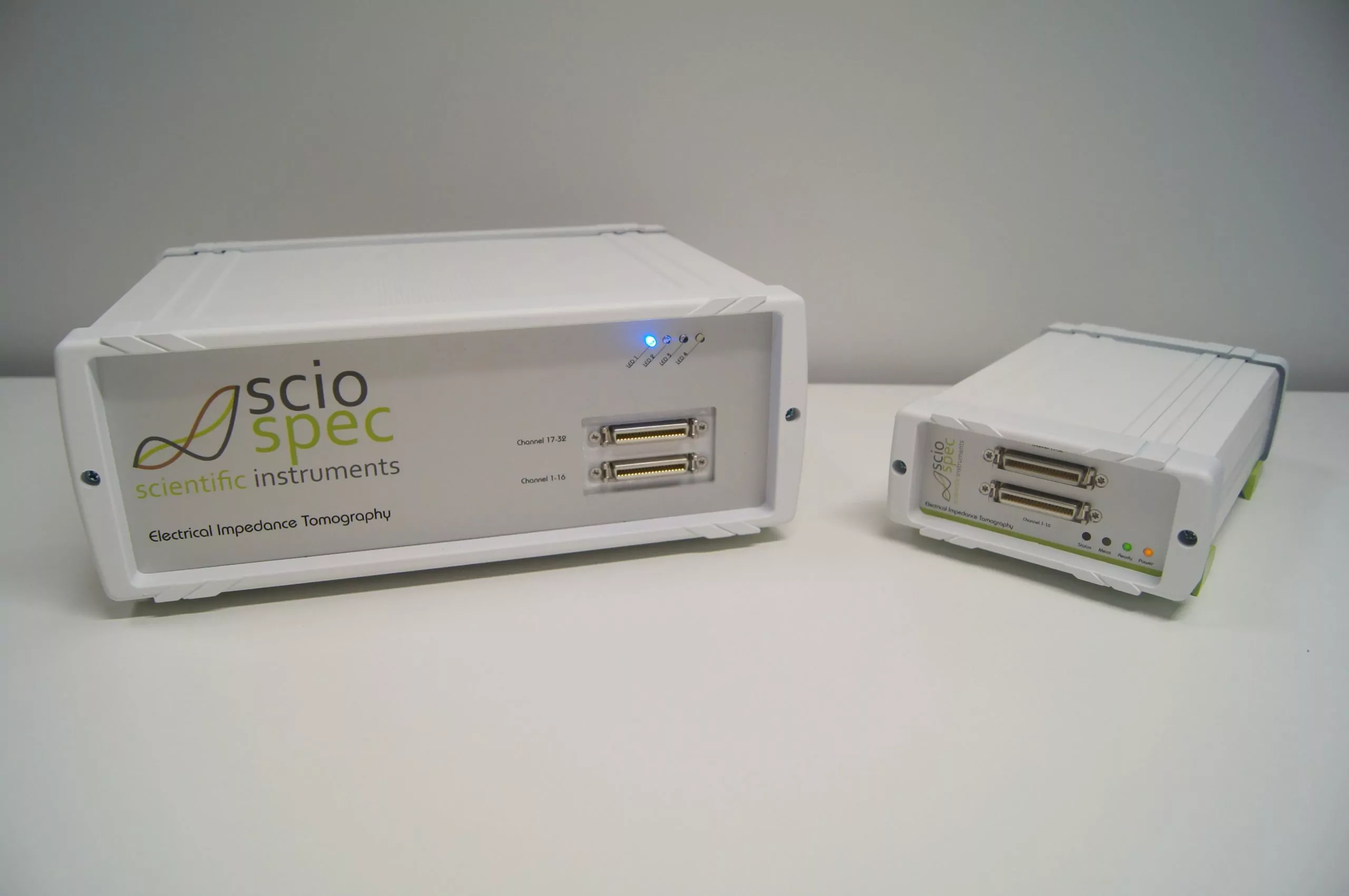
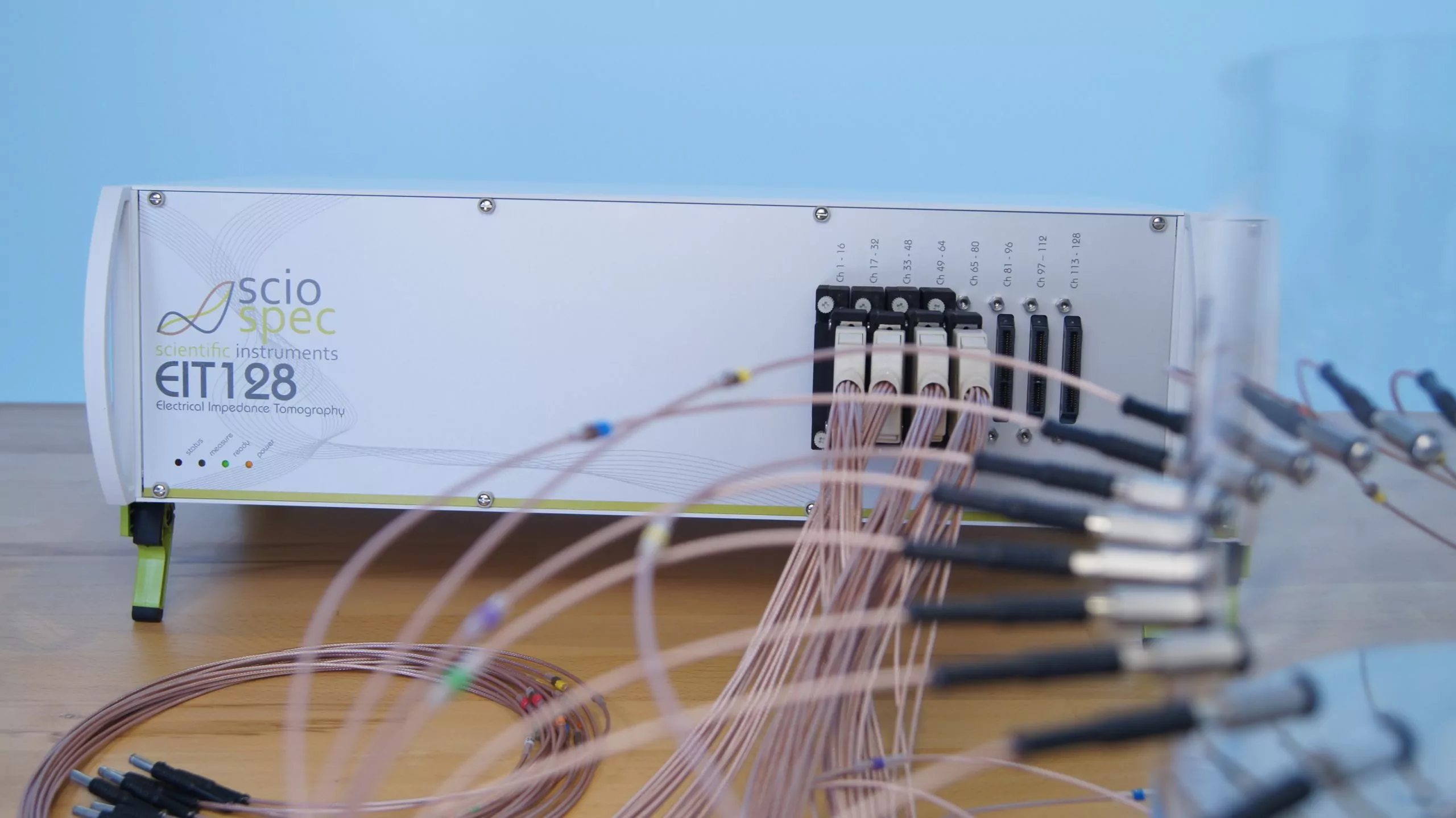
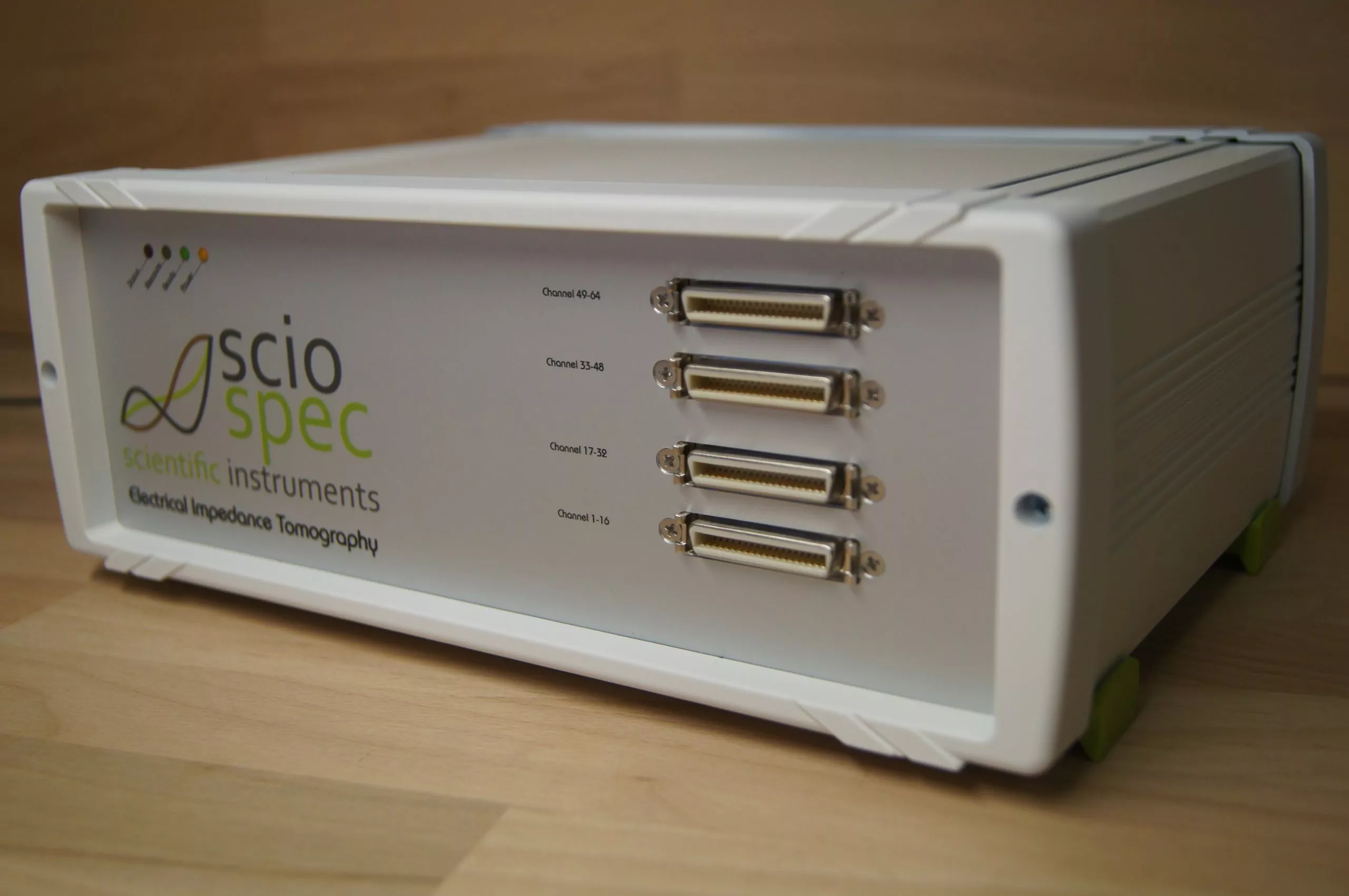
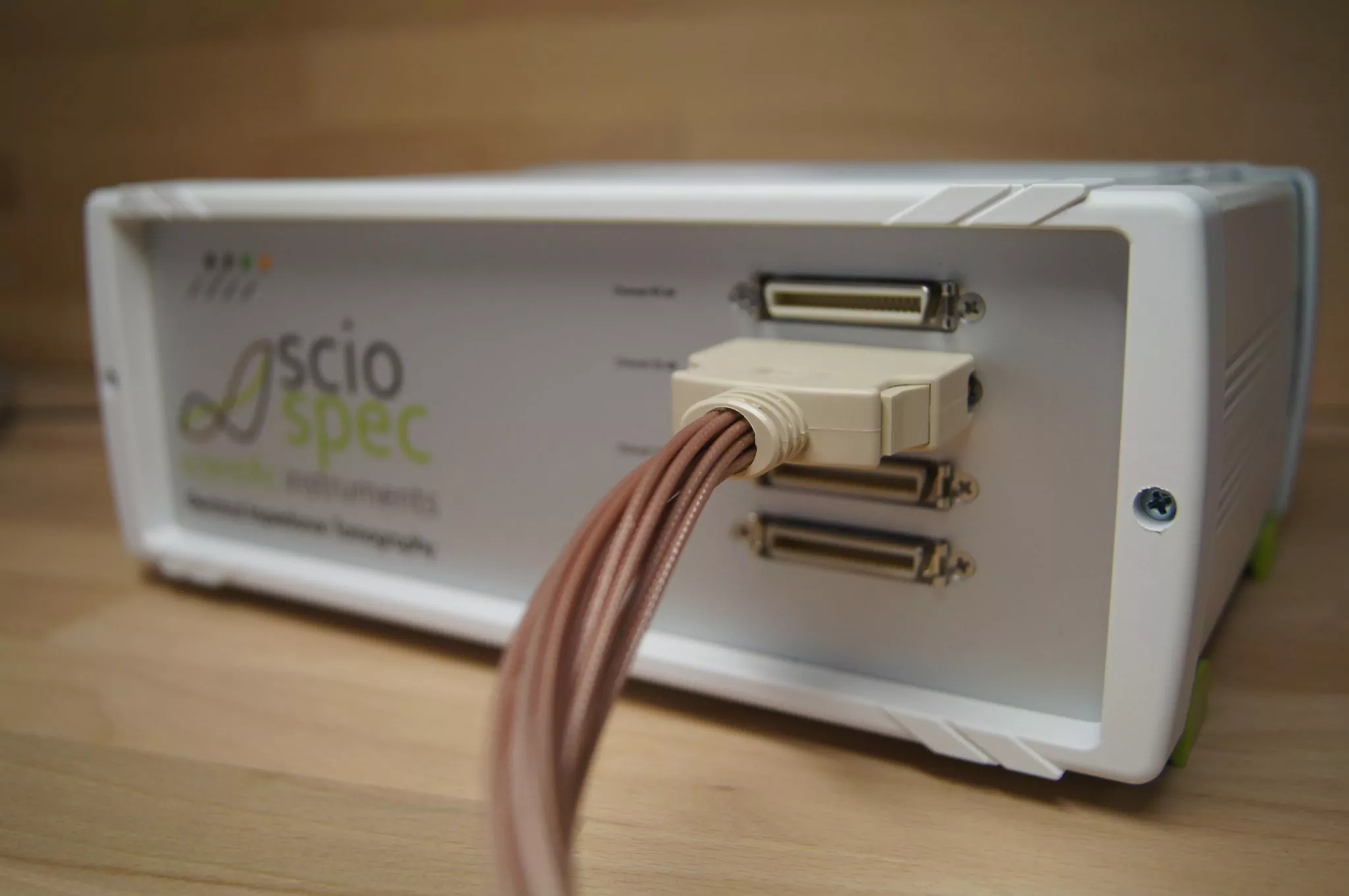
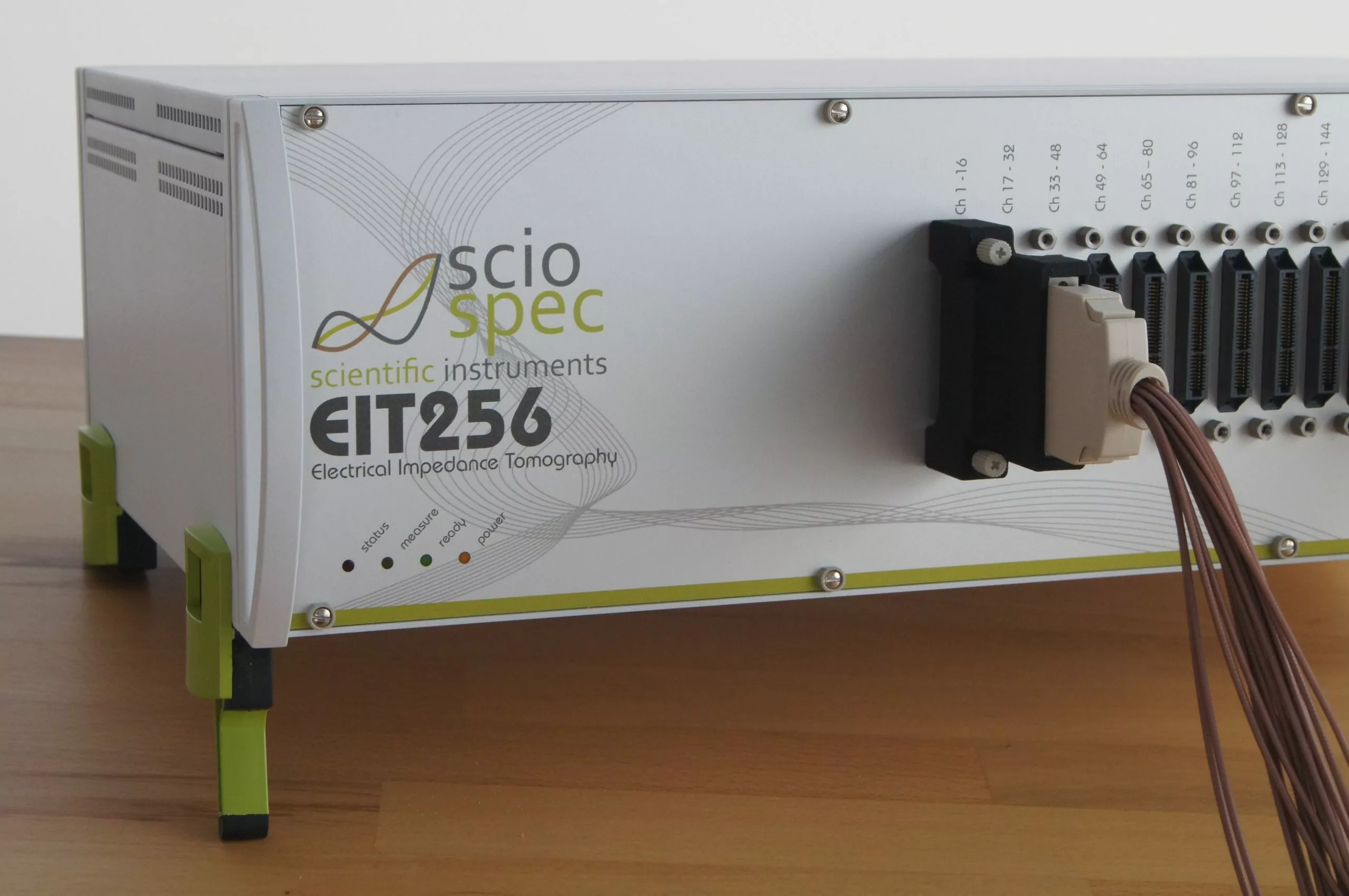
The EIT32/64/128+ systems combine 32, 64, 128 and larger channel configurations with simultaneous multichannel voltage acquisition, freely configurable current injection, multifrequency operation and open reconstruction workflows.
Use them for multi-plane and 3D EIT, process tomography, physiological research and new EIT sensor concepts – wherever you need more than 16 electrodes and still need fast frame acquisition as the setup grows.
- 32, 64, 128 and larger channel configurations for 2D, multi-plane and 3D EIT
- All channel voltages acquired together during each injection step - no additional sequential voltage scan
- Up to 100 fps, up to 128 frequencies, Sciospec or custom reconstruction
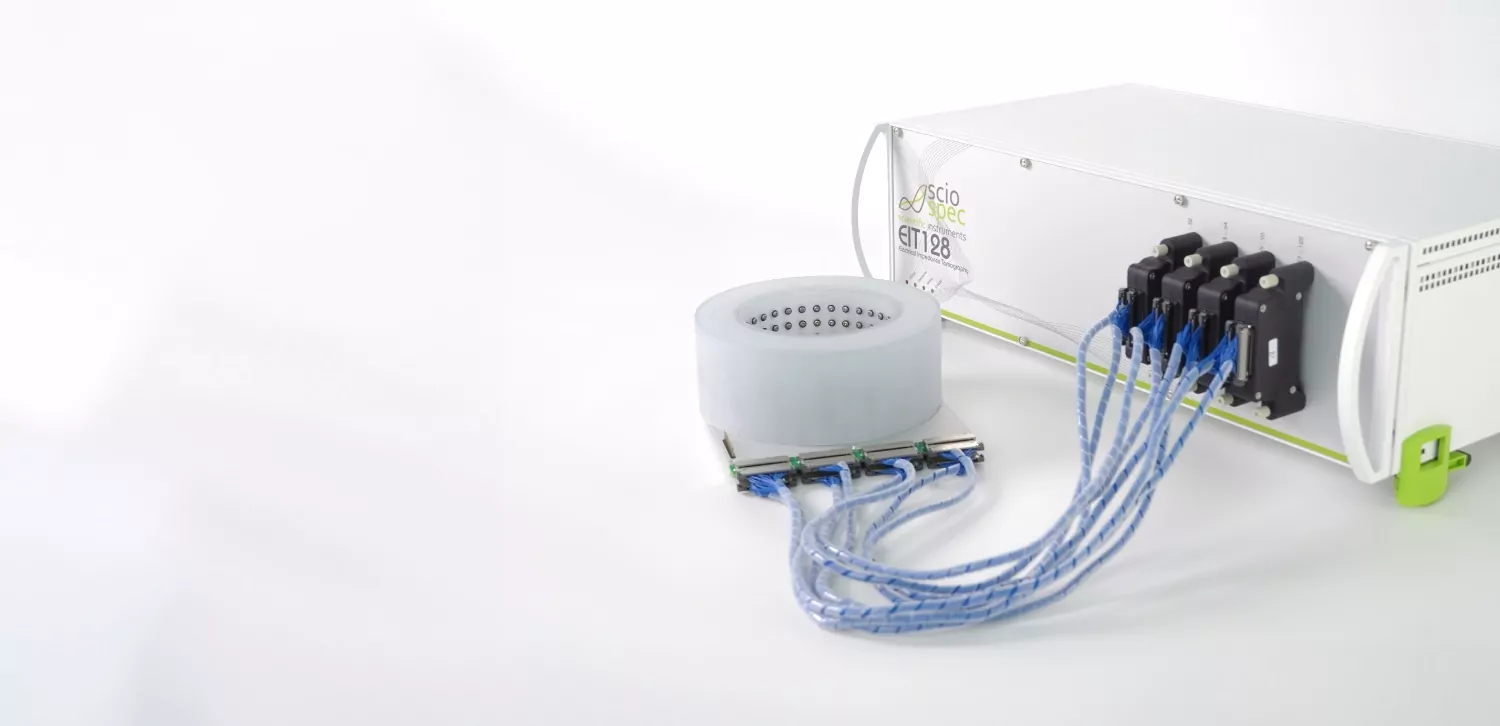
32 / 64 / 128+
CHANNEL COUNT From dense 2D arrays to multi-plane and 3D electrode setups.
ANY-TO-ANY
INJECTION CONTROL Choose source and sink anywhere in the array and define the injection sequence you need.
UP TO 100 FPS
FRAME RATE Fast enough for dynamic EIT; complete-frame rate depends on the injection sequence, frequencies and acquisition settings.
UP TO 128 FREQUENCIES
MULTIFREQUENCY EIT Single- or multifrequency EIT across the released 100 Hz to 1 MHz range.
High channel counts without sequential voltage scanning
With many EIT electrodes, speed quickly becomes a practical issue. In a sequential topology, every additional voltage channel adds another measurement step before the system can move on.
Sciospec takes a different approach: each electrode has its own measurement channel. For every current-injection step, the voltages across all connected channels are acquired together. The system then moves to the next injection pair. A complete frame is therefore driven mainly by the injection sequence and frequency settings – not by an additional sequential scan through 32, 64 or 128 voltage channels.
32 / 64 / 128+ ELECTRODES → CHOOSE INJECTION PAIR → INJECT CURRENT → ACQUIRE ALL CHANNEL VOLTAGES TOGETHER → NEXT PAIR → COMPLETE FRAME → RECONSTRUCT
Keep high-channel-count measurements fast
Because all channel voltages are acquired together for each injection step, large arrays avoid an extra channel-by-channel voltage scan. That makes 32-, 64- and 128-channel setups attractive when you need to follow changing flow, motion, deformation or physiology.
Build 2D, multi-plane and 3D setups
Use more electrodes when the experiment needs denser coverage, several measurement planes, a larger sensing surface or a custom 3D arrangement.
Use the stimulation pattern your experiment needs
Choose any electrode pair as source and sink and define the order yourself - from conventional EIT patterns to application-specific sequences.
Use Sciospec imaging or your own model
Start with Sciospec time- or frequency-difference reconstruction, load your own reconstruction matrix, or work from raw data in MATLAB/EIDORS and custom analysis workflows.
16 dual-role electrodes
ANY-TO-ANY INJECTION
Truly simultaneous sampling on all 16 channels
16 dual-role electrode connections combine voltage measurement and current injection. Any combination of 2 out of 16 channels can serve as positive / negative injection — driven by a fast-switching, ultra-low-leakage reed-relay matrix.
Pseudo-differential source
100 nA – 10 mA PEAK
Wide-range excitation with tightly synchronized DAQ
Pseudo-differential current source delivers excitation signals up to 10 mA, with a tightly synchronized data acquisition path so every channel samples in lock-step — no software-side stitching, no per-channel skew.
SineFit + imaging
READY-TO-GO ALGORITHMS
Fast, precise signal extraction with built-in imaging
The Sciospec SineFit algorithm extracts amplitude and phase quickly and accurately, while the EIT software ships with ready-to-go imaging algorithms — so you can move from raw data to reconstructions out of the box.
32, 64 or 128+ channels: choose what your setup needs
32 channels for denser 2D or two-level setups
Use 32 channels for a denser single-plane setup, two 16-electrode levels or other arrays that need more than 16 connections.
64 channels for larger arrays and multi-plane setups
A natural fit for two 32-electrode levels, larger sensor surfaces or setups where 32 connections are no longer enough.
128+ channels for high-density and 3D EIT
Use 128 channels and beyond for several measurement planes, high-density arrays and custom 3D electrode arrangements.
More Insights: Does a 128-channel system automatically run slower than EIT32?
Not because of the voltage-channel count itself. In the dedicated Sciospec architecture, the voltages from all connected channels are acquired together during each injection step. A complete frame is therefore determined mainly by the number of injection states, the frequencies and the acquisition settings.
If EIT32, EIT64 and EIT128 use the same injection stack and frequency settings, the larger voltage-channel count does not add a separate 32-, 64- or 128-step voltage scan. In practice, higher-channel-count experiments often use more injection patterns, so the final frame rate still depends on the measurement strategy.
Technical specifications
Parameter
Specification
Details
EIT ARCHITECTURE
Electrode / measurement channels
32 / 64 / 128; higher channel counts configuration-dependent
One dual-role measurement / current-injection connection per channel
Voltage acquisition
All system channels acquired together
During each active injection state
Current injection selection
Any-to-any source / sink pair
Each electrode can be selected in the configured excitation sequence
Current source
Pseudo-differential
Dedicated EIT excitation architecture
Injection sequence
Freely configurable
User-defined source/sink sequence
MEASUREMENT
Frequency range
100 Hz – 1 MHz
Released dedicated-EIT specification
Frequency sweep
Up to 128 frequencies
Multifrequency / spectral EIT
Current excitation
100 nA – 10 mA peak
Configurable excitation amplitude
Frame rate
0.1 – 100 fps
Depends on injection sequence, frequencies and acquisition settings
Signal extraction
Sciospec SineFit
Real-time extraction of complex signal information
RECONSTRUCTION & DATA
Standard reconstruction
Time- and frequency-difference EIT
Ready-to-use Sciospec reconstruction
User-defined reconstruction
Custom reconstruction matrix
Can be used in the Sciospec workflow
Raw-data route
Raw frame data
For custom processing and reconstruction
External reconstruction
MATLAB / EIDORS-compatible route
For research and custom analysis workflows
SETUPS & INTERFACES
Standard phantom setups
32-electrode ring · 2 × 16 · 2 × 32 · 4 × 32
Availability depends on selected system / accessory configuration
Custom phantoms
Alternative electrode counts, multiple rows and dimensions
Alternative electrode counts, rows and dimensions available on request
Application interfaces
Standard connectors, custom cabling, chip / sensor adapters
Configuration-dependent
General multi-port impedance measurement
Supported architecture
Tomographic reconstruction is not mandatory for every multielectrode application
Applications for high-channel-count EIT
Move beyond a single electrode plane
Use 32, 64 or 128+ channels to build multi-ring, multi-plane and custom 3D setups while keeping injection patterns, frequency strategy and reconstruction under your control. Particularly relevant for EIT method and reconstruction research.
Track distributions inside pipes, vessels and reactors
Use several electrode planes or larger arrays to follow changing flows, mixtures and conductivity distributions. Fast multichannel acquisition is especially valuable when the process changes while the frame is being acquired.
Map larger sensor surfaces and deformable structures
Conductive skins, tactile sensors and soft structures often need many electrodes across unusual shapes. Keep the measurement system flexible while electrode placement, injection patterns and reconstruction evolve.
Use more electrode positions without losing dynamic information
For physiological and bioimpedance research, higher channel counts can support several electrode levels, broader coverage or custom arrangements while preserving fast acquisition. Human-connected setups require technical and safety review; pulmonary research should start with LungEIT.
Secondary use: the dedicated architecture can also acquire general multi-port impedance data when distributed electrical information is useful but tomographic reconstruction is not the final result.
Parametric imaging with EIT128
A research setup built around the EIT128 and a customizable phantom tank uses parametric impedance imaging for object localization and structural analysis.
It is a strong example of what the larger Sciospec EIT systems are built for: many electrode positions, a test geometry tailored to the question, and reconstruction that can be adapted to the analysis rather than fixed by the instrument.
128-channel EIT acquisition
The EIT128 provides the channel count needed for the chosen electrode arrangement.
Customizable test geometry
The tank can be adapted in electrode count, rows and dimensions to match the experiment.
Parametric impedance imaging
The analysis focuses on localization and structural information derived from the measured impedance distribution.
Instrument, phantom and reconstruction together
The reference combines the measurement hardware, electrode arrangement and reconstruction around one research question.
Phantoms, cables and interfaces for multichannel EIT
32-electrode ring and 16 × 2 phantoms
Use standard phantom and cable configurations for common 32-channel EIT setups.
32 × 2 and 32 × 4 phantoms
Use ready multi-ring phantoms for common 64- and 128-channel arrangements.
Need a different tank, electrode count or number of rows?
Sciospec can review custom tanks and cabling for alternative dimensions, electrode layouts, process vessels and research setups.
Connect your own array, chip or electrode structure
For custom sensors and electrode structures, Sciospec can review connectors, carriers, adapters and application-specific front ends.
Publication: S. M. Weiz, M. Medina-Sánchez, K. Lee, O. G. Schmidt – Electrical impedance tomography in on-chip integrated microtubular fluidic channels, Proceedings of the 18th International Conference on Electrical Impedance Tomography.
Configure channel count, connection and accessories
Loading configurator…
From ready-to-use EIT images to your own reconstruction pipeline
Set up channels, injection patterns and frequencies
Configure current amplitude, frequencies, injection sequence and acquisition settings for the actual EIT setup.
Start with ready-to-use EIT imaging
Use Sciospec time- and frequency-difference reconstruction for a direct imaging workflow.
Use your own reconstruction matrix
Load a reconstruction matrix developed for your electrode arrangement, forward model or analysis method.
Work with the raw EIT data
Use raw frame data in MATLAB/EIDORS or your own processing environment for algorithm development and advanced analysis.
Which EIT system should you choose?
16-channel dedicated EIT
Use EIT16 when 16 electrodes are enough. It uses the same dedicated measurement principle in a smaller system.
Maximum freedom when the electronics are part of the research
A custom current source, switching and DAQ stack makes sense when you actively want to develop the acquisition electronics. Choose EIT32/64/128+ when you want the experimental freedom without making the measurement hardware the project.
Pulmonary EIT research package
Choose LungEIT when belts, pulmonary imaging workflow and safety-oriented options are central to the project. Use EIT32/64/128+ for general-purpose high-channel-count EIT and custom electrode arrangements.
EIT plus advanced impedance spectroscopy
Choose ISX-3 EIT when broad EIS, many spectral points, DC bias or detailed impedance characterization matter more than maximum tomographic acquisition speed.
Within the dedicated EIT family, the difference is simple: use EIT16 when 16 channels are enough; use EIT32/64/128+ when the setup needs more electrodes.
Develop the EIT setup first. Engineer the final reader when the requirements are clear.
High-channel-count EIT projects often change several times before the final electrode count, injection patterns, timing and reconstruction are settled. A configurable research system lets you learn those requirements on professional hardware instead of freezing a custom reader too early.
Once the measurement concept is stable, Sciospec can use that experience to evaluate the next stage – application-specific interfaces, software, embedded electronics or a dedicated OEM system.
Prove the measurement
Work out electrode count, injection patterns, useful frequencies, frame rate and reconstruction on the multichannel system.
Make it repeatable
Define the sensor or phantom, cabling, synchronization, front end and control workflow for the real application.
Build for the final use
When the requirements are stable, evaluate dedicated electronics, software, mechanics and manufacturing as a separate development project.
Frequently Asked Questions
What is the EIT32/64/128+ platform?
How can a 64- or 128-channel EIT system still run at high frame rates?
How do I choose between EIT32, EIT64 and EIT128+?
Choose based on how many electrodes you actually need to connect. EIT32 is a natural fit for 32-electrode or two-level 16-electrode arrangements; EIT64 and EIT128+ are useful for larger arrays, several measurement planes and 3D setups. If 16 channels are enough, use EIT16.
Do 64 or 128 channels automatically give higher spatial resolution?
Potentially, but not automatically. Higher electrode counts can provide more boundary data and support denser or multi-plane arrangements, which may improve the information available to the reconstruction. The actual spatial resolution still depends on electrode placement, contact quality, conductivity contrast, signal quality, the forward model and reconstruction method.
Can the system support multilayer or 3D EIT?
How fast is EIT32/64/128+?
Can I define my own current-injection sequence?
What frequency and excitation range does the dedicated platform cover?
Can it perform multifrequency EIT?
Can I use my own reconstruction?
Can Sciospec provide custom phantom tanks, cabling or electrode interfaces?
Can these systems be used for human or medical research?
When should I choose the EIT16 instead?
When should I choose ISX-3 EIT instead?
Can the platform be used for measurements that are not reconstructed into an EIT image?
Choose the right multichannel EIT setup
Configure and request a quote
Select EIT32, EIT64 or EIT128+, connection format, standard options, accessories and quantity. Send the selected setup directly for quotation.
Review your EIT setup
Send the electrode layout or CAD, expected conductivity or impedance, injection concept, frequencies and target frame rate. We will review the channel count, timing and interface with you.
Discuss a dedicated or OEM system
If the validated EIT setup is moving toward a dedicated instrument or product, discuss the next hardware, software and integration stage separately with Sciospec.
Need a different EIT route? 16-electrode dedicated EIT → EIT16 · Pulmonary research → LungEIT · Detailed EIS + spatial measurement → ISX-3 EIT · Download EIT documentation · Explore EIT applications · Compare Sciospec EIT systems
Get in touch with us
Phone
Headquarters
Sciospec Scientific Instruments GmbH
Leipziger Str. 43b
04828 Bennewitz, Germany
Open in Google Maps