
Measure multiple impedance paths at the same time.
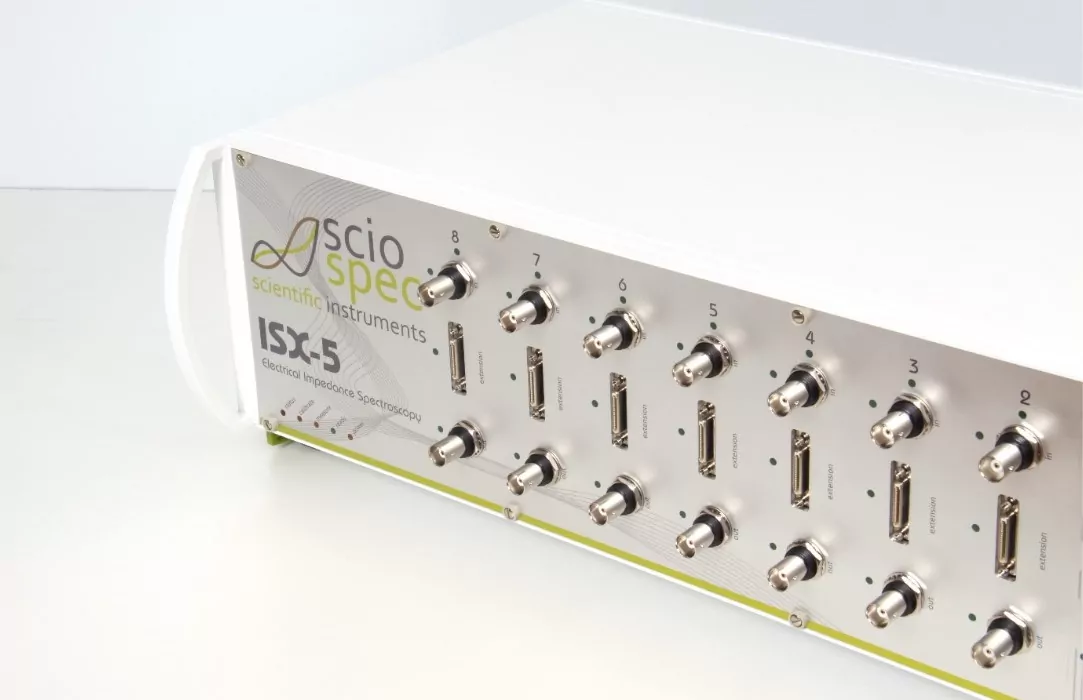
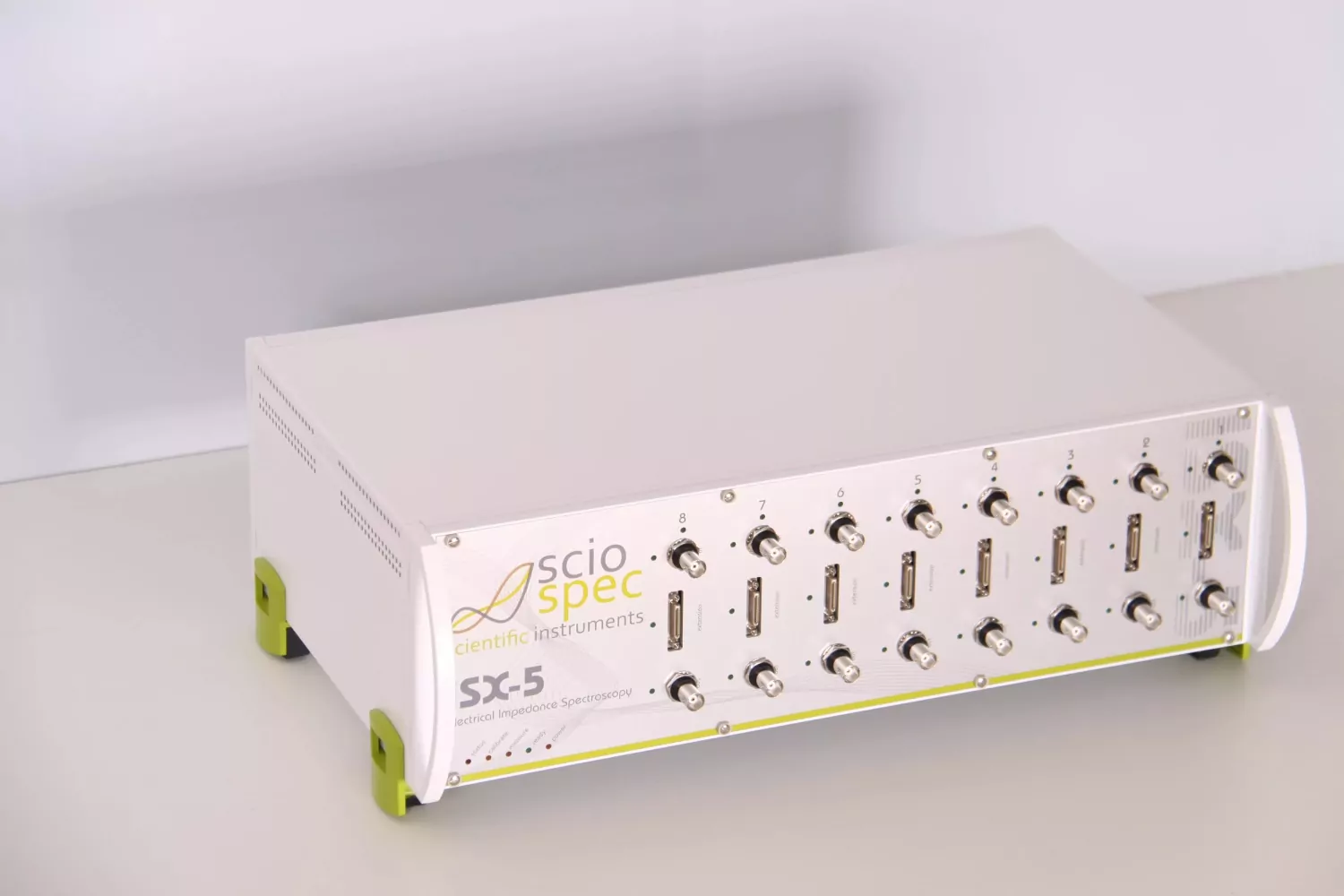
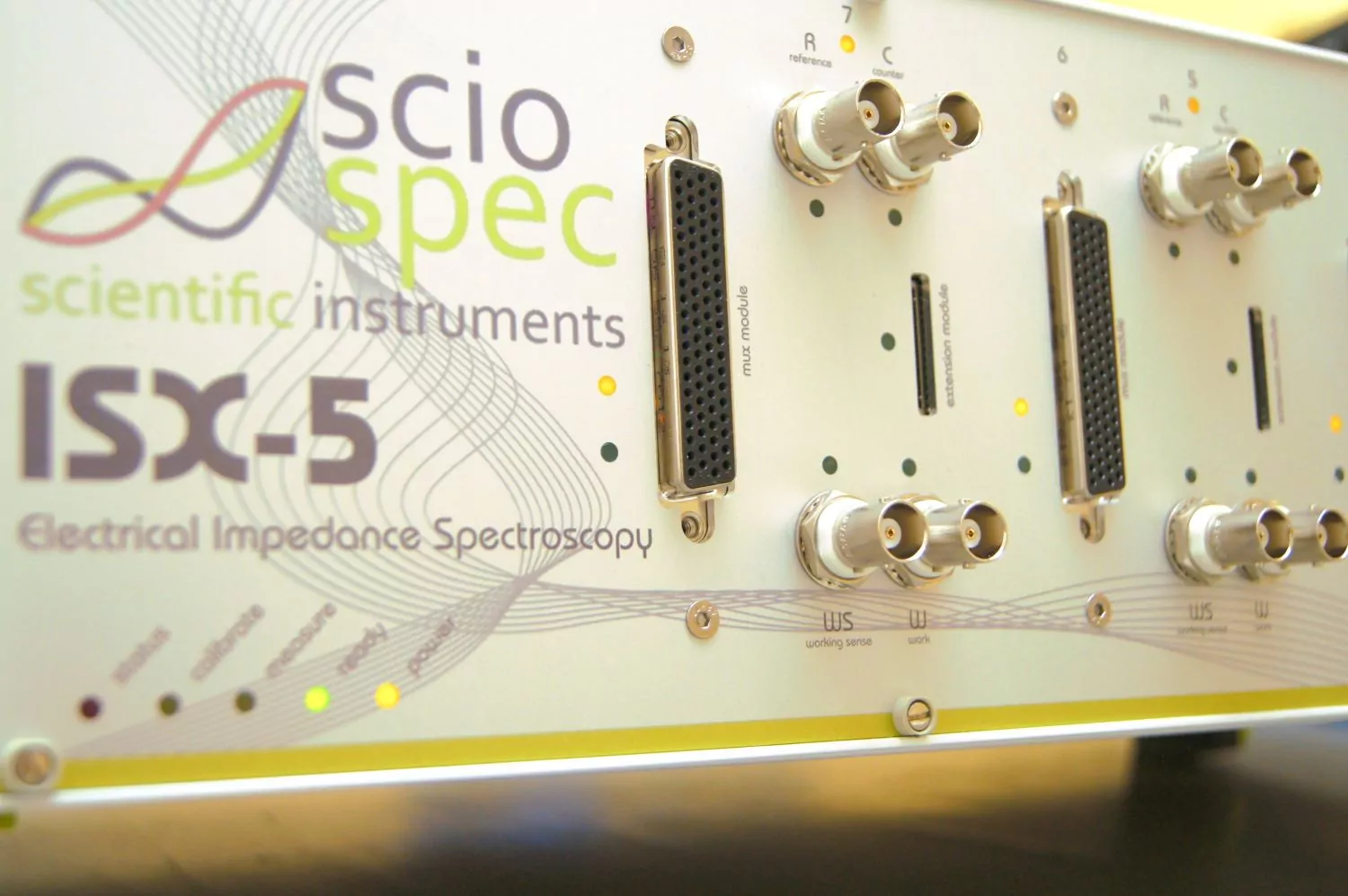
The ISX-5 combines up to eight independent EIS measurement modules in one chassis.
Each module provides full broadband impedance spectroscopy and can run synchronously with the others or use its own measurement configuration.
Use the ISX-5 when several impedance measurements need to run in parallel. Add MUX32/64 behind individual modules where the same system also needs larger numbers of sequential measurement positions.
The tightly synchronized module timing keeps simultaneous events aligned across channels and enables phase-consistent cross-module excitation and measurement for complex impedance applications.
- Up to 8 independent true-parallel EIS measurement modules in one chassis
- Tightly synchronized low-level signal timing across modules for matched timing and phase-consistent cross-module measurements
- 100 mHz to 10 MHz standard EIS per module, with up to 2048 frequency points per sweep
- Combine parallel modules with MUX32/64 for hybrid systems - up to 512 connected positions with 8 x MUX64, configuration dependent
Need many stable positions but not parallel acquisition? An ISX-3 with MUX may be the simpler route.
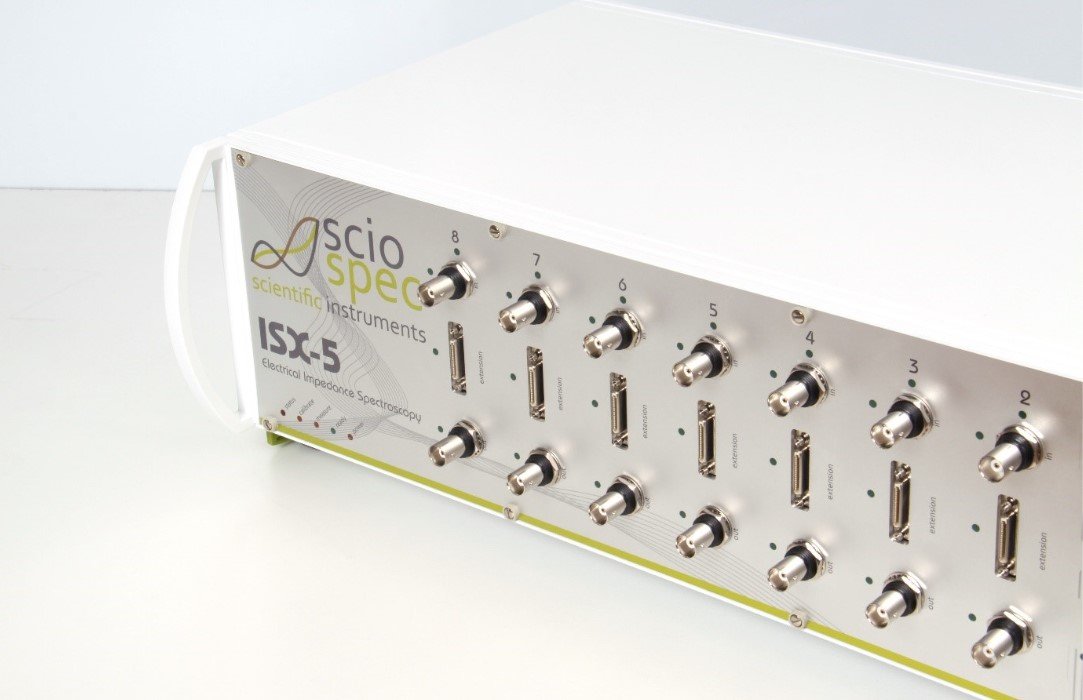
Up to 8
INDEPENDENT EIS MODULES Dedicated measurement modules acquire several impedance paths in parallel rather than switching one analyzer between inputs.
Tightly synchronized
MATCHED SIGNAL TIMING Low-level timing is aligned across modules for simultaneous events and phase-consistent cross-module measurements.
100 mHz–10 MHz
BROADBAND EIS PER MODULE Full impedance spectroscopy on every parallel measurement path.
Parallel + Mux
UP TO 512 CONNECTED POSITIONS Add MUX32/64 behind selected modules when the system also needs many sequential positions.
When is simultaneous measurement required?
A multiplexer lets one analyzer reach many positions by measuring them sequentially. That is usually the simplest and most efficient route when the DUTs remain stable during the scan.
ISX-5 uses independent measurement modules to acquire several impedance paths in parallel. This matters when samples change during acquisition, several responses must be compared through the same event, or running several complete measurements concurrently materially reduces experiment time.
BUYER RULE — If sequential measurements describe the experiment correctly, use multiplexing. If several impedance measurements really need to run together, use parallel EIS.
Sequential measurement
Channel 1 -> Channel 2 -> Channel 3 -> Channel 4
Best when many positions can be measured one after another.
Parallel measurement
Channel 1 =====\ Channel 2 =====\ Channel 3 =====\ Channel 4 =====\
Best when several impedance paths must be acquired over the same time window.
Complete EIS capability on every parallel path.
ISX-5 is not one analyzer with several simultaneous inputs. Each parallel path has its own complete impedance-measurement module, with matched low-level timing across modules.
That architecture gives you more than several measurements at once: it enables synchronized operation, independent channel configuration, cross-module measurements with preserved phase relationship and parallel throughput.
Run channels together
Coordinate several modules around the same measurement sequence, time window or experimental event.
Let each module match its DUT
Use different frequency programmes, excitation levels, electrode configurations or measurement settings on different modules.
Keep complex impedance meaningful across modules
Because module timing is tightly synchronized, excitation from one module can be measured by another while preserving the phase relationship needed for complex impedance.
Run several full spectra at once
Acquire several complete EIS measurements concurrently even where strict simultaneity is not the only reason for the system.
One module per parallel path
Module 1 -> DUT 1 · Module 2 -> DUT 2 · Module 3 -> DUT 3 · ... · Module 8 -> DUT 8
Each module provides an independent EIS path.
More than eight parallel paths
For applications requiring more than eight parallel EIS modules, multi-chassis architectures can be engineered application-specifically.
A parallel multichannel platform built on the ISX-3 measurement core
The ISX-5 combines up to 8 parallel IF channels with a powerful DSP backend, the ExtensionPort and the Sciospec software stack — a platform designed to raise throughput and channel count without compromising lab-grade EIS performance.
Parallel IF channels
UP TO 8 / CHASSIS
Truly parallel impedance channels with per-channel parameters
Up to 8 fully-featured IF channels per ISX-5 chassis run synchronously or independently, each with its own frequency list, amplitude and DC bias. Multiple analysis ports can share a single excitation source for advanced electrode arrangements.
DSP backend
HIGH-THROUGHPUT BACKEND
All channels active — without throughput penalty
A powerful signal-processing backend keeps every channel fast, even when all are active. Channel-to-channel synchronization and an ultra-fast hardware sync (sync in/out) enable cascaded multi-chassis setups for higher channel counts.
ExtensionPort + software
INTEGRATION & AUTOMATION
Open interfaces for custom front-ends and automation
The ExtensionPort exposes 2/3/4-electrode signals and digital IOs to application-specific front-ends. The Sciospec software suite and COM API integrate the ISX-5 with Java, C, Python, LabVIEW and MATLAB for automated, high-throughput workflows.
Full EIS capability on every parallel path.
Configure up to eight independent measurement modules in one chassis. Run modules synchronously, use independent measurement settings where required and add multiplexing behind selected modules where the system also needs sequential positions.
Parameter
Specification
Details
MULTICHANNEL ARCHITECTURE
Parallel measurement modules
Up to 8 in one chassis
Each module provides its own complete EIS measurement path.
Module timing
Tightly synchronized low-level signal timing
Align simultaneous events across channels and preserve phase relationship for cross-module measurements.
Measurement mode
Synchronous or independent operation; individual settings per module
Run modules together or use different measurement programmes and excitation settings where required.
Hybrid expansion
MUX32 / MUX64 behind selected modules; up to 8 multiplexers
Combine parallel acquisition with sequential expansion; up to 512 connected positions with 8 x MUX64.
Larger parallel systems
Application-specific multi-chassis architectures
For projects needing more than 8 parallel paths.
Synchronization
Hardware sync input/output and external control options
Coordinate EIS acquisition between modules, chassis and external experiment events.
IMPEDANCE SPECTROSCOPY
Frequency Range
100 mHz – 10 MHz
Broadband EIS per measurement module; extended-frequency configurations by technical review.
Frequency points
1 ... 2048 per sweep
Detailed linear, logarithmic and block-wise frequency programmes.
Impedance Range
mOhm ... GOhm specified
Use the accuracy contour for the actual impedance/frequency operating region.
Magnitude accuracy
0.1% specified
Broad central reference region reaches 0.01% under documented conditions.
Phase accuracy
0.1°
Specified phase accuracy for EIS.
Voltage excitation
1 mV ... 1 V peak
Controlled voltage excitation.
Current excitation
10 µA ... 10 mA peak
Controlled current excitation.
Electrode configurations
2-, 3- and 4-electrode
Adapt topology to the DUT and connection effects.
DC bias
±1 V
Configuration and combined excitation/bias limits apply.
CONTROL & INTERFACES
Computer interface
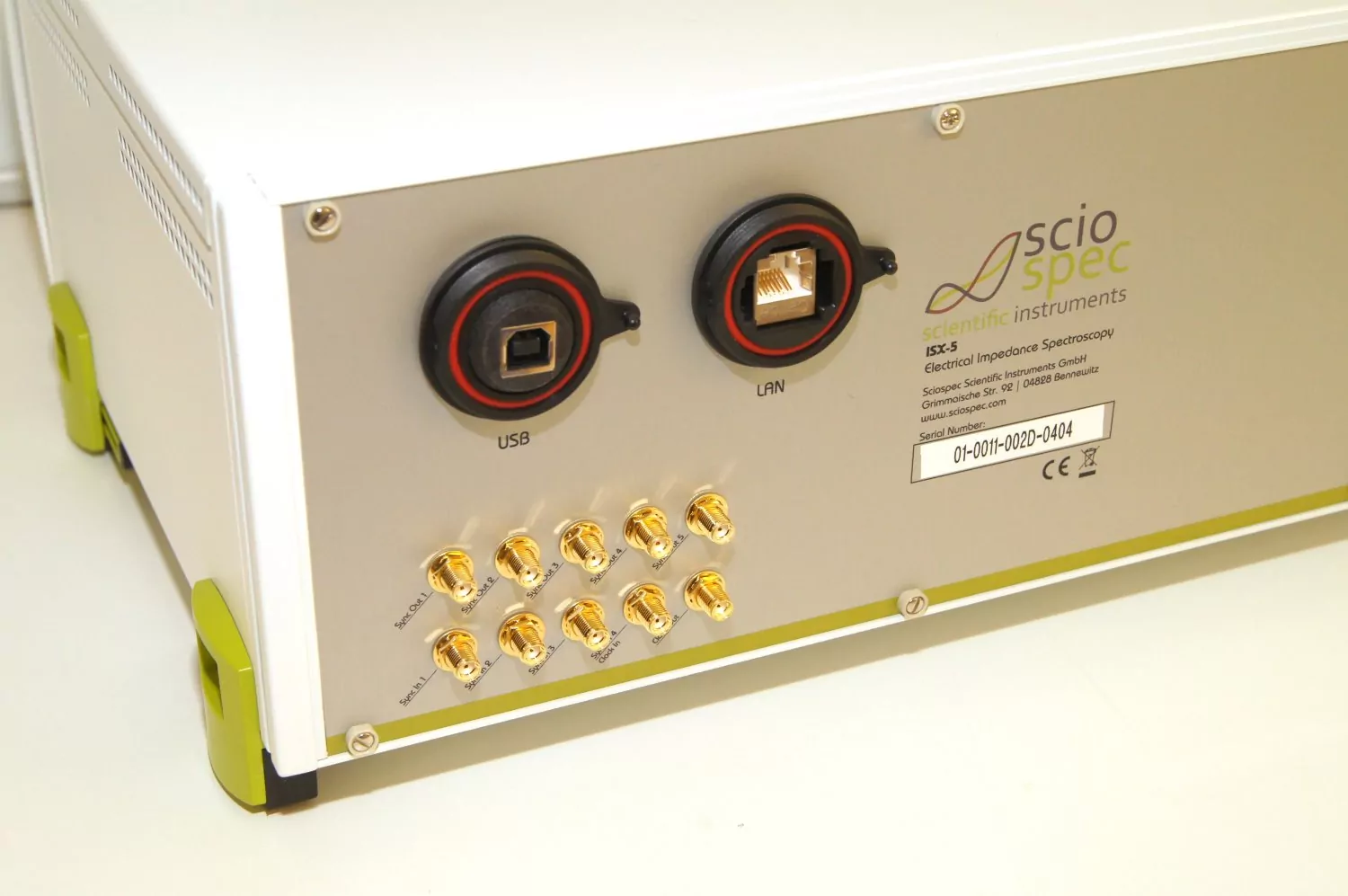
USB and Ethernet
PC operation and programmatic control.
Application interface
ExtensionPort / front-panel connector options
Application-specific frontends, adapters and sensor interfaces where required.
Connector options
BNC, SMA, MCX, banana plug, DSUB or custom, configuration dependent
Select the physical interface around the DUT and channel architecture.
High accuracy across a wide EIS measurement range.
The useful performance of each ISX-5 measurement module depends on the combination of frequency, impedance and the complete connection path. The accuracy contour is therefore more meaningful than a single best-case number.
For hybrid systems, multiplexers, cables, fixtures and application-specific frontends become part of the real measurement chain and should be reviewed where the operating point is demanding.
Check the actual impedance/frequency region
Show the released ISX accuracy contour and highlight the region relevant to the parallel experiment.
Show why matched module timing matters
Use a dynamic DUT or cross-module example to demonstrate matched event timing and phase-consistent acquisition.
Where parallel EIS makes the difference.
ISX-5 is strongest when several samples, sensors or measurement sites need to be acquired concurrently, compared through the same event or measured with phase-consistent relationships between modules.
Compare several sites or samples while they are changing
Use parallel EIS for cultures, tissues, biochips or physiological models where several regions or conditions respond during the same experiment.
Measure several sensors responding to the same stimulus
Acquire multiple sensor channels in parallel when the response timing or channel-to-channel comparison is part of the result.
Run several complete measurements concurrently
Compare samples during temperature changes, fluidic events, chemical exposure, mechanical stimulation or other controlled conditions.
Observe several locations with a common time reference
Use parallel modules where different regions, electrode groups or measurement paths need to be compared without scan-order delay.
Preserve phase relationships across modules
Use tightly synchronized modules when excitation and sensing span different modules and complex impedance phase must remain meaningful.
Coordinate EIS with the rest of the system
Combine parallel acquisition with external control, synchronization and software integration when impedance measurement is one part of a larger experiment.
APPLICATION INTERFACE — ISX-3 + real adapter/frontend: MEArack proves that application adaptation is real hardware, not a promise.
Up to 8 parallel paths. Up to 512 connected positions.
Each ISX-5 measurement module can also be combined with a MUX32 or MUX64. This allows the system to keep independent parallel measurement paths where they are needed while adding sequential positions behind each module.
With eight MUX64-equipped modules, one ISX-5 chassis can address up to 512 connected positions while retaining up to eight independent parallel EIS paths. Larger multiplexed configurations, such as 128 ports per module, are possible as application-specific systems.
8 parallel measurements
Each module connects directly to one DUT or measurement path.
4 parallel groups · up to 128 connected positions
Four modules remain parallel; positions behind each MUX are measured sequentially.
8 parallel groups · up to 512 connected positions
Eight modules remain parallel; each module can scan up to 64 positions sequentially.
Configure your ISX-5
Start with the impedance paths that truly need parallel measurement. Then define any multiplexed positions, measurement settings, interfaces and synchronization requirements.
Loading configurator…
From a benchtop ISX-5 to your high-throughput OEM platform
When you move from benchtop to product, we help migrate the ISX-5 architecture into dedicated OEM electronics with tailored firmware, connectors and certifications for your target environment.
- 01
Throughput validation
Validate your high-throughput method on a standard ISX-5 with the chosen channel count, multiplexers and software stack.
- 02
Custom front-end & fixtures
Attach application-specific front-ends and fixtures through the ExtensionPort for your wells, electrodes or sensors.
- 03
Embedded OEM platform
Migrate the ISX-5 architecture into a dedicated multichannel OEM platform with tailored electronics, firmware and connectors.
Published reference
ISX-3 tracking conductivity changes in plant tissue exposed to PEFs
ISX-5 in real high-throughput workflows
Challenge
Track interfacial behaviour in microfluidic channels with broadband impedance, across multiple measurement sites in parallel.
SCIOSPEC ROLE
The ISX-5 provides the parallel multichannel EIS backend, per-channel parameters and synchronized sweeps used throughout the study.
RESULT
A publishable multichannel workflow linking impedance signatures to microfluidic interfacial behaviour.
USER VOICE
- "More performance, higher throughput, more channels — the ISX-5 is the solution for everyone who wants to raise the bar a little higher."
Sciospec product team
[Specific user attribution needed]
Additional published work covers prostate cancer gene detection, DNA characterization and toxin-induced cell damage — all using the ISX-3 as the EIS platform.
Software for parallel EIS, module setup, MUX routing and system control.
Configure spectra, module settings and electrode topology in the ISX software. For more complex systems, define multiplexed paths, coordinate acquisition and integrate the analyzer through USB, Ethernet, sync and I/O routes.
Configure several modules
Set frequency programmes, excitation, precision and topology across the independent measurement modules.
Run modules together or separately
Coordinate channels for matched timing or configure different measurement programmes where the DUTs require it.
Add sequential positions where needed
Configure C, R, WS and W roles across direct and multiplexed paths.
Integrate with the experiment
Use command control, synchronization and I/O when EIS acquisition is part of a larger automated setup.
Not every multichannel impedance setup needs ISX-5.
Many positions, sequential measurement
Use when samples or electrode positions can be measured one after another and parallel acquisition is not needed.
One primary EIS path
Use when one impedance path is enough and the setup does not need parallel channels.
Spatial EIS / tomography
Use when multi-electrode spatial acquisition and detailed spectroscopy belong together.
Dense sensor topology and electrochemistry
Use when 64-port sensor routing, electrochemical modes and a compact hybrid architecture fit better.
Build parallel EIS into your own instrument or test system.
Establish the parallel measurement
Use ISX-5 to determine how many impedance paths need parallel acquisition, which can be multiplexed and which timing and measurement settings matter.
Stabilise the application setup
Fix the channel map, DUT interface, synchronization, software workflow and automation around the proven measurement.
Move into dedicated hardware where justified
Use the validated requirements to scope dedicated electronics, firmware, software, mechanics and production implementation.
ISX-5 FAQ
What is the ISX-5?
The ISX-5 is Sciospec’s true-parallel multichannel impedance analyzer. It combines up to eight independent EIS measurement modules in one chassis so several impedance paths can be acquired in parallel rather than scanned sequentially.
How is ISX-5 different from ISX-3 with a multiplexer?
An ISX-3 with MUX uses one analyzer and switches it between positions. ISX-5 uses dedicated measurement modules for the paths that need to be acquired in parallel. Use MUX when many positions can be measured one after another; use ISX-5 when several paths need parallel acquisition – and combine parallel modules with MUX when the experiment needs both.
Do I need ISX-5 just because I have many samples?
Not necessarily. If the samples are stable enough for sequential scanning, ISX-3 + MUX may be the simpler and more cost-effective route. ISX-5 is justified when timing, dynamic change, phase-consistent cross-module measurement or parallel throughput matters.
What does tight synchronization between modules enable?
The measurement modules are synchronized at low-level signal timing. This aligns simultaneous events across modules and enables cross-module excitation and sensing while preserving the phase relationship required for complex impedance measurements.
Can ISX-5 also use multiplexers?
Yes. ISX-5 can combine several independent measurement modules with a MUX32 or MUX64 behind each module. An 8-module system with eight MUX64s can address up to 512 connected positions: the eight primary modules remain the parallel measurement paths, while positions behind each MUX are measured sequentially. Larger multiplexed configurations, such as 128 ports per module, can be reviewed application-specifically.
What if I need more than eight parallel paths?
More than eight parallel measurement modules can be achieved through application-specific multi-chassis architectures. These should be reviewed around the timing, synchronization, interface and software requirements of the application.
What frequency and impedance range does ISX-5 cover?
The standard ISX measurement platform covers 100 mHz to 10 MHz and a specified impedance range from mOhm to GOhm. Extended-frequency configurations can be reviewed where the complete interface supports them.
Can each channel use different settings?
Yes. Parallel modules can run synchronously or use different measurement parameters where the experiment requires it. Frequency programmes, excitation and other settings can therefore be adapted per measurement module rather than forcing every path into one identical programme.
Can I automate an ISX-5 setup?
Yes. The system can be controlled through the Sciospec communication interface and integrated with external equipment using synchronization and I/O options where required.
When should I choose ISX-3 instead?
Choose ISX-3 when one impedance path is enough, or when many positions can be measured sequentially with a multiplexer. Choose ISX-5 when several impedance paths need parallel acquisition, tightly synchronized cross-module measurement or a hybrid system combining parallel measurement with additional multiplexed positions.
Can ISX-5 become part of a custom or OEM system?
Yes. ISX-5 can establish the parallel and multiplexed measurement requirements for a later dedicated system. Custom/OEM development remains a separate engineering stage once channel count, timing, interfaces and workflow are mature.
How would you like to continue?
Choose the next step that fits where you are in your project — from first conversation to OEM integration.
Tell us about your idea
Share your high-throughput project — we’ll help scope the right ISX-5 setup.
Configure your ISX-5
Choose the channel count, frequency range, multiplexer and options that match your throughput target.
Talk to us about OEM
Discuss embedded multichannel electronics and custom platforms built on the ISX-5 architecture.
Plan the right mix of parallel measurement and multiplexing.
Review the timing and channel architecture
Tell us which paths must run in parallel, how fast the samples change, whether cross-module measurement is required and how many additional positions can be sequential. We will recommend ISX-5, hybrid ISX-5 + MUX, multi-chassis review or ISX-3 + MUX.
Build your ISX-5 setup
Select the number of parallel modules, MUX options, interfaces and synchronization requirements and send the configuration for review and quotation.
Discuss custom integration
Use this route when parallel EIS is becoming part of a recurring test system, reader or OEM product.
Get in touch with us
Phone
Headquarters
Sciospec Scientific Instruments GmbH
Leipziger Str. 43b
04828 Bennewitz, Germany
Open in Google Maps