
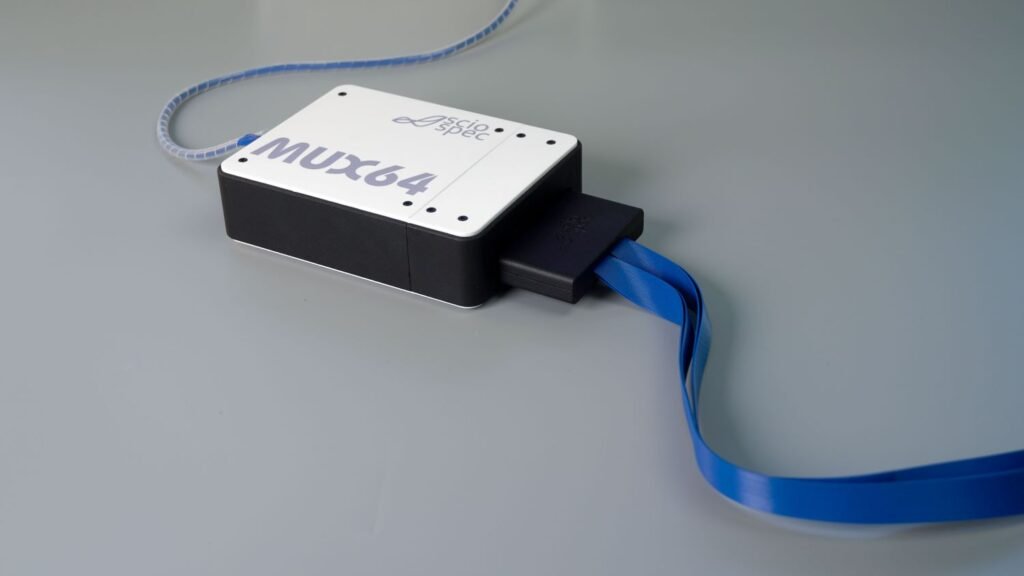
Functional multiplexing, , endless port combinations.
From 32 to 256+ channels — the perfect choice for impedance measurements in any sequential multichannel setup. Constraint-free any-to-any port assignments let you configure any 2/3/4-port combination you need, without the limits of conventional fixed-matrix multiplexers.
- Any-to-any functional multiplexing · 32 / 64 / 128 / 256+ channels
- High isolation, ultra-low parasitic switches — close to no cell loading
- External unit or integrated with ISX-3 / ISX-5 · SC98 edge-card standard
4 digital IOs with flexible functions through the Sciospec InterfacePort standard.
32 / 64 / 128 / 256+
Channels
> 10 TΩ ‖ 0.4 pF
Isolation
< 0.7 pF
Parasitics
≤ 200 mΩ on
Series R
A multiplexer family built around functional, software-defined switching
Available as an external unit (any ExtensionPort-compatible Sciospec analyzer) or integrated with ISX-3 / ISX-5. Defaults to MUX32 and MUX64, expandable to 128, 256 and beyond — with switch characteristics that don’t compromise the analyzer behind them.
Any-to-any switching
FUNCTIONAL MULTIPLEXING
Constraint-free 2 / 3 / 4-port combinations
Unlike conventional fixed-matrix multiplexers, the Sciospec MUX family lets you assign any port to any role — work, sense, counter, reference. Build 2-, 3- or 4-electrode configurations on the fly and switch polarities, scan potentials or realise EIT-style injection patterns from software.
Superior switch quality
LOW PARASITICS · HIGH ISOLATION
Close to no cell loading, even at MHz
> 10 TΩ ‖ 0.4 pF isolation, parasitic capacitance < 0.7 pF, max. 200 mΩ series resistance and zero leakage / charge injection on — perfect for high-accuracy, high-bandwidth EIS in 2/3/4-electrode configurations.
SC98 edge-card standard
FLEXIBLE CONNECTIVITY
Adapter cards, sensor carriers and coax breakouts
SC98 is easy to use, cost-optimised and highly flexible. Choose stock connectors, design your own (data shared with your team) or have Sciospec build a custom carrier — direct PCB-based sensor carriers, SC98-to-SC98 extension cables, AC coupling and filtering networks all supported.
Technical Specifications
Core specifications for the Sciospec multiplexer family. Full datasheet available on request.
Parameter
Specification
Notes
CHANNELS & CONFIGURATION
Channel counts
32 · 64 · 128 · 256+
MUX32 / MUX64 defaults; expandable
Switching mode
Any-to-any functional
2 / 3 / 4-port combinations
Form factor
External or integrated
Standalone, or with ISX-3 / ISX-5
Connector standard
SC98 edge-card
Stock or custom carriers
SWITCH PERFORMANCE
Off / disconnect isolation
> 10 TΩ ‖ 0.4 pF
Power off or cell disconnect
Parasitic capacitance
< 0.7 pF
Close to no cell loading
Series resistance
≤ 200 mΩ
Connected state
Leakage / charge injection
Zero (on)
No distortion, thermal-limited noise
INTERFACES
Analyzer link
ExtensionPort
Any compatible Sciospec analyzer
Digital IO
4 × DIO
Flexible via InterfacePort
Sensor carriers
Stock + custom
Direct PCB carriers, AC coupling, filters
Where the multiplexers fit in
Sequential multi-channel EIS, impedance mapping, EIT injection patterns on sensor arrays, battery and material testing, OEM screening platforms — anywhere you need a large, low-parasitic switch matrix in front of a Sciospec analyzer.
Sequential multi-channel EIS
Step through dozens to hundreds of channels with high-accuracy EIS — sensor arrays, MEAs, electrode strips, multi-well chips.
Impedance mapping & EIT
Use any-to-any switching to realise EIT-style injection patterns and reconstruct impedance maps on sensor arrays and MEAs.
Battery & material testing
Switch between cells, coupons or test fixtures without rewiring — accurate at MHz thanks to low parasitics and high isolation.
OEM screening platforms
Use the MUX core as the switching layer inside OEM impedance screening platforms — scalable from 32 to several hundred channels.
Configure your multiplexer
Pick channel count, external or integrated form factor, SC98 carrier type and add-ons — cables, AC coupling, custom carriers, EIT option and training.
Loading configurator…
Complete your setup
Pair the multiplexer with cabling, sensor carriers and front-end networks — built on the SC98 standard and the InterfacePort DIO conventions.
MUX cable set 1 m
Standard MDR-to-banana cable set with 32 crocodile clips — drop-in for bench setups. [Product-specific accessory image needed]
Details
MUX cable extension 1 m
Extension cable to reach larger fixtures and rack-mounted experiments without compromising signal integrity.
Details
Custom MUX cable
Built to your length, connectors and shielding requirements — co-engineered with the Sciospec team.
Details
Sensor carriers (SC98)
Direct PCB-based sensor carriers on the SC98 edge-card standard — stock layouts or custom designs.
Details
From a 32-port MUX to your OEM screening platform's switching core
When your experiment scales beyond a single bench unit, we migrate the MUX core into OEM hardware with tailored channel counts, sensor carriers, DIO routing and branding.
- 01
Prototype on stock MUX32 / MUX64
Start with stock channel counts and SC98 carriers — develop your measurement protocol and switching scheme on bench hardware.
- 02
Scale to 128, 256 or beyond
When the experiment grows, add channels and migrate to custom sensor carriers, AC coupling and front-end filtering as needed.
- 03
Integrate into an OEM screening platform
The MUX core becomes the switching layer inside an OEM product — tailored mechanics, connectors, DIO and branding.
Published reference
High-throughput cardiac safety screening — 96 to 576+ channels at 1 ms
From MUX32 prototypes to 576+ channel screening platforms
The same switching core that drives MUX32 / MUX64 bench setups powers Sciospec OEM cardiac safety screening platforms — simultaneous impedance and EFP recordings at 1 ms, scaling from 96 to 576+ channels.
Challenge
Give research and screening teams a large, low-parasitic switch matrix without compromising the high-accuracy EIS behind it.
SCIOSPEC ROLE
A multiplexer family with any-to-any switching, > 10 TΩ isolation and < 0.7 pF parasitics — same architecture used in industrial cardiac safety and TEER platforms.
RESULT
Teams scale from 32-port bench prototypes to 576+ channel OEM screening products on a single switching architecture.
USER VOICE
- "Any-to-any port assignments free you from the constraints of conventional multiplexers — switch polarities, scan potentials, run impedance mapping, do EIT on top of your data."
Sciospec applications team
[Specific user attribution needed]
Additional work covers Organ-on-Chip TEER monitoring (Merck, Roche), modular EIT systems on Sciospec EIT16 and IWIS training on impedance instrumentation — all on the same impedance core the multiplexers sit in front of.
Individual FAQ
Short technical answers to the questions we hear most often about the Sciospec multiplexer family.
What channel counts are available?
MUX32 and MUX64 are the defaults; expandable to 128, 256 and beyond depending on your application and form factor.
What does 'any-to-any functional multiplexing' mean?
Each port can be assigned to any electrode role (work / sense / counter / reference) on the fly. You can build arbitrary 2-, 3- or 4-electrode configurations, switch polarities, scan potentials and realise EIT-style injection patterns — all from software, without rewiring.
How good are the switch characteristics?
> 10 TΩ ‖ 0.4 pF isolation at power off or selected cell disconnect, parasitic capacitance < 0.7 pF, max. 200 mΩ series resistance on, zero leakage current and zero charge injection — no distortion, no noise beyond thermal noise.
Can the multiplexer be integrated into an analyzer?
Yes. Available as an external unit on any ExtensionPort-compatible Sciospec analyzer, or integrated with the ISX-3 / ISX-5 in a single enclosure.
What about custom sensor carriers?
SC98 is open by design. Pick stock connectors, design your own carrier (we share the design data), or have Sciospec build a custom carrier with AC coupling, filtering or application-specific routing.
Are digital IO and triggers available?
Yes — 4 digital IOs with flexible functions through the Sciospec InterfacePort standard, for triggering, syncing and controlling external instrumentation.
How would you like to continue?
Choose the next step that fits where you are — from first conversation to scaling from MUX32 prototypes to OEM screening platforms.
Tell us about your channel count
Share the analyzer, sensor and channel count you need — we’ll help scope the right MUX configuration.
Configure your multiplexer
Pick channel count, form factor, SC98 carrier and add-ons — cables, AC coupling, custom carriers, EIT option.
Need the analyzer too?
The ISX-3 and ISX-5 pair natively with the Sciospec MUX family — start from the analyzer side if you’re building a full setup.
Get in touch with us
Phone
Headquarters
Sciospec Scientific Instruments GmbH
Leipziger Str. 43b
04828 Bennewitz, Germany
Open in Google Maps