At a glance
Three-dimensional (3D) in vitro cell culture models serve as valuable tools for accurately replicating cellular microenvironments found in vivo. While cell culture technologies are rapidly advancing, the availability of non-invasive, real-time, and label-free analysis methods for 3D cultures remains limited. To meet the demand for higher-throughput drug screening, there is a demanding need for analytical methods that can […]
Full reference article
Three-dimensional (3D) in vitro cell culture models serve as valuable tools for accurately replicating cellular microenvironments found in vivo. While cell culture technologies are rapidly advancing, the availability of non-invasive, real-time, and label-free analysis methods for 3D cultures remains limited. To meet the demand for higher-throughput drug screening, there is a demanding need for analytical methods that can operate in parallel. Microelectrode systems in combination with microcavity arrays (MCAs), offer the capability of spatially resolved electrochemical impedance analysis and field potential monitoring of 3D cultures. However, the fabrication and handling of small-scale MCAs have been labour-intensive, limiting their broader application. To overcome this challenge, we have established a process for creating MCAs in a standard 96-well plate format using high-precision selective laser etching. In addition, to automate and ensure the accurate placement of 3D cultures on the MCA, we have designed and characterized a plug-in tool using SLA-3D-printing. To characterize our new 96-well plate MCA-based platform, we conducted parallel analyses of human melanoma 3D cultures and monitored the effect of cisplatin in real-time by impedance spectroscopy. In the following we demonstrate the capabilities of the MCA approach by analysing contraction rates of human pluripotent stem cell-derived cardiomyocyte aggregates in response to cardioactive compounds. In summary, our MCA system significantly expands the possibilities for label-free analysis of 3D cell and tissue cultures, offering an order of magnitude higher parallelization capacity than previous devices. This advancement greatly enhances its applicability in real-world settings, such as drug development or clinical diagnostics.
Learn more about the ISX-3 impedance analyzer
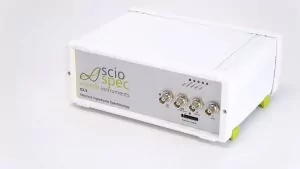
Class-Leading Impedance analyzer, the Sciospec ISX-3