Case summary
At a glance
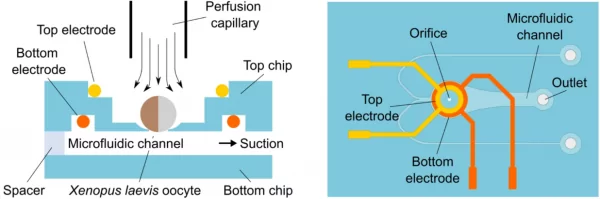
The Aachen Fast Ion Channel Sensor (AFIS) system enables rapid, non-invasive analysis of ligand-gated ion channels in Xenopus laevis oocytes, streamlining high-throughput drug screening.
Full reference article
Why This Matters for Ion Channel Research and Drug Discovery
Ion channel kinetics are crucial in fields such as neuroscience, pharmacology, and drug development. Traditional methods like patch-clamp and TEVC require complex, invasive procedures that can limit throughput and reproducibility. This new research confirms that impedance-based techniques provide a promising alternative, making it possible to record fast ion channel responses with minimal cell perturbation.
Sciospec’s impedance measurement technology plays a central role in enabling this breakthrough. The ability to accurately measure rapid ion channel kinetics without disrupting cell integrity opens new possibilities for screening ligand-gated ion channels more efficiently than ever before.
Advancing Ion Channel Research with Sciospec's impedance analyzers
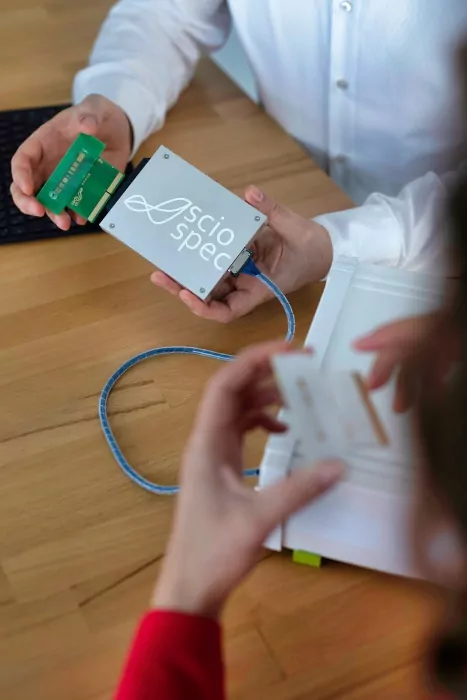
The recently published study showcases how the ISX-3 mini impedance analyzer helps obtaining high-precision, real-time data on ion channel kinetics. This compact yet powerful impedance spectrometer was used in the AFIS system to measure rapid ligand-gated ion channel responses with unparalleled accuracy, providing researchers with a non-invasive alternative to patch-clamp methods. By integrating seamlessly into workflows such as drug screening with ion channels, EIS technology allows for:
- Non-invasive electrophysiology methods that preserve cell viability
- EIS vs. patch-clamp comparisons, demonstrating robust performance
- High-throughput screening capabilities for pharmaceutical research
- Alternatives to patch-clamp that reduce the complexity of traditional electrophysiology
Looking for more answers? Keep reading to learn more. We also have a detailed FAQ section further down. Or take the shortcut and directly reach out to us.
The Technology behind this
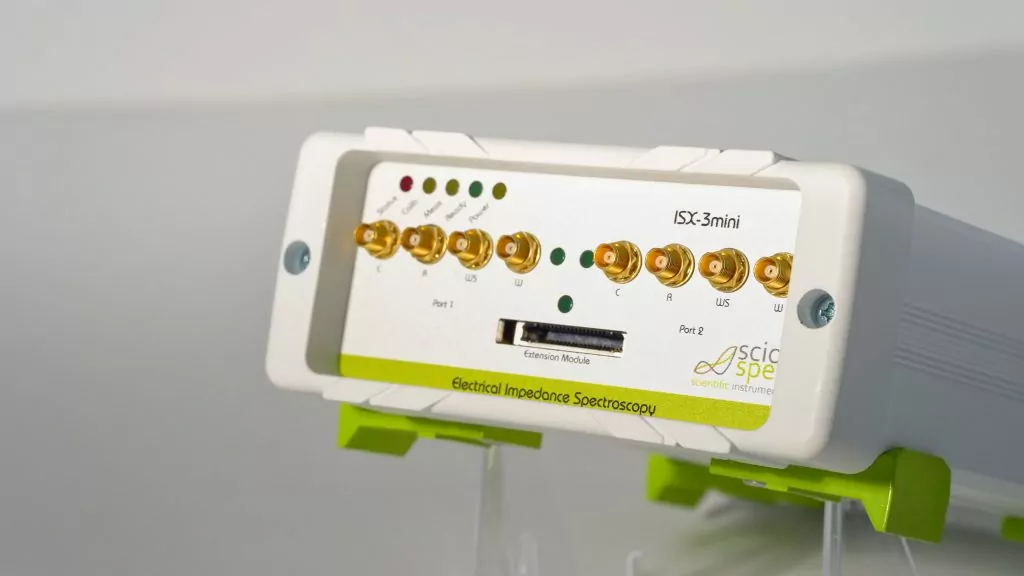
The ISX-3 mini is an ideal choice for most advanced impedance measurement challenges and trusted by researchers and engineers all around the world. It is also the very same instrument that enabled the groundbreaking research featured in this publication .The instrument’s combination of ultra-fast measurement speeds and high accuracy makes it perfect for ion channel research.
For flawless integration into your application choose from our many sensor & chip adapters or talk to us for custom integrations. Need to scale up? No problem – we offer compatible multiplexers and multichannel impedance analyzers.

Want to dive deeper? Talk to our experts!
Experience the Future of Ion Channel Kinetics with EIS !
As the field of electrophysiology continues to evolve, impedance-based techniques offer exciting new pathways for fast ion channel analysis and drug screening. This latest publication confirms the accuracy and efficiency of EIS in recording ion channel kinetics, providing researchers with a powerful, scalable alternative to traditional methods.
As the field of electrophysiology continues to evolve, impedance-based techniques offer exciting new pathways for fast ion channel analysis and drug screening. This latest publication confirms the accuracy and efficiency of EIS in recording ion channel kinetics, providing researchers with a powerful, scalable alternative to traditional methods.
💡Curious for more? Check out our latest developments and products.
🧪Want to try it yourself? Contact us for more information
🚀Looking for a tailored solution? Our experts can help!
📢 Follow us on LinkedIn for more updates.
Explore Related Research and Insights
explore by relevant keywords
…or just browse our most recent posts:
Get in touch with us
Frequently asked questions
What is the Aachen Fast Ion Channel Sensor (AFIS) system?
The Aachen Fast Ion Channel Sensor (AFIS) system is a microfluidic lab-on-a-chip device designed for high-throughput, non-invasive ion channel recordings. It enables fast and accurate electrical impedance spectroscopy (EIS) measurements of ligand-gated ion channels in Xenopus laevis oocytes, offering an efficient alternative to traditional electrophysiology methods. The AFIS system’s microfluidic design allows for parallel measurements across multiple samples, making it ideal for high-throughput screening in pharmaceutical research.
How is electrical impedance spectroscopy used in ion channel research?
EIS measures changes in electrical properties when ion channels open and close, providing real-time insights into ion channel activity without requiring invasive. Learn more about Electrical Impedance Spectroscopy here
What are the advantages over patch clamp methods?
EIS offers several advantages over traditional patch-clamp techniques. Unlike patch-clamp which requires complex microelectrode insertion and highly skilled operation, EIS is a non-invasive method that preserves cell viability and allows for high-throughput screening. As an alternative to patch-clamp, EIS provides a method for measuring ion channel activity without the need for direct electrode contact making it particularly useful for long-term studies and applications where high cell viability is crucial.
How does EIS compare to traditional electrophysiology methods?
EIS offers a non-invasive, high-throughput alternative to TEVC and patch-clamp providing similar sensitivity for rapid ion channel kinetics while eliminating the need for microelectrode impalement. EIS vs. patch-clamp: Unlike patch-clamp which requires complex and invasive microelectrode insertion, EIS enables dynamic and real-time measurements of ion channel activity without damaging the cell membrane. This makes EIS a more scalable method allowing for high-throughput screening while maintaining the precision needed for accurate ion channel research.
What are the benefits of using impedance-based techniques for drug screening?
EIS enables fast, high-throughput measurements, reducing the time and complexity associated with conventional electrophysiology methods while maintaining accuracy in measuring ion channel responses.
Can EIS provide accurate measurements of fast ion channel kinetics?
Yes! This publication confirms that EIS can reliably detect fast ligand-gated ion channel activity offering an effective tool for impedance-based drug discovery.