Case summary
At a glance
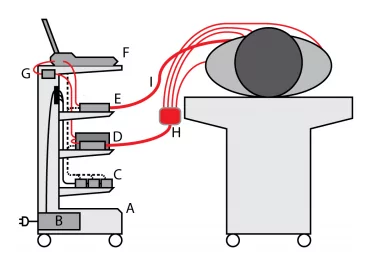
The ISX-3 used for electrode impedance recordings
Full reference article
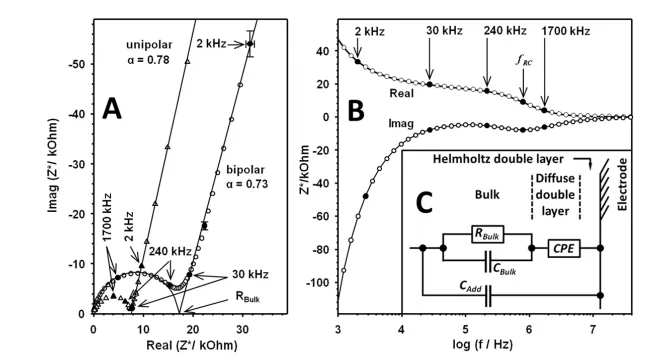
An animal model of deep brain stimulation (DBS) was used in in vivo studies of the encapsulation process of custom-made platinum/iridium microelectrodes in the subthalamic nucleus of hemiparkinsonian rats via electrical impedance spectroscopy. Two electrode types with 100-μm bared tips were used: i) a unipolar electrode with a 200-μm diameter and a subcutaneous gold wire counter electrode and ii) a bipolar electrode with two parallelshifted 125-μm wires. Miniaturized current-controlled pulse generators (130 Hz, 200 μA, 60 μs) enabled chronic DBS of the freely moving animals. A phenomenological electrical model enabled recalculation of the resistivity of the wound tissue around the electrodes from daily in vivo recordings of the electrode impedance over two weeks. In contrast to the commonly used 1 kHz impedance, the resistivity is independent of frequency, electrode properties, and current density. It represents the ionic DC properties of the tissue. Significant resistivity changes were detected with a characteristic decrease at approximately the 2nd day after implantation. The maximum resistivity was reached before electrical stimulation was initiated on the 8th day, which resulted in a decrease in resistivity. Compared with the unipolar electrodes, the bipolar electrodes exhibited an increased sensitivity for the tissue resistivity.