At a glance
Biomedical in vitro sensors use cell cultures grown on sensor chips for drug testing, toxicological screening, studying pathologic processes in tissue and for personalized medicine. Microfluidic systems and chips bridge the gap of the biological micro world to our accessible macro world, creating the interface between e.g., cells on a chip to reservoirs and pumps. […]
Full reference article
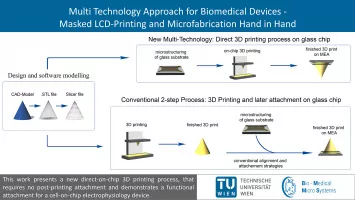
Biomedical in vitro sensors use cell cultures grown on sensor chips for drug testing, toxicological screening, studying pathologic processes in tissue and for personalized medicine. Microfluidic systems and chips bridge the gap of the biological micro world to our accessible macro world, creating the interface between e.g., cells on a chip to reservoirs and pumps. Prototype and low volume lab scale microfluidic devices have traditionally been realized by soft lithography using polydimethylsiloxane (PDMS) technology. Recently, rapid prototyping of microfluidic devices using direct 3D printing has become widely available. Usually, the 3D printed parts are (i) either stand-alone systems requiring only fluidic connections, or (ii) they need to be carefully aligned and skilfully attached to the rigid micro fabricated chip. This post-fabrication attachment is time-consuming and a frequent source of error. In this work the fabrication of the microchip and the microfluidic system have been integrated into a multi technology fabrication process. For the first time we demonstrate the “on-chip 3D printing” of a microfluidic attachment directly onto an in-house fabricated multi electrode array chip. The process uses a desktop-sized LCD resin printer and eliminates the time-consuming post-deposition alignment and attachment. Biocompatibility of the used resin was confirmed for murine fibroblasts and validates this multi technology approach for biomedical cell chips.
Learn more about the ISX-3 impedance analyzer
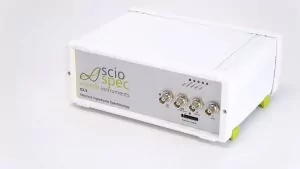
Class-Leading Impedance analyzer, the Sciospec ISX-3