
EIT16
Open, configurable EIT. Compact 16-channel platform.
The EIT16 combines simultaneous multichannel voltage acquisition with freely configurable injection patterns, multifrequency operation and open reconstruction workflows in a dedicated 16-channel Electrical Impedance Tomography system.
Use it for EIT method and algorithm development, dynamic functional imaging, sensor and electrode evaluation, chip-based EIT and feasibility studies – wherever 16 electrodes are enough and you want professional instrumentation without a closed imaging workflow or a home-built acquisition stack.
- 16 simultaneous voltage channels with freely configurable current injection
- Up to 100 fps and up to 128 measurement frequencies
- Sciospec reconstruction, custom matrices, raw data and EIDORS-compatible workflows
Need more electrode access? Explore EIT32/64/128+.
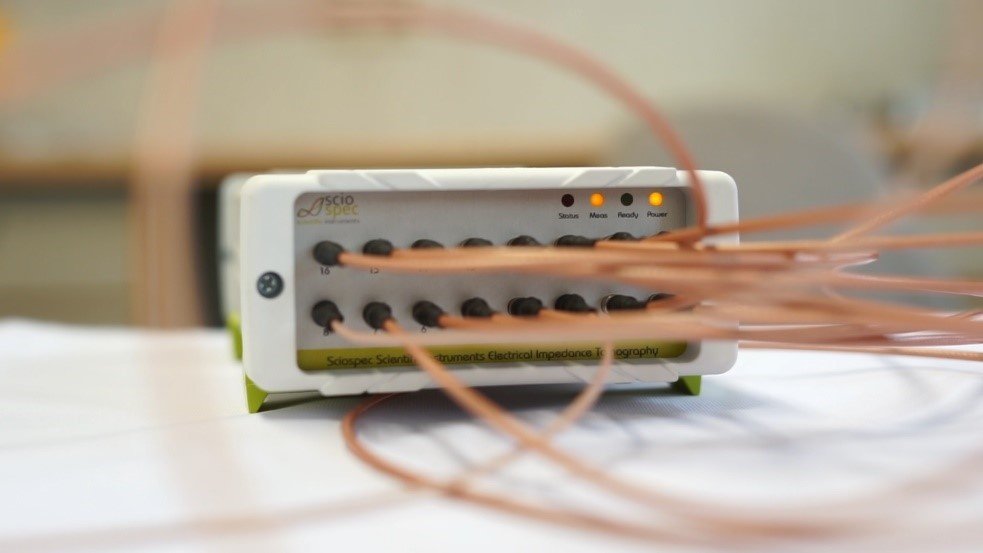
SYNCHRONOUS ACQUISITION
16 CHANNELS Sample all 16 channel voltages together during each active injection state.
INJECTION CONTROL
ANY-TO-ANY Choose any two electrodes as source and sink and define the injection sequence around your geometry.
FRAME RATE
UP TO 100 FPS Fast acquisition for dynamic experiments; complete-frame rate depends on the configured sequence and frequencies.
MULTIFREQUENCY EIT
UP TO 128 FREQUENCIES Run single- or multifrequency EIT across the released 100 Hz to 1 MHz range.
Simultaneous voltage acquisition. Flexible injection control.
High-quality EIT measurements require synchronized acquisition and precise control over current injection paths. The EIT16 is built around exactly that measurement cycle.
For each active injection state, the EIT16 selects two electrodes as current source and sink and acquires the voltage response across all 16 measurement channels synchronously. It then advances to the next freely configured injection pair. The complete sequence produces the frame data used for EIT reconstruction.
16-ELECTRODE ARRAY → SELECT SOURCE + SINK → INJECT CURRENT → SAMPLE ALL 16 CHANNEL VOLTAGES → NEXT INJECTION PAIR → COMPLETE SEQUENCE → EIT FRAME DATA → RECONSTRUCT / IMAGE
Stable acquisition for dynamic, time-sensitive imaging
All 16 measurement-channel voltages are sampled together during each current-injection state. This avoids channel-to-channel time skew within that state when the conductivity distribution changes quickly.
Build the injection pattern around your geometry
Choose any two electrodes as source and sink, then define the sequence that fits the electrode arrangement, stimulation strategy and research question.
Go beyond single-frequency imaging
Measure at one frequency or configure sweeps with up to 128 frequencies. Frequency-dependent data can add another contrast dimension; more frequencies also increase complete-frame acquisition time.
Use Sciospec imaging - or your own pipeline
Start with Sciospec time- or frequency-difference reconstruction, load a user-defined reconstruction matrix, or use raw frame data in MATLAB/EIDORS and custom analysis workflows.
16 dual-role electrodes
ANY-TO-ANY INJECTION
Truly simultaneous sampling on all 16 channels
16 dual-role electrode connections combine voltage measurement and current injection. Any combination of 2 out of 16 channels can serve as positive / negative injection — driven by a fast-switching, ultra-low-leakage reed-relay matrix.
Pseudo-differential source
100 nA – 10 mA PEAK
Wide-range excitation with tightly synchronized DAQ
Pseudo-differential current source delivers excitation signals up to 10 mA, with a tightly synchronized data acquisition path so every channel samples in lock-step — no software-side stitching, no per-channel skew.
SineFit + imaging
READY-TO-GO ALGORITHMS
Fast, precise signal extraction with built-in imaging
The Sciospec SineFit algorithm extracts amplitude and phase quickly and accurately, while the EIT software ships with ready-to-go imaging algorithms — so you can move from raw data to reconstructions out of the box.
Technical Specifications
Parameter
Specification
Details
EIT ARCHITECTURE
Electrode / measurement channels
16
Dual-role connections for voltage measurement and current injection
Voltage acquisition
16 channels synchronously sampled
During each active injection state
Current injection selection
Any-to-any; any 2 of 16 electrodes
Each electrode can be selected as source or sink in the configured injection sequence
Current source
Pseudo-differential
Dedicated EIT excitation architecture
Injection sequence
Freely configurable
User-defined source/sink sequence
MEASUREMENT
Frequency range
100 Hz – 1 MHz
Sweeps up to 128 frequencies
Frequency sweep
Up to 128 frequencies
Multifrequency EIT
Current excitation
100 nA – 10 mA peak
Configurable excitation amplitude
Frame rate
0.1 – 100 fps
Depends on injection sequence, frequencies and acquisition settings
Signal extraction
Sciospec SineFit
Real-time extraction of complex signal information
RECONSTRUCTION & DATA
Standard reconstruction
Time- and frequency-difference EIT
Ready-to-use Sciospec reconstruction
User-defined reconstruction
Custom reconstruction matrix
Can be used in the Sciospec workflow
Raw-data route
Raw frame data
For custom processing and reconstruction
External reconstruction
MATLAB / EIDORS-compatible route
For research and custom analysis workflows
APPLICATION / CONNECTION
Standard accessories
EIT cable set · phantom tank
For conventional 16-electrode EIT setups
Application interfaces
Multiple connector and custom cabling options
Configuration-dependent
Chip-based EIT
Slide-chip adapter / carrier route
Available for appropriate sensor formats
General multi-port impedance measurement
Supported architecture
Reconstruction is not mandatory for every multielectrode use
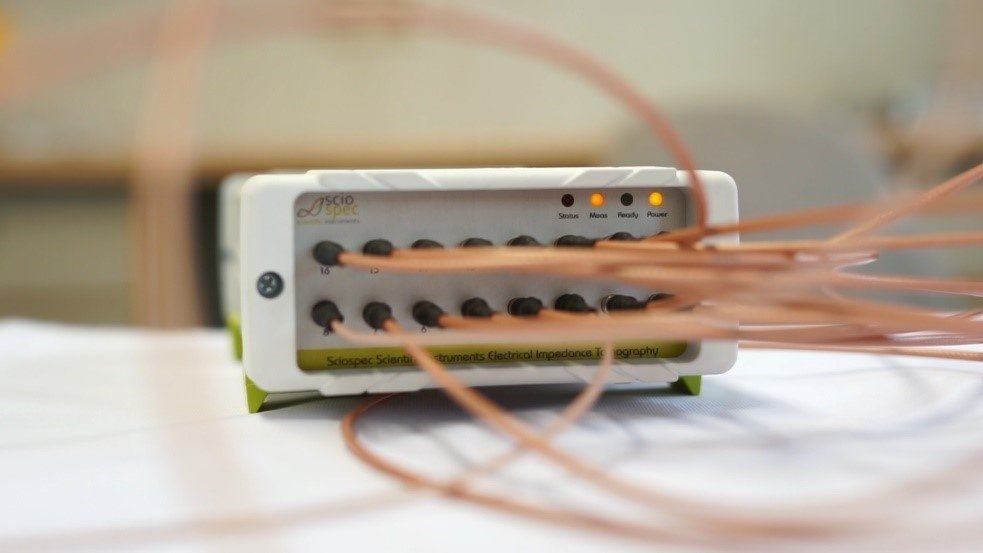
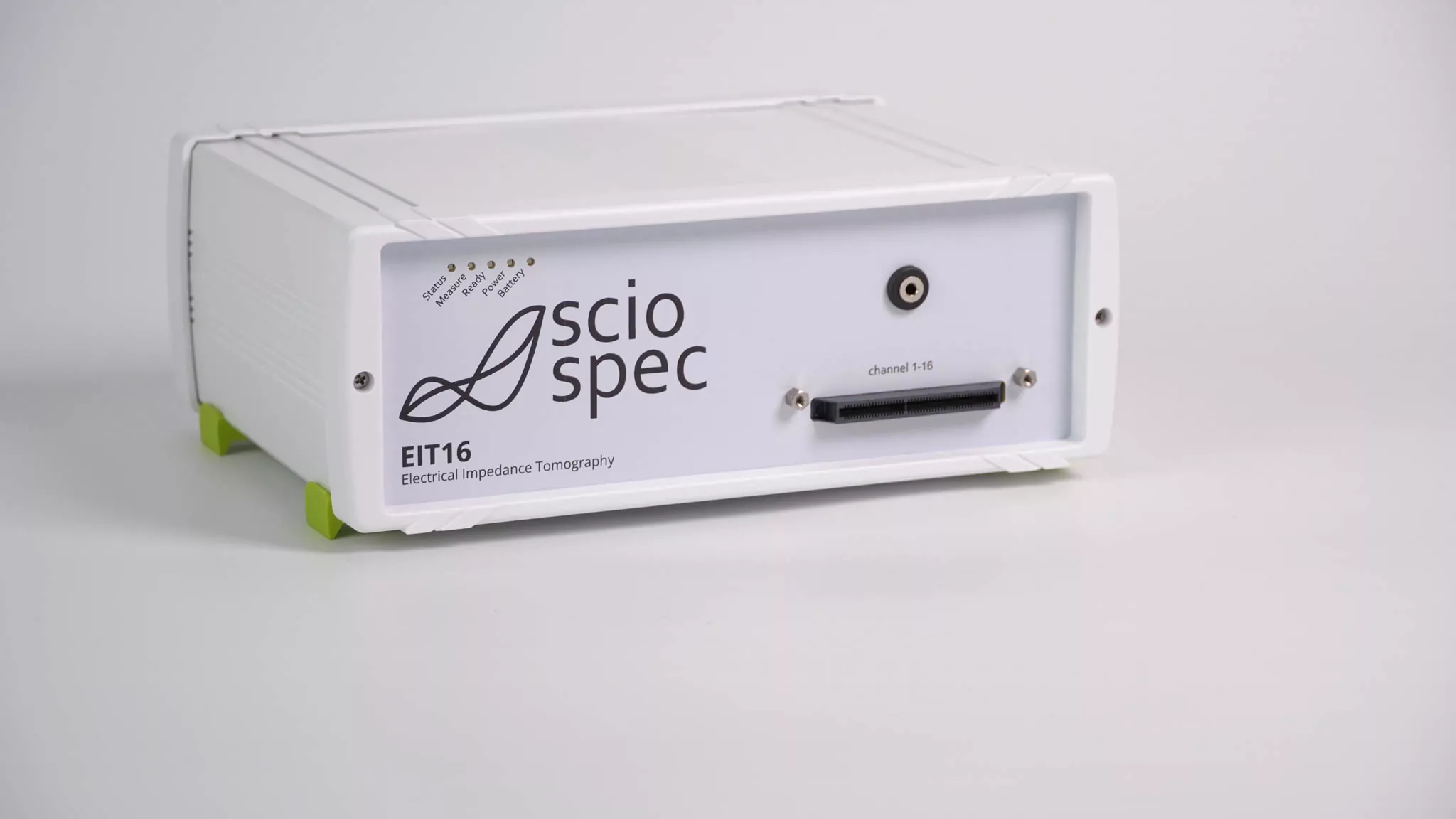
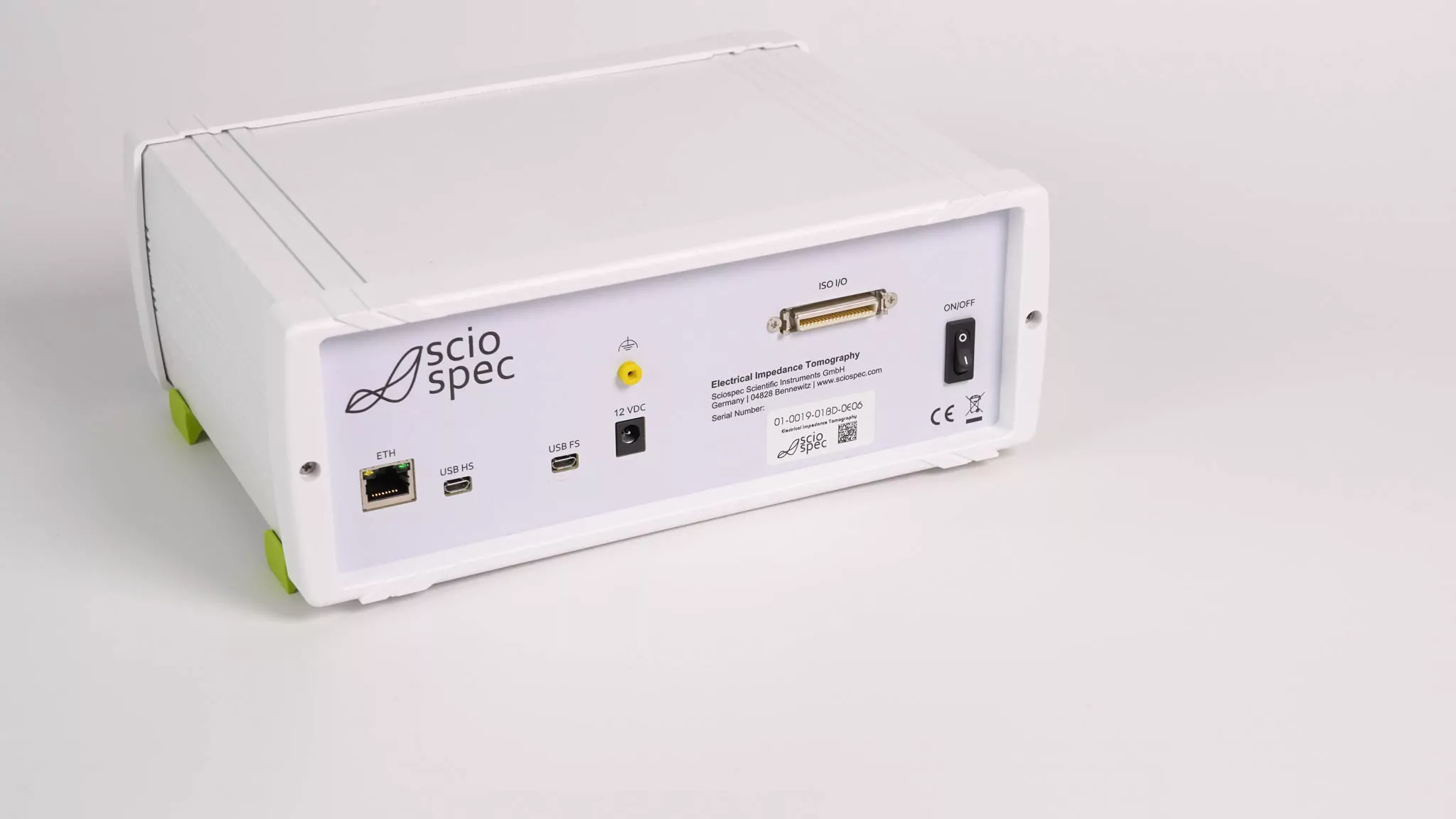
Where compact 16-channel EIT creates the most value
Change the method without rebuilding the acquisition hardware
Test injection patterns, frequencies, reference conditions and reconstruction algorithms on a professional 16-channel platform. Start with Sciospec reconstruction, then move into your own matrix or raw-data workflow as the research evolves.
Let the sensor evolve before you freeze the reader
Conductive elastomers, tactile surfaces, wearables and other distributed sensors often change electrode geometry during development. Keep the measurement platform stable while material, electrodes, stimulation and reconstruction are still being optimized.
Bring EIT into non-standard electrode geometries
Connect chip-based and microfabricated electrode structures through suitable carriers and interfaces. Freely configurable injection is especially valuable when the geometry no longer resembles a conventional peripheral electrode ring.
Track changing conductivity distributions over time
Use 16-electrode EIT for changing flows, material distributions and other electrically accessible processes where temporal information matters. Electrical fit, electrode interface and the required spatial information should be reviewed for the actual process.
General multi-port impedance measurement
Electrical Impedance Tomography inside a microfluidic chip
Researchers at the Leibniz Institute for Solid State and Materials Research Dresden brought Electrical Impedance Tomography into on-chip integrated microtubular fluidic channels – a measurement geometry far removed from the standard circular phantom.
The work is a strong example of what an open, configurable EIT platform makes possible: current injection, multichannel acquisition and reconstruction can follow the electrode structure of the application rather than forcing the application into a predefined measurement geometry.
For the product page, use the actual chip, electrode layout, Sciospec EIT setup and reconstruction as tangible proof that compact 16-channel EIT can serve highly specialized research geometries.
On-chip microtubular channels
The research moved EIT into a microfabricated fluidic geometry where conventional tank-style electrodes and interfaces were not the point of the experiment.
Configurable multichannel EIT
The Sciospec EIT platform provided the configurable stimulation and distributed boundary measurements required for the integrated electrode arrangement.
Built around the chip geometry
The electrode structure and carrier make the physical interface part of the measurement - exactly where adaptable EIT connections become important.
Published on-chip EIT imaging
The work demonstrated Electrical Impedance Tomography in the integrated microtubular channels and was presented at the 18th International Conference on EIT.
Phantoms, electrodes and interfaces for the real EIT setup
EIT cable set + phantom tank
A straightforward route for conventional 16-electrode experiments, algorithm development, demonstrations and setup validation.
Slide-chip adapter + carriers
Connect appropriate chip-based electrode structures through a defined carrier system rather than improvised individual wiring.
Build the physical geometry around the experiment
For unusual tanks, electrode arrangements or cable concepts, Sciospec can review the geometry and connection requirements.
Adapt more than the connector when the measurement requires it
The underlying EIT platform supports application-specific interface electronics where the electrode or signal path requires additional adaptation. Treat this as an engineering review rather than universal plug-and-play compatibility.
Configure your EIT16
Choose the safety class, front-panel connector and the phantoms, adapters and software options that match your research workflow.
Loading configurator…
Open reconstruction workflows instead of a closed imaging system
Control acquisition and injection strategy
Set excitation frequency, current amplitude, injection sequence and acquisition parameters for the experiment.
Start with ready-to-use EIT imaging
Use Sciospec's established reconstruction algorithms for time- and frequency-difference imaging.
Bring your own reconstruction into the workflow
Insert a user-defined reconstruction matrix when your geometry, model or algorithm needs a different reconstruction approach.
Build your own reconstruction pipeline
Use the acquired frame data for custom processing and reconstruction, including MATLAB/EIDORS-based workflows and external analysis environments.
When should you choose the EIT16?
Maximum freedom when you want to develop the acquisition hardware yourself
A custom current source, switching and DAQ stack makes sense when instrumentation development is one of your objectives. EIT16 is stronger when you want experimental control over injection, data and reconstruction without spending the project building and maintaining the measurement electronics.
Use more electrode access when the geometry actually needs it
Choose the larger dedicated family for more than 16 connections, multiple rings or planes, or a larger distributed sensor. EIT16 is the cleaner choice when 16 electrodes already solve the experiment.
Start with the lung-specific package for pulmonary research
LungEIT is the better route when belts, pulmonary workflow and safety-oriented configuration are part of the requirement. EIT16 is the better fit for a general-purpose 16-electrode EIT research setup.
When you need EIT plus detailed impedance spectroscopy
Choose ISX-3 EIT when the project also needs broader EIS, many spectral points, DC bias or analyzer-level impedance characterization. Choose EIT16 when fast dedicated tomographic acquisition is the main requirement.
Develop the measurement before you freeze the reader.
For new EIT-based sensors and spatial-impedance applications, the final product electronics are often unknown when the first serious measurements begin.
The EIT16 can provide a professional reference platform while electrode geometry, injection sequence, frequency strategy and reconstruction are still evolving. As the application stabilizes, the validated measurement concept, interface and data workflow can inform a separately engineered application-specific or OEM system – without starting the measurement concept from zero.
Establish the measurement
Determine electrode geometry, stimulation strategy, useful frequencies, frame requirements and reconstruction.
Stabilize the interface and workflow
Add a defined sensor carrier, cable set, fixture, control workflow or application-specific front end.
Engineer the system for the final application
When the requirements are mature, Sciospec can evaluate dedicated electronics, mechanics, software and integration as a separate development project.
Complete your setup
Combine the EIT16 with phantom tanks, cable sets, chip adapters and software exports — everything you need from a first EIT experiment to a repeatable research workflow.
EIT32 phantom tank
Standard one-ring phantom tank with 32 electrodes for method validation and benchmarking. [Product-specific accessory image needed]
Details
16 × 2 phantom tank
Two-ring phantom tank with 16 electrodes per ring — for 3D reconstruction and multi-plane experiments.
Details
Cable sets
Standard cable sets matching every front-panel connector option (card-edge, MDR40, SMA, MCX, banana, DSUB).
Details
EIT slide chip adapter
Carrier boards for chip-based biosensing with off-the-shelf or custom chip sensors. [Product-specific accessory image needed]
Details
From a standard EIT16 to your OEM EIT platform
The EIT16 shares its architecture with the EIT32 / 64 / 128+ scalable platform and the EIT cores used in Sciospec OEM systems — so the same workflow scales from a 16-channel research bench to a multi-hundred-channel industrial system.
When you move from a research instrument to a product, we help migrate the EIT core into OEM hardware with tailored firmware, connectors and software branding.
- 01
Validate on a standard EIT16
Prove out your EIT workflow on a standard 16-channel system with the right phantom, connector and software setup.
- 02
Scale to more channels
When you outgrow 16 channels, move to the EIT32 / 64 / 128+ platform with the same architecture and software stack.
- 03
Embedded OEM EIT platform
For product integration, migrate the EIT core into a dedicated OEM platform with tailored electronics, enclosure and software branding.
Published reference
Organ-on-Chip TEER: high-throughput screening & real-time barrier integrity
The standard EIT system, validated by published research
The EIT16 and its bigger siblings are cited across published work on cardiac safety screening, Organ-on-Chip TEER monitoring and modular EIT system architectures — all relying on Sciospec’s synchronized multi-channel impedance core.
Challenge
Industrial-scale, non-invasive monitoring of cell-culture barrier integrity with rapid, repeatable readouts.
SCIOSPEC ROLE
Sciospec EIT / impedance cores — the same architecture used in the EIT16 — provide the multi-channel front-end and synchronized DAQ.
RESULT
Readout times under 30 seconds with industrial partners including Merck and Roche.
USER VOICE
- "The EIT16 is the instrument we recommend to anyone getting started with EIT — fast enough for real experiments, easy enough to teach, and built on the same architecture that scales to our industrial systems."
Sciospec EIT team
[Specific user attribution needed]
Additional published work covers high-throughput cardiac safety screening and modular EIT system architectures — all sharing the Sciospec EIT measurement core.
Frequently Asked Questions
What is the EIT16?
What does the EIT16 measure simultaneously?
How fast is the EIT16?
Can I define my own current-injection pattern?
What frequency range does the EIT16 cover?
Can the EIT16 perform multifrequency EIT?
Can I use my own EIT reconstruction?
Does 16 channels mean 16 electrodes?
What spatial resolution can I expect with 16 electrodes?
When should I choose EIT32/64/128+ instead?
Can I connect a chip-based or custom EIT sensor?
Can I use the EIT16 for lung EIT?
Can the EIT16 be used without reconstructing an image?
When should I choose ISX-3 EIT instead?
Turn your EIT requirement into the right setup
Configure and request a quote
Choose the connection format, EIT accessories, available system options and quantity. Send the resulting EIT16 configuration directly for quotation.
Review your EIT setup
Send the electrode geometry, expected conductivity or impedance, injection concept, frequencies and required frame rate. We will review whether EIT16 is a sensible fit and what interface or setup is likely to be required.
Find the right Sciospec EIT system
Need more than 16 electrodes, a pulmonary research package, detailed impedance spectroscopy or a future dedicated EIT reader? Compare the EIT family or discuss the appropriate route with us.
Download EIT16 datasheet · View user manual · Explore EIT applications
Get in touch with us
Phone
Headquarters
Sciospec Scientific Instruments GmbH
Leipziger Str. 43b
04828 Bennewitz, Germany
Open in Google Maps