Case summary
At a glance
In today’s neurodevelopment and -disease research, human neural stem/progenitor cell-derived networks represent the sole accessible in vitro model possessing a primary phenotype. However, cultivation and moreover, differentiation as well as maturation of human neural stem/progenitor cells are very complex and time-consuming processes. Therefore, techniques for the sensitive non-invasive, real-time monitoring of neuronal differentiation and maturation […]
Full reference article
In today’s neurodevelopment and -disease research, human neural stem/progenitor cell-derived networks represent the sole accessible in vitro model possessing a primary phenotype. However, cultivation and moreover, differentiation as well as maturation of human neural stem/progenitor cells are very complex and time-consuming processes. Therefore, techniques for the sensitive non-invasive, real-time monitoring of neuronal differentiation and maturation are highly demanded.
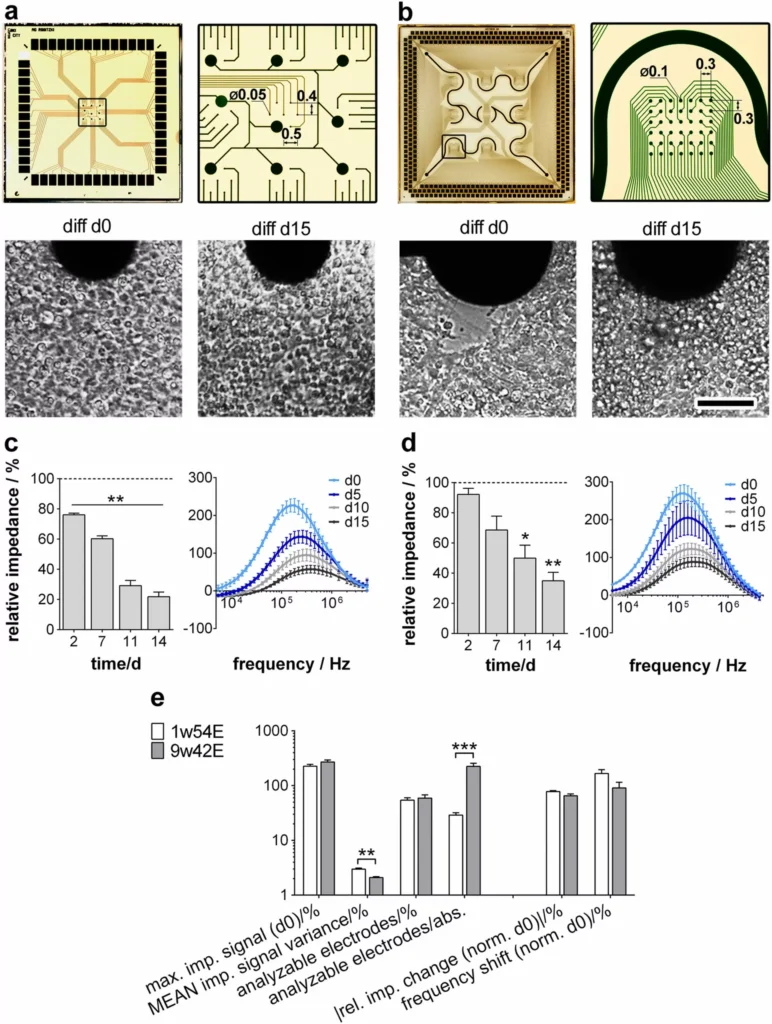
Using impedance spectroscopy, the differentiation of several human neural stem/progenitor cell lines was analyzed in detail. After development of an optimum microelectrode array for reliable and sensitive long-term monitoring, distinct cell-dependent impedimetric parameters that could specifically be associated with the progress and quality of neuronal differentiation were identified. Cellular impedance changes correlated well with the temporal regulation of biomolecular progenitor versus mature neural marker expression as well as cellular structure changes accompanying neuronal differentiation. More strikingly, the capability of the impedimetric differentiation monitoring system for the use as a screening tool was demonstrated by applying compounds that are known to promote neuronal differentiation such as the γ-secretase inhibitor DAPT.
The non-invasive impedance spectroscopy-based measurement system can be used for sensitive and quantitative monitoring of neuronal differentiation processes. Therefore, this technique could be a very useful tool for quality control of neuronal differentiation and moreover, for neurogenic compound identification and industrial high-content screening demands in the field of safety assessment as well as drug development.
Using impedance spectroscopy, the differentiation of several human neural stem/progenitor cell lines was analyzed in detail. After development of an optimum microelectrode array for reliable and sensitive long-term monitoring, distinct cell-dependent impedimetric parameters that could specifically be associated with the progress and quality of neuronal differentiation were identified. Cellular impedance changes correlated well with the temporal regulation of biomolecular progenitor versus mature neural marker expression as well as cellular structure changes accompanying neuronal differentiation. More strikingly, the capability of the impedimetric differentiation monitoring system for the use as a screening tool was demonstrated by applying compounds that are known to promote neuronal differentiation such as the γ-secretase inhibitor DAPT.
The non-invasive impedance spectroscopy-based measurement system can be used for sensitive and quantitative monitoring of neuronal differentiation processes. Therefore, this technique could be a very useful tool for quality control of neuronal differentiation and moreover, for neurogenic compound identification and industrial high-content screening demands in the field of safety assessment as well as drug development.