At a glance
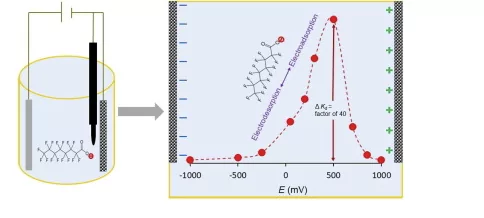
Electrosorption was investigated as an innovative approach for removal of perfluoroalkyl acids (PFAAs) from contaminated water. Direct electrical potentials were applied to conductive activated carbon felts (ACFs) for enhancing adsorption of PFAA anions under anodic polarization and facilitate desorption under cathodic polarization. Single point adsorption coefficients Kd of perfluorooctanoic acid (PFOA) at environmentally relevant concentrations vary between […]
Full reference article
Electrosorption was investigated as an innovative approach for removal of perfluoroalkyl acids (PFAAs) from contaminated water. Direct electrical potentials were applied to conductive activated carbon felts (ACFs) for enhancing adsorption of PFAA anions under anodic polarization and facilitate desorption under cathodic polarization. Single point adsorption coefficients Kd of perfluorooctanoic acid (PFOA) at environmentally relevant concentrations vary between 650,000 L/kg at positive potentials and 14,800 L/kg at negative potentials, i.e. by a factor of 44. The differences were even higher (factor of 100) for perfluorobutanoic acid (PFBA). A first estimation of the achievable concentration factor for PFOA in a fixed-bed electrosorption unit with potential swings results in values ≥40. This illustrates the great potential of electrosorption as pre-concentration approach which can be synergistically combined to subsequent PFAAs destruction technologies such as electrooxidation for concentrate treatment. The initial cyclic experiments at +500 mV/−1000 mV vs. Ag/AgCl revealed a decline in performance of the electrosorption cell over prolonged polarization times. Information on potential of zero charge (EPZC) of the ACFs was used to select milder potential swings, e.g. −100 mV < EPZC = +75 mV < +300 mV which significantly improved stability in a ten cycle electroadsorption/-desorption experiment over 1000 h operation time. The weak impact of competitive inorganic ions on electrosorption of PFBA and PFOA and a small effect of variable pH values indicate that this concept is applicable for remediation of various sources of water contaminated with both short- and long-chain PFAAs.
Learn more about the ISX-3 impedance analyzer
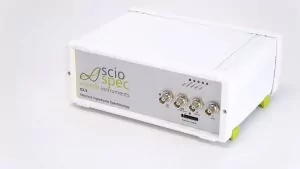
Class-Leading Impedance analyzer, the Sciospec ISX-3