At a glance
The Earth has entered the Anthropocene, which is branded by ubiquitous and devastating environmental pollution from plastics such as polyethylene terephthalate (PET). Ecofriendly and at the same time economical solutions for plastic recycling and reuse are being sought more urgently now than ever. With the possibility to recover its building blocks, the hydrolysis of PET waste […]
Full reference article
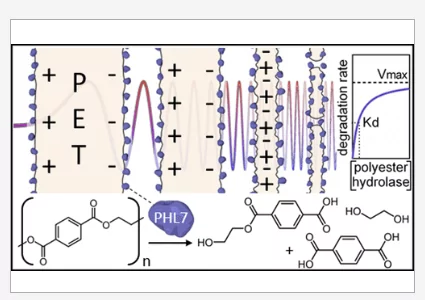
The Earth has entered the Anthropocene, which is branded by ubiquitous and devastating environmental pollution from plastics such as polyethylene terephthalate (PET). Ecofriendly and at the same time economical solutions for plastic recycling and reuse are being sought more urgently now than ever. With the possibility to recover its building blocks, the hydrolysis of PET waste by its selective biodegradation with polyester hydrolases is an appealing solution. We demonstrate how changing the dielectric properties of PET films can be used to evaluate the performance of polyester hydrolases. For this purpose, a PET film separates two reaction chambers in an impedimetric setup to quantify the film thickness- and surface area-dependent change in capacitance caused by the enzyme. The derived degradation rates determined for the polyester hydrolases PHL7 and LCC were similar to those obtained by gravimetric and vertical scanning interferometry measurements. Compared to optical methods, this technique is also insensitive to changes in the solution composition. AFM and FEM simulations further supported that impedance spectroscopy is a powerful tool for the detailed analysis of the enzymatic hydrolysis process of PET films. The developed monitoring system enabled both high-temporal resolution and parallel processing suitable for the analysis of the enzymatic degradability of polyester films and the properties of the biocatalysts.
Learn more about the ISX-3 impedance analyzer
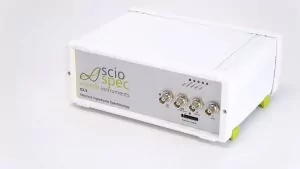
Class-Leading Impedance analyzer, the Sciospec ISX-3