Case summary
At a glance
Background Intra-procedural characterization of stroke thromboemboli might guide mechanical thrombectomy (MT) device choice to improve recanalization rates. Electrochemical impedance spectroscopy (EIS) has been used to characterize various biological tissues in real time but has not been used in thrombus. Objective To perform a feasibility study of EIS analysis of thrombi retrieved by MT to evaluate: […]
Full reference article
Background
Intra-procedural characterization of stroke thromboemboli might guide mechanical thrombectomy (MT) device choice to improve recanalization rates. Electrochemical impedance spectroscopy (EIS) has been used to characterize various biological tissues in real time but has not been used in thrombus.
Intra-procedural characterization of stroke thromboemboli might guide mechanical thrombectomy (MT) device choice to improve recanalization rates. Electrochemical impedance spectroscopy (EIS) has been used to characterize various biological tissues in real time but has not been used in thrombus.
Objective
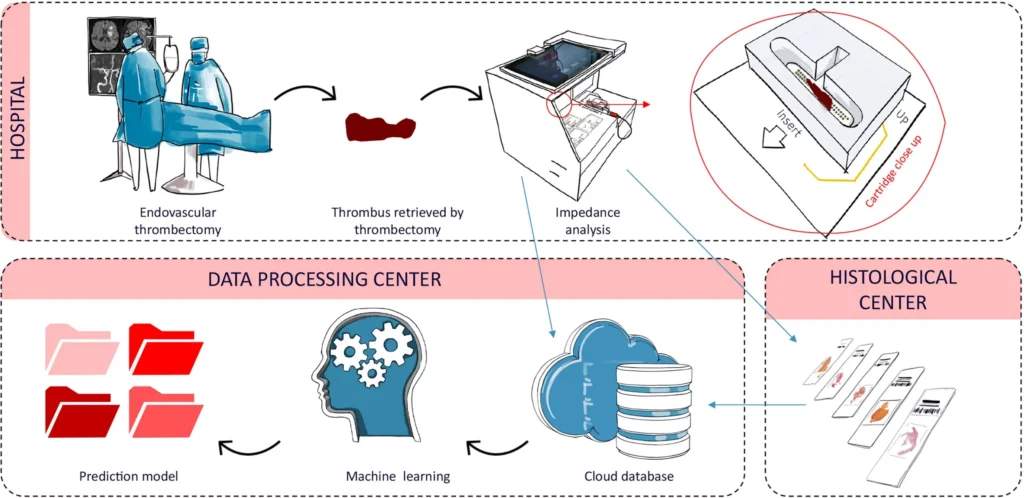
To perform a feasibility study of EIS analysis of thrombi retrieved by MT to evaluate: (1) the ability of EIS and machine learning to predict red blood cell (RBC) percentage content of thrombi and (2) to classify the thrombi as “RBC-rich” or “RBC-poor” based on a range of cutoff values of RBC.
To perform a feasibility study of EIS analysis of thrombi retrieved by MT to evaluate: (1) the ability of EIS and machine learning to predict red blood cell (RBC) percentage content of thrombi and (2) to classify the thrombi as “RBC-rich” or “RBC-poor” based on a range of cutoff values of RBC.
Methods
ClotbasePilot was a multicentric, international, prospective feasibility study. Retrieved thrombi underwent histological analysis to identify proportions of RBC and other components. EIS results were analyzed with machine learning. Linear regression was used to evaluate the correlation between the histology and EIS. Sensitivity and specificity of the model to classify the thrombus as RBC-rich or RBC-poor were also evaluated.
ClotbasePilot was a multicentric, international, prospective feasibility study. Retrieved thrombi underwent histological analysis to identify proportions of RBC and other components. EIS results were analyzed with machine learning. Linear regression was used to evaluate the correlation between the histology and EIS. Sensitivity and specificity of the model to classify the thrombus as RBC-rich or RBC-poor were also evaluated.
Results
Among 514 MT,179 thrombi were included for EIS and histological analysis. The mean composition in RBC of the thrombi was 36% ± 24. Good correlation between the impedance-based prediction and histology was achieved (slope of 0.9, R2 = 0.53, Pearson coefficient = 0.72). Depending on the chosen cutoff, ranging from 20 to 60% of RBC, the calculated sensitivity for classification of thrombi ranged from 77 to 85% and the specificity from 72 to 88%.
Among 514 MT,179 thrombi were included for EIS and histological analysis. The mean composition in RBC of the thrombi was 36% ± 24. Good correlation between the impedance-based prediction and histology was achieved (slope of 0.9, R2 = 0.53, Pearson coefficient = 0.72). Depending on the chosen cutoff, ranging from 20 to 60% of RBC, the calculated sensitivity for classification of thrombi ranged from 77 to 85% and the specificity from 72 to 88%.
Conclusion
Combination of EIS and machine learning can reliably predict the RBC composition of retrieved ex vivo AIS thrombi and then classify them into groups according to their RBC composition with good sensitivity and specificity.
Combination of EIS and machine learning can reliably predict the RBC composition of retrieved ex vivo AIS thrombi and then classify them into groups according to their RBC composition with good sensitivity and specificity.
Learn more about the ISX-3 impedance analyzer
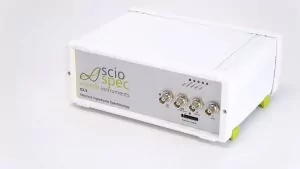
Class-Leading Impedance analyzer, the Sciospec ISX-3