Case summary
At a glance
Explore how Sciospec EIT16 enables modular Electrical Impedance Tomography (EIT) Systems from open-source prototyping to full product integration.
EIT Prototyping with Modular Open-Source Hardware
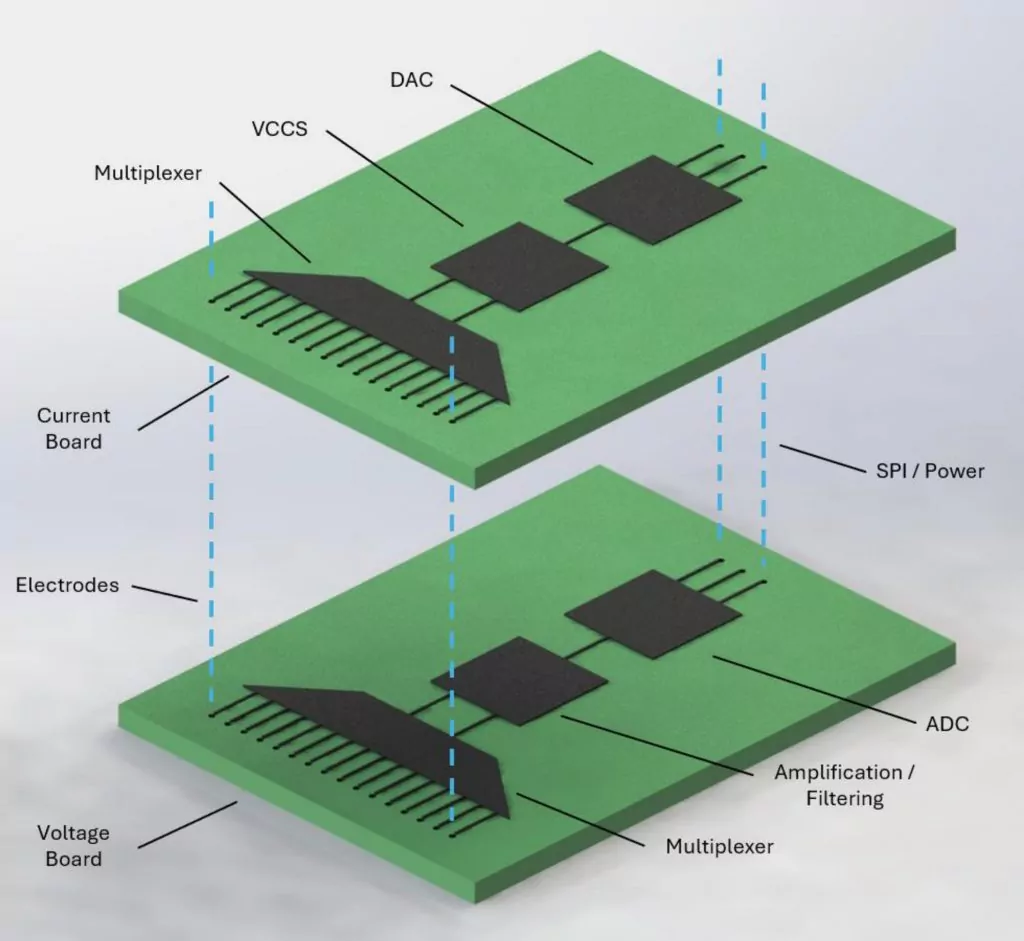
The publication “A Modular Open-Source Platform for Electrical Impedance Tomography Applications” outlines a path for researchers to build scalable EIT systems without expensive, closed-source hardware. The team combined flexible open-source switching electronics with Sciospec’s EIT16 measurement system, enabling stable multi-channel impedance acquisition, essential for real-time conductivity imaging.
EIT16 served as the core impedance measurement engine, delivering the signal integrity needed to validate electrode switching and reconstruction processes.
*Hall, H. W., Holder-Pearson, L., Zhou, C., & Chase, J. G. A modular open-source platform for electrical impedance tomography applications. HardwareX (2025). https://www.hardware-x.com/article/S2468-0672(25)00076-8/fulltext
Why Custom EIT Hardware Matters in Imaging Projects
Off-the-shelf EIT systems can be difficult to adapt for custom setups involving unique geometries, multi-layer phantoms, or integration with custom software stacks. This study tackled that challenge by building a fully modular EIT platform where each subsystem from switching logic to acquisition could be independently configured.
Here, the Sciospec EIT16 allowed precise, multi-frequency impedance tracking across 16 channels. This enabled stable image reconstruction with low signal variation crucial for confirming that the open-source switching matrix was performing as expected.
Building an EIT workflow around your design—not the other way around? Contact Our Experts to see how the EIT16 gives you measurement flexibility without system lock-in.
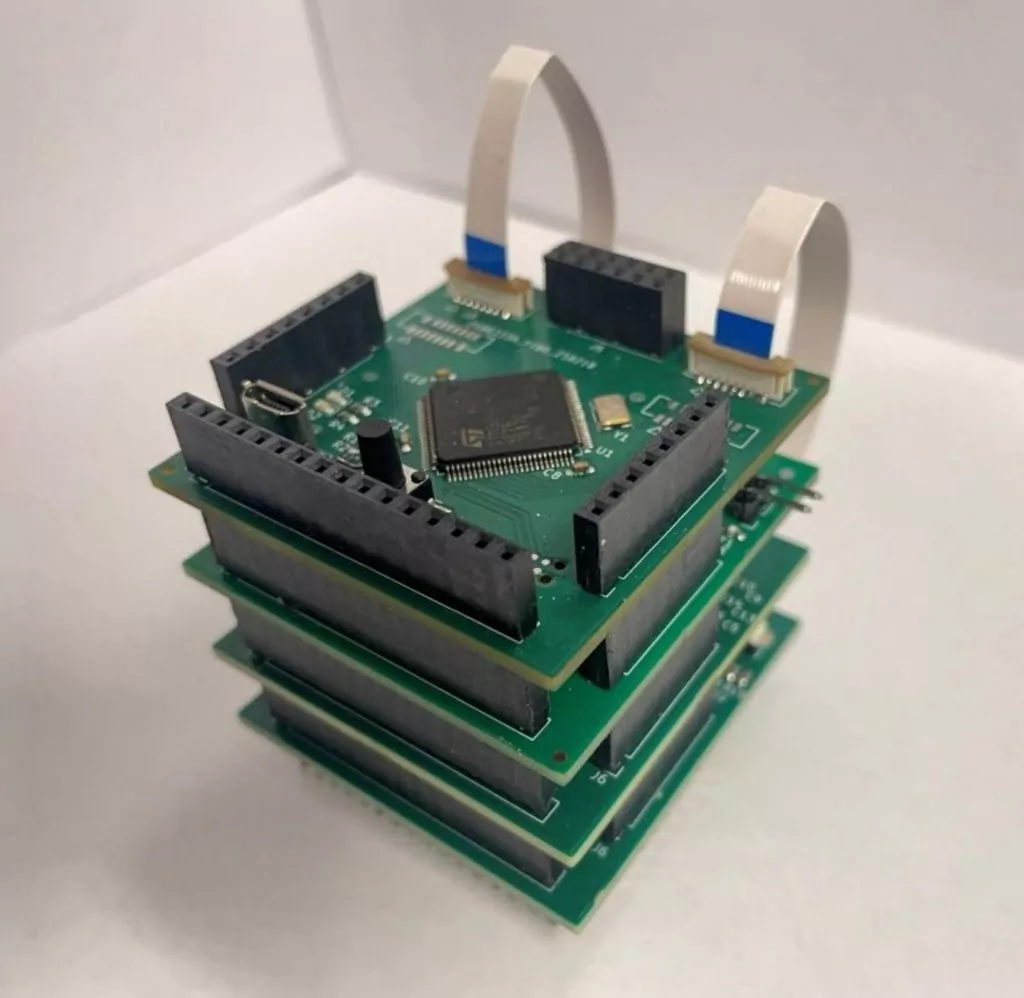
An assembled PCB stack with ribbon cables connected.
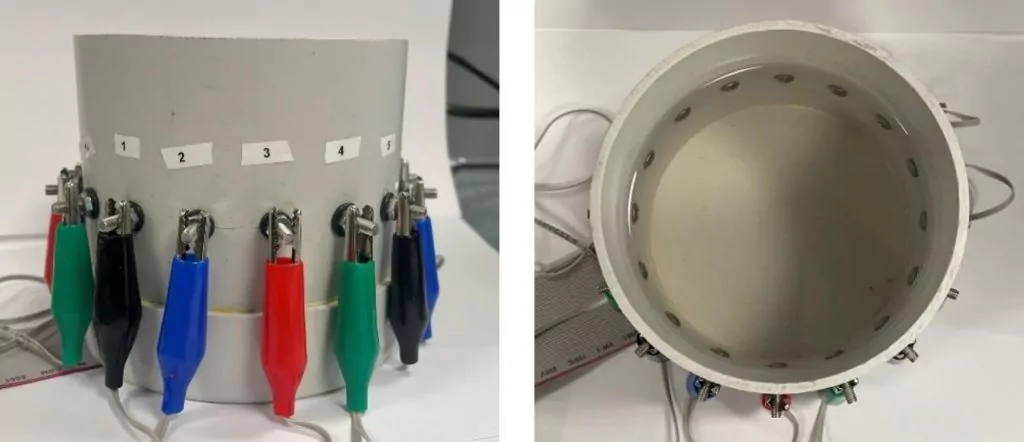
EIT16 for Bioimpedance Imaging in Open-Source Platforms
- Synchronous 16-channel acquisition → Allowed consistent impedance input for tomographic reconstruction
- Wide frequency support → Ensured characterization across biologically and industrially relevant bandwidths
- Software & protocol compatibility → Integrated smoothly into the open-source stack used in the project
- Small-form factor with full performance → Easily embedded into a compact benchtop system without sacrificing accuracy
All these contributed directly to the success of the modular, low-cost EIT platform.
👉 Want to capture synchronized multi-channel impedance data for your custom EIT platform, just like in this study? See how EIT16 delivers reliable acquisition for modular imaging systems
Scalable EIT Systems: From 16 to 256 Channels
As EIT projects mature, resolution demands grow. That’s why the same architecture behind EIT16 also powers EIT32, EIT64, and EIT128+ supporting larger sensor arrays and higher spatial fidelity.
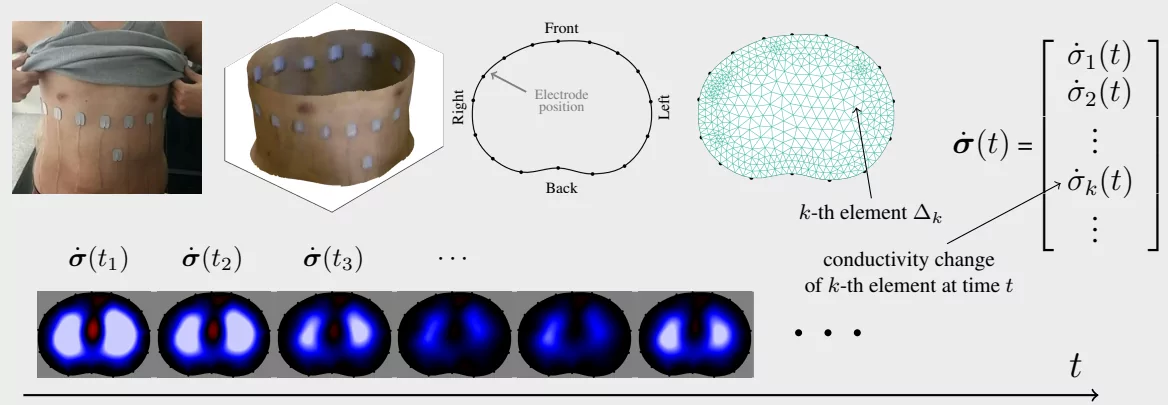
So whether you’re working on 2D thorax models or multilayer material diagnostics you can start with EIT16 and scale your system as your research expands without rewriting your signal processing stack or swapping measurement hardware.
👉 Scaling your imaging system? Upgrade to EIT32, 64 or 128 as your project grows
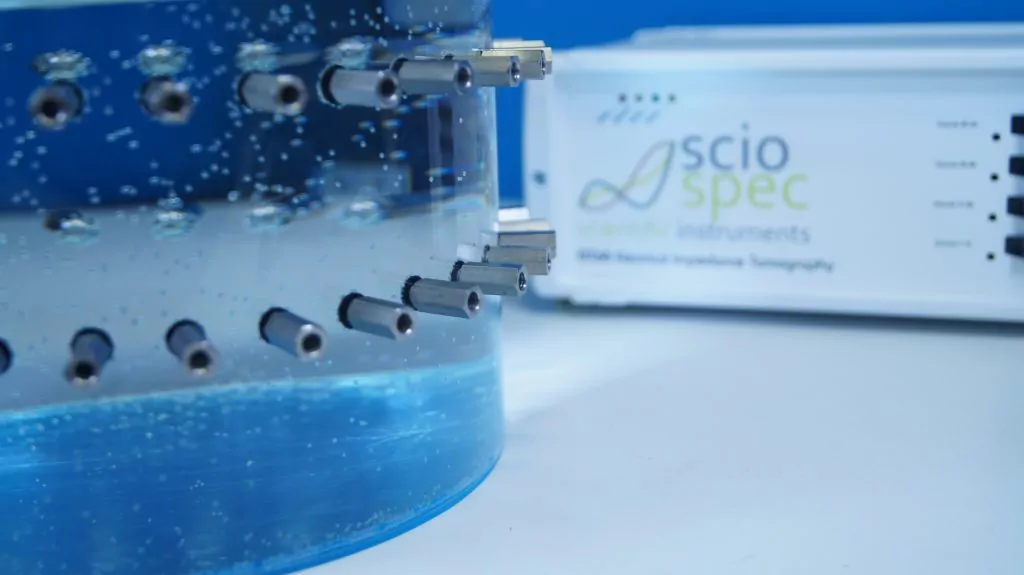
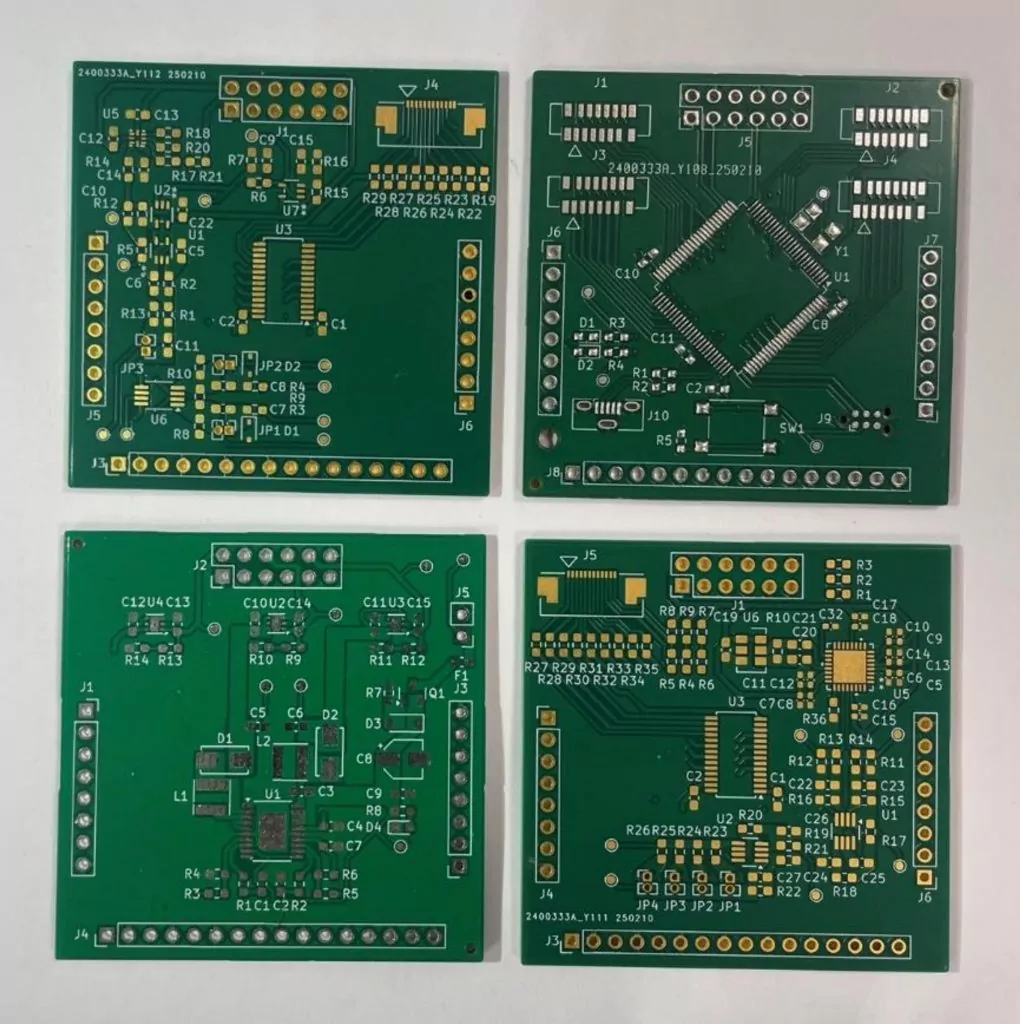
An assembled PCB stack with ribbon cables connected.
OEM Integration: Embedding Sciospec EIT Technology
One of the core takeaways from this research is that custom EIT platforms can work when each component is reliable. That’s why many developers choose to integrate Sciospec technology into their own devices.
If you’re building an EIT system for education, diagnostics, or industrial control, you can start with a Sciospec OEM platform and get:
- Synchronous 16-channel acquisition → Allowed consistent impedance input for tomographic reconstruction
- Wide frequency support → Ensured characterization across biologically and industrially relevant bandwidths
- Software & protocol compatibility → Integrated smoothly into the open-source stack used in the project
- Small-form factor with full performance → Easily embedded into a compact benchtop system without sacrificing accuracy
Want to Build your own product around EIT? See how Sciospec supports custom integration

Want to dive deeper? Talk to our experts!
Our experts are ready to help you understanding how this technology works and how you can apply and integrate it into your work. Get in touch today to get a personalized consultation to enhance your work with our advanced solutions
Accelerating Custom EIT Development with Sciospec
This research is a proof-of-concept that custom EIT systems don’t need to be costly or complex as long as the signal integrity is guaranteed. With EIT16 at the heart of the measurement stack, the team successfully built and validated a complete tomographic platform using open-source components.
Whether you’re an academic researcher or a product team prototyping an imaging tool, Sciospec’s EIT solutions help you test, validate, and scale faster with full confidence in your signal backbone.
👉 Planning a custom impedance imaging system? Let’s talk about how EIT16 fits your goals !
💡Curious for more? Check out our latest developments and products.
🧪Want to try it yourself? Contact us for more information
🚀Looking for a tailored solution? Our experts can help!
📢 Follow us on LinkedIn for more updates.
#Innovation #Sciospec #modularEITsystems #customEIThardware #scalableEITsetup
Explore Related Research and Insights
explore by relevant keywords
…or just browse our most recent posts:
Get in touch with us
Frequently asked questions
Why use an open-source platform for EIT development ?
Open-source platforms allow researchers to customize every component of the EIT system—switching matrices, signal acquisition, and image reconstruction. This avoids vendor lock-in and supports highly experimental setups.
In this study, Sciospec’s EIT16 was chosen as the hardware layer due to its compatibility with open-source frameworks and support for seamless integration via APIs and standard interfaces.
👉 Want EIT hardware that supports open development? Check how EIT16 supports modular research systems
What is SNR and why is it important in EIT imaging ?
GREIT (Graz consensus Reconstruction algorithm for EIT) is a standardized image reconstruction framework designed to optimize EIT image quality across various platforms. It helps ensure consistent performance and comparability. In modular setups like this study, EIT16 provides data that integrates well with GREIT-based reconstruction algorithms thanks to its uniform channel performance and high-frequency resolution.
Can I use the EIT16 for custom geometries and switching setups ?
Yes. The EIT16 is designed for compatibility with custom electrode arrangements, switching matrices, and timing protocols. This flexibility was essential in the study, where a modular switching logic was paired with EIT16 for full control over signal routing.
What if I need more than 16 channels ?
EIT16 is part of a scalable architecture. For higher-resolution imaging or larger sensor arrays, you can upgrade to EIT32, EIT64, or even EIT128 without changing your development framework. This means you can prototype with 16 channels and scale your system as your project evolves.
👉 Scaling your EIT system? Check Sciospec’s full EIT versions to fit your channel needs.
Can I integrate Sciospec EIT systems into my own product or OEM device ?
Absolutely. Sciospec offers OEM services that allow you to embed EIT technology like the EIT16 directly into your diagnostic, monitoring, or educational products. From custom form factors to firmware access, your EIT platform can carry your brand with Sciospec technology at its core. Explore our OEM offerings to power your product with EIT16 technology