
Compact LCR meter
with high-end accuracy.
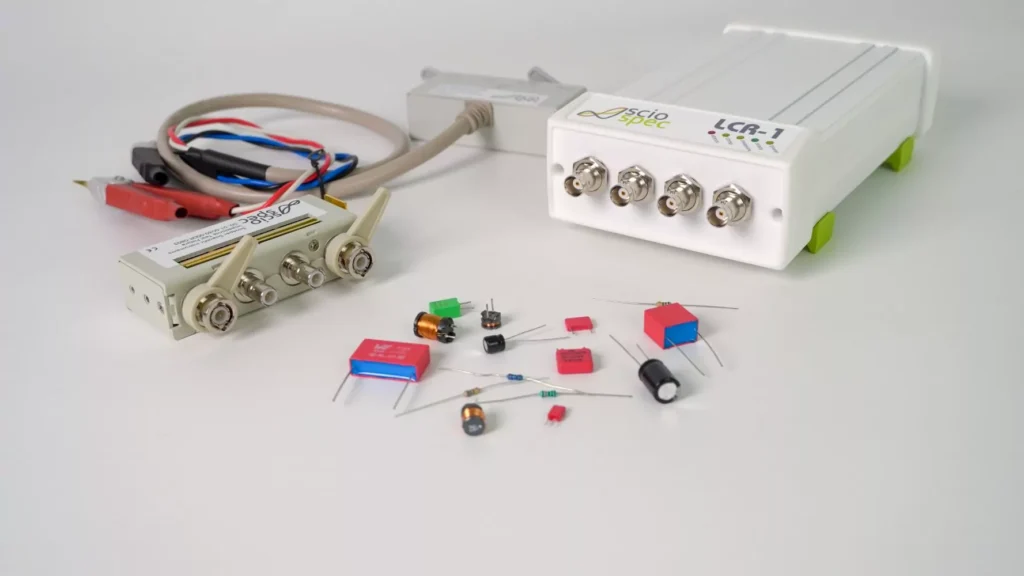
Electrical component analysis has never been easier. The LCR-1 is built on the same technology as our industry-leading impedance analyzers — next-level performance with the simplicity of a benchtop LCR meter, at a price typically not found in this class.
- Single-channel compact LCR meter — 2-, 3- and 4-port measurements
- 100 mHz – 1 MHz standard, extendable to 40 MHz
- 0.01 % base accuracy · R 1 mΩ–1 TΩ · C 10 fF–1 kF · L 1 nH–1 TH
100 mHz – 1 MHz
Frequency Range
0.01 %
Base Accuracy
mΩ … TΩ
Impedance Span
2 / 3 / 4-port
Configurations
High-end accuracy, in a compact, easy-to-use LCR meter
The LCR-1 inherits the measurement core from our impedance analyzer range — wrapped in a benchtop instrument with direct-access presets, simple workflows and broad adapter support so you can take it from the workshop bench to the research lab without switching tools.
High-end measurement core
0.01 % BASE ACCURACY
The same cutting-edge core as our impedance analyzers
Under the simple exterior is the same measurement technology that powers the ISX-3 range — 0.01 % base accuracy across R 1 mΩ – 1 TΩ, C 10 fF – 1 kF and L 1 nH – 1 TH, with manual and automatic ranges and triggers.
Day-to-day usability
DIRECT-ACCESS PRESETS
Direct-access presets and a simple workflow anyone can pick up
Configurable averaging, compensation and integration time, direct-access presets for repeat tests, and a workflow simple enough for daily workshop use — without locking away high-end measurement features when you need them.
Models, circuits, parameters
ELECTRICAL MODELING
Large selection of common electrical models and parameters
Out-of-the-box support for the standard set of electrical models, equivalent circuits and parameters used in component QA, material research and educational labs — fit and report without writing your own toolbox.
Technical Specifications
Core electrical parameters and measurement features for the LCR-1 base configuration. Full datasheet available on request.
Parameter
Specification
Notes
GENERAL
Channels
Single channel
Benchtop LCR meter
Electrode Configurations
2 / 3 / 4-port
Selectable per measurement
Interfaces
USB
Software & automation
MEASUREMENT
Frequency Range
100 mHz – 10 MHz
Extendable to 40 MHz
Base Accuracy
0.01 %
Typical
Resistance Range
1 mΩ – 1 TΩ
Auto / manual ranging
Capacitance Range
10 fF – 1 kF
Auto / manual ranging
Inductance Range
1 nH – 1 TH
Auto / manual ranging
Ranges & Triggers
Manual and automatic
Configurable per workflow
Compensation & Averaging
Configurable
Integration time, averaging, compensation
MODELS & SOFTWARE
Electrical Models
Large built-in selection
Common circuits and parameters
Presets
Direct-access
For repeat day-to-day tests
Adapter Support
Components · foils · thin films · liquids
Industry-standard cable sets
Where the LCR-1 fits in
Wherever you need a compact, accurate LCR bench — component QA, pre-pick-and-place checks, material and component research, teaching labs and entry-level bioimpedance — the LCR-1 brings impedance-analyzer-grade precision into an easy-to-use instrument.
Component QA & pre-pick-and-place
Quick R, L and C tests for incoming inspection, component QA and pre-checking before pick-and-place assembly — without the workflow overhead of a research instrument.
Material & component research
Dielectric and thin-film characterization, foils, liquids and SMD components with the same high-end measurement core as our impedance analyzers.
Workshop & teaching labs
Direct-access presets and configurable averaging / compensation / integration time make the LCR-1 a fit for workshop benches, teaching labs and shared instrument rooms.
Bioimpedance entry-level studies
When you need a compact, accurate impedance bench for entry-level bioimpedance work — many published studies cited for the ISX-3 range share this measurement core.
Configure your LCR-1
Choose the frequency range and the adapters that match your day-to-day tests — components, foils, thin films or liquids.
Loading configurator…
Complete your setup
Combine the LCR-1 with cable sets, component clamps and test fixtures for components, foils, thin films and liquids — making it ready for workshop benches and research labs alike.
Industry-standard cable sets
BNC-style cable sets for general 2-, 3- and 4-port LCR measurements. [Product-specific accessory image needed]
Details
Universal component clamps
Multiple clamp types for axial, radial and unusually-shaped components.
Details
THT component test fixture
Test fixture for through-hole components — fast, repeatable insertion for QA work.
Details
From a benchtop LCR-1 to your OEM LCR platform
The LCR-1 shares its measurement core with the impedance analyzer range — so the same architecture can scale into multichannel platforms like the LCR-3 and into dedicated OEM electronics.
When you move from benchtop to product, we help migrate the LCR measurement core into OEM hardware with tailored firmware, connectors and software branding for your target environment.
- 01
Workshop / lab validation
Validate your LCR workflow on a standard LCR-1 with the right adapters and presets for your day-to-day tests.
- 02
Scale to multichannel testing
When you outgrow single-channel testing, move to the LCR-3 platform with integrated multiplexers for up to 256 ports — same measurement core.
- 03
Embedded OEM LCR platform
For high-volume production, migrate the LCR measurement core into a dedicated OEM platform with tailored electronics, enclosure and software.
Published reference
ISX-3 tracking conductivity changes in plant tissue exposed to PEFs
High-end accuracy, validated by real research workflows
The LCR-1 shares its measurement core with the ISX-3 impedance analyzer range — cited in published work on PEF in plant tissue, prostate-cancer gene detection, DNA characterization and toxin-induced cell-damage detection.
Challenge
Track conductivity changes in plant tissue exposed to pulsed electric fields with reproducible, high-accuracy impedance measurements.
SCIOSPEC ROLE
The same measurement core used in published Sciospec impedance studies powers the LCR-1 — bringing that accuracy into a benchtop LCR form factor.
RESULT
Published EIS workflow for PEF-treated plant tissue, with conductivity tracking across the relevant frequency range.
USER VOICE
- "Don't be fooled by the simplicity on the outside and the affordable pricing — the LCR-1 combines high-end accuracy, range and speed with simplicity and ease of use anyone can pick up."
Sciospec product team
[Specific user attribution needed]
Additional published work covers prostate-cancer gene detection, DNA characterization with bioimpedance and AI, and toxin-induced cell-damage detection — all sharing the Sciospec impedance measurement core.
Individual FAQ
Short technical answers to the questions we hear most often about the LCR-1.
What's the difference between the LCR-1 and the LCR-3?
The LCR-1 is a compact single-channel benchtop LCR meter. The LCR-3 is a modular, automation-ready platform on the same measurement core, with optional integrated multiplexers up to 256 ports and a desktop or 19″ rack-mount form factor.
How accurate is it?
0.01 % base accuracy, with R 1 mΩ – 1 TΩ, C 10 fF – 1 kF and L 1 nH – 1 TH ranges. Manual and automatic ranges and triggers, plus configurable averaging, compensation and integration time.
What frequency range does it cover?
100 mHz to 1 MHz standard, extendable to 40 MHz at order time.
What measurement configurations are supported?
2-, 3- and 4-port measurements, selectable per workflow. A large built-in selection of common electrical models, equivalent circuits and parameters is included.
Which test fixtures are available?
Industry-standard cable sets, universal component clamps (multiple types), THT and SMT component test fixtures, dielectric test fixtures for foils and thin films and liquid test fixtures.
Can it be used for research too?
Yes. The measurement core is the same one used in our impedance analyzer range, so the LCR-1 is a strong fit for both workshop tests and material / component research.
How would you like to continue?
Choose the next step that fits where you are — from first conversation to scaling up to multichannel LCR testing.
Tell us about your workflow
Share your component-test, QA or research workflow — we’ll help scope the right LCR-1 setup.
Configure your LCR-1
Choose the frequency range and adapters that match your day-to-day tests.
Looking for multichannel?
If you need integrated multiplexing and automation up to 256 ports, the LCR-3 may be a better fit.
Get in touch with us
Phone
Headquarters
Sciospec Scientific Instruments GmbH
Leipziger Str. 43b
04828 Bennewitz, Germany
Open in Google Maps