Case summary
At a glance
The analysis of receptor activity, especially in its native cellular environment, has always been of great interest to evaluate its intrinsic but also downstream biological activity. An important group of cellular receptors are ion channels. Since they are involved in a broad range of crucial cell functions, they represent important therapeutic targets. Thus, novel analytical […]
Full reference article
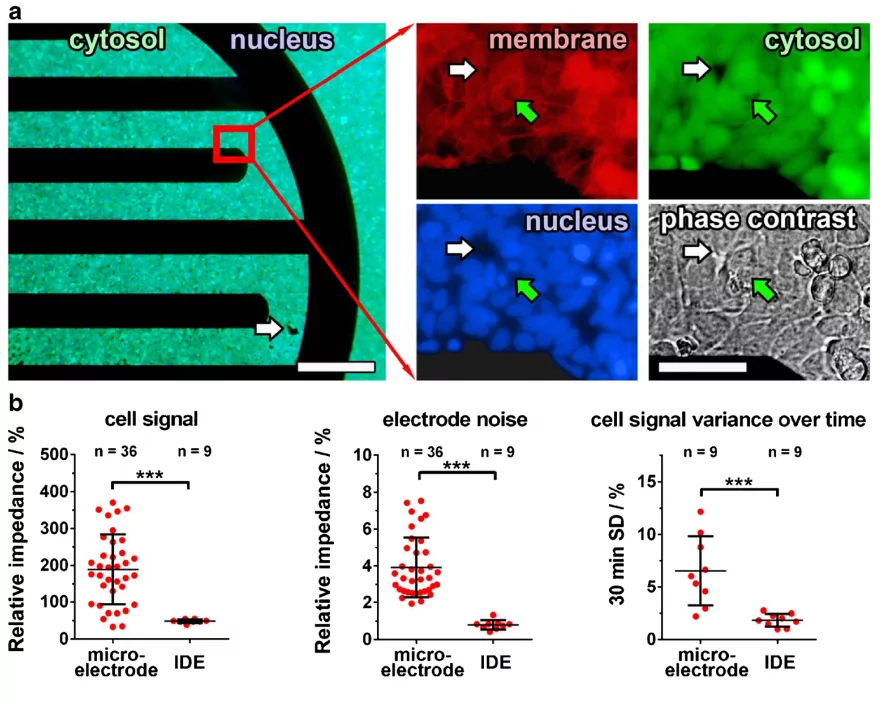
The analysis of receptor activity, especially in its native cellular environment, has always been of great interest to evaluate its intrinsic but also downstream biological activity. An important group of cellular receptors are ion channels. Since they are involved in a broad range of crucial cell functions, they represent important therapeutic targets. Thus, novel analytical techniques for the quantitative monitoring and screening of biological receptor activity are of great interest. In this context, we developed an impedance spectroscopy-based label-free and non-invasive monitoring system that enabled us to analyze the activation of the transient receptor potential channel Vanilloid 1 (TRPV1) in detail. TRPV1 channel activation by capsaicin resulted in a reproducible impedance decrease. Moreover, concentration response curves with an EC50 value of 0.9 μM could be determined. Control experiments with non TRPV1 channel expressing HEK cells as well as experiments with the TRPV1 channel blocker ruthenium red validated the specificity of the observed impedance decrease. More strikingly, through correlative studies with a cytoskeleton restructuring inhibitor mixture and equivalent circuit analysis of the acquired impedance spectra, we could quantitatively discriminate between the direct TRPV1 channel activation and downstream-induced biological effects. In summary, we developed a quantitative impedimetric monitoring system for the analysis of TRPV1 channel activity as well as downstream-induced biological activity in living cells. It has the capabilities to identify novel ion channel activators as well as inhibitors for the TRPV1 channel but could also easily be applied to other ion channel-based receptors.