Reference case

A non-invasive approach to skin cancer diagnosis via graphene electrical tattoos and electrical impedance tomography

Category

Application

Medical & healthcare

Case summary

At a glance

Objective. Making up one of the largest shares of diagnosed cancers worldwide, skin cancer is also one of the most treatable. However, this is contingent upon early diagnosis and correct skin cancer-type differentiation. Currently, methods for early detection that are accurate, rapid, and non-invasive are limited. However, literature demonstrating the impedance differences between benign and malignant […]
Full reference article

Objective. Making up one of the largest shares of diagnosed cancers worldwide, skin cancer is also one of the most treatable. However, this is contingent upon early diagnosis and correct skin cancer-type differentiation. Currently, methods for early detection that are accurate, rapid, and non-invasive are limited. However, literature demonstrating the impedance differences between benign and malignant skin cancers, as well as between different types of skin cancer, show that methods based on impedance differentiation may be promising. Approach. In this work, we propose a novel approach to rapid and non-invasive skin cancer diagnosis that leverages the technologies of difference-based electrical impedance tomography (EIT) and graphene electronic tattoos (GETs). Main results. We demonstrate the feasibility of this first-of-its-kind system using both computational numerical and experimental skin phantom models. We considered variations in skin cancer lesion impedance, size, shape, and position relative to the electrodes and evaluated the impact of using individual and multi-electrode GET (mGET) arrays. The results demonstrate that this approach has the potential to differentiate based on lesion impedance, size, and position, but additional techniques are needed to determine shape. Significance. In this way, the system proposed in this work, which combines both EIT and GET technology, exhibits potential as an entirely non-invasive and rapid approach to skin cancer diagnosis.

Learn more about Sciospec’s EIT platform
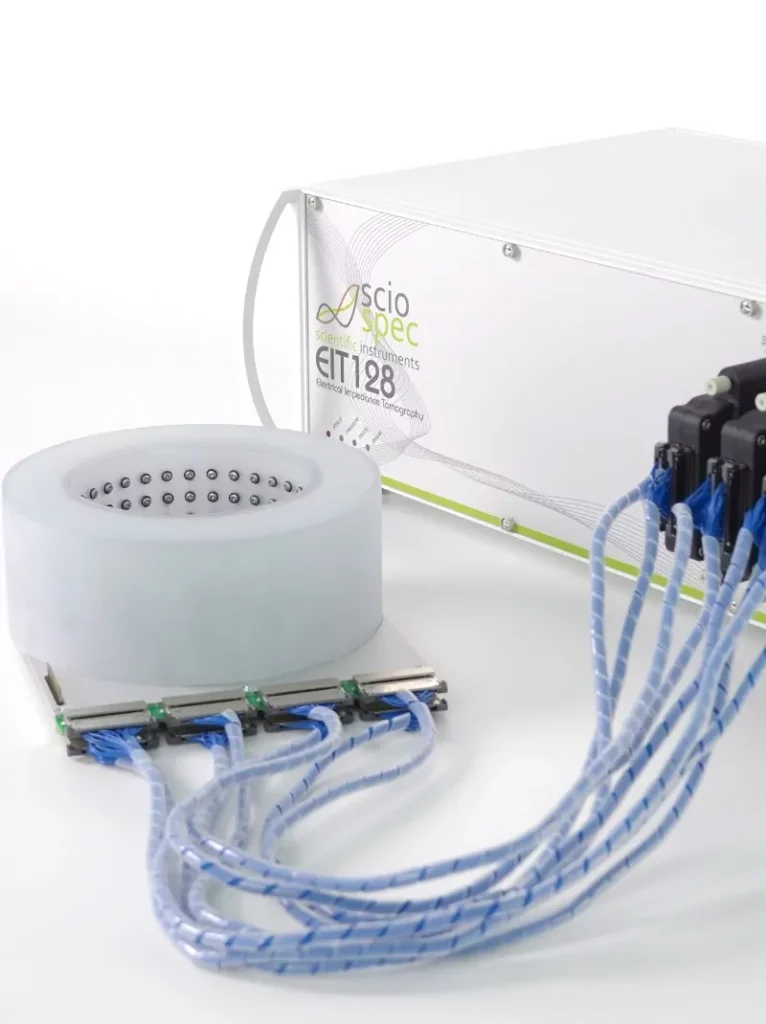
Sciospec high frame rate high precision EIT instruments with 32, 64, 128 or even 256 channels
In this section

Table of Contents

Reference facts

Application area

Medical & healthcare

Category

Published

June 26, 2024

Tags

Key takeaway
Objective. Making up one of the largest shares of diagnosed cancers worldwide, skin cancer is also one of the most treatable. However, this is contingent upon early diagnosis and correct skin cancer-type differentiation.…
Related references

You may also like

Time-difference phantom experiment

Mathematical model of conductive fabric-based flexible pressure sensor

A biosensor capable of identifying low quantities of breast cancer cells by electrical impedance spectroscopy

Discuss your application

Want to build something like this?

Talk to our application engineers about scoping a similar setup for your team.

Get in touch with us

Headquarters

Sciospec Scientific Instruments GmbH Leipziger Str. 43b 04828 Bennewitz, Germany

Open in Google Maps

Get in touch with us

We typically reply within one business day.