At a glance
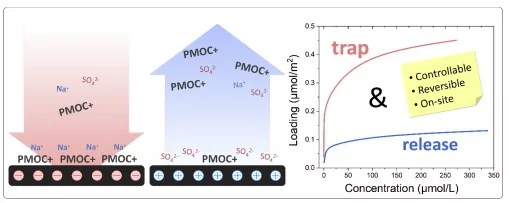
Highly water-soluble, persistent, and mobile organic compounds (PMOCs) are more and more often detected in surface and groundwater, evoking potential threats to the environment and human health. Traditional water treatment strategies, including adsorption by activated carbon materials, fail to efficiently remove PMOCs due to their hydrophilic nature. Electro-assisted sorption processes offer a clean, facile, and […]
Full reference article
The Earth has entered the Anthropocene, which is branded by ubiHighly water-soluble, persistent, and mobile organic compounds (PMOCs) are more and more often detected in surface and groundwater, evoking potential threats to the environment and human health. Traditional water treatment strategies, including adsorption by activated carbon materials, fail to efficiently remove PMOCs due to their hydrophilic nature. Electro-assisted sorption processes offer a clean, facile, and promising solution to remove PMOCs on activated carbon-based electrodes and potentially allow an easy on-site sorbent regeneration (trap&release). In this work, the electrosorption of five selected PMOCs, that is, tetrapropylammonium (TPA+), benzyltrimethylammonium (BTMA+), p-tosylate (p-TsO–), p-toluenesulfonamide (p-TSA), and methyl-tert-butyl ether (MTBE), were investigated on two comprehensively characterized activated carbon felt (ACF) types carrying different surface functionalities. Significant enrichment factors in ranges of 102 to 103 for charged PMOCs were expected by our first estimation for electro-assisted trap&release on ACFs in flow systems applying potentials in the range of −0.1 V/+0.6 V vs. SHE for ad-/desorption, respectively. Defunctionalized ACF carrying larger density in surface π-systems and lower O-content promises a higher capability in electrosorption processes than the pristine material in terms of better material stability (tested for 5 cycles over 500 h) and better removal efficiency of ionic PMOCs. To improve ACFs adsorption performance for cationic and anionic PMOCs, permanent chemical surface modification and reversible electric polarization as alternative strategies are compared. Our findings explore future electrode and process design of electrosorption for applications to treat water contaminated by emerging PMOCs.quitous and devastating environmental pollution from plastics such as polyethylene terephthalate (PET). Ecofriendly and at the same time economical solutions for plastic recycling and reuse are being sought more urgently now than ever. With the possibility to recover its building blocks, the hydrolysis of PET waste by its selective biodegradation with polyester hydrolases is an appealing solution. We demonstrate how changing the dielectric properties of PET films can be used to evaluate the performance of polyester hydrolases. For this purpose, a PET film separates two reaction chambers in an impedimetric setup to quantify the film thickness- and surface area-dependent change in capacitance caused by the enzyme. The derived degradation rates determined for the polyester hydrolases PHL7 and LCC were similar to those obtained by gravimetric and vertical scanning interferometry measurements. Compared to optical methods, this technique is also insensitive to changes in the solution composition. AFM and FEM simulations further supported that impedance spectroscopy is a powerful tool for the detailed analysis of the enzymatic hydrolysis process of PET films. The developed monitoring system enabled both high-temporal resolution and parallel processing suitable for the analysis of the enzymatic degradability of polyester films and the properties of the biocatalysts.
Learn more about the ISX-3 impedance analyzer
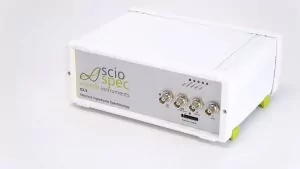
Class-Leading Impedance analyzer, the Sciospec ISX-3