Case summary
At a glance
Discover how the ISX-3 enables real-time, high-precision EDA tracking across a broad frequency range
Full reference article
Unlocking the Secrets of Electrodermal Activity (EDA) with Multi-Frequency Analysis
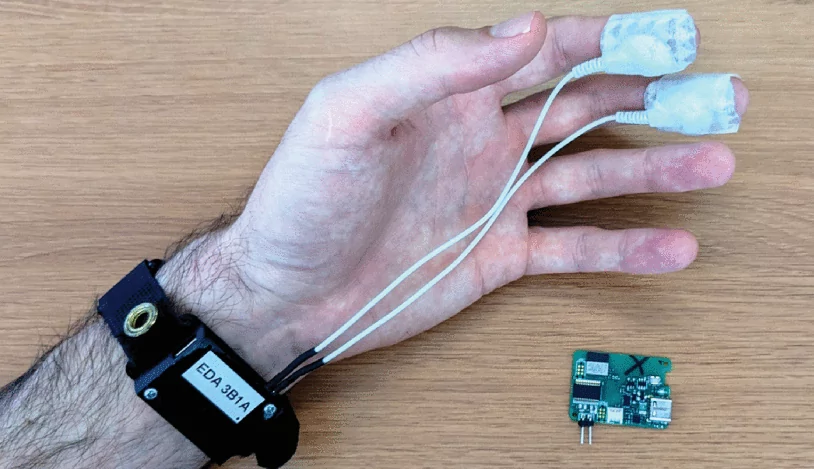
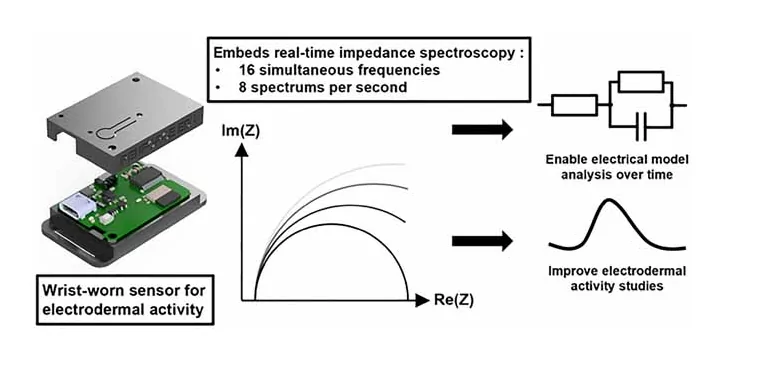
Traditional EDA measurements rely on single-frequency skin conductivity readings, which can be influenced by electrode type, placement, and skin hydration levels, leading to inconsistent results. This study highlights the power of multi-frequency impedance measurement, which reduces these limitations by analyzing frequency-dependent changes in skin impedance.
Why Multi-Frequency EDA Matters ?
- Decomposes Complex Signals – Differentiates sweat gland activity from electrode-skin interface effects
- Enhances Accuracy – Identifies optimal frequency ranges for precise stress monitoring
- Enables Real-Time Insights – Lays the foundation for wearable technology in stress tracking
Curious to learn more about EDA? Check out our detailed FAQ section.
Why This Research is a Game-Changer for Stress Monitoring
- Breakthroughs in emotional and cognitive research
- More reliable stress detection for chronic stress management
- Better personalized biofeedback solutions in mental health & wellness
As demand for wearable stress-monitoring devices grows, multi-frequency skin impedance sensors are emerging as a game-changer for real-time emotional and stress tracking. This study confirms that Continuous Impedance Spectroscopy (CIS) can significantly enhance the accuracy and reliability of stress quantification in everyday life.
Looking for more answers? Keep reading to learn more. We also have a detailed FAQ section further down. Or take the shortcut and directly reach out to us.
Impedance Measurement Solutions for Psychophysiological Research
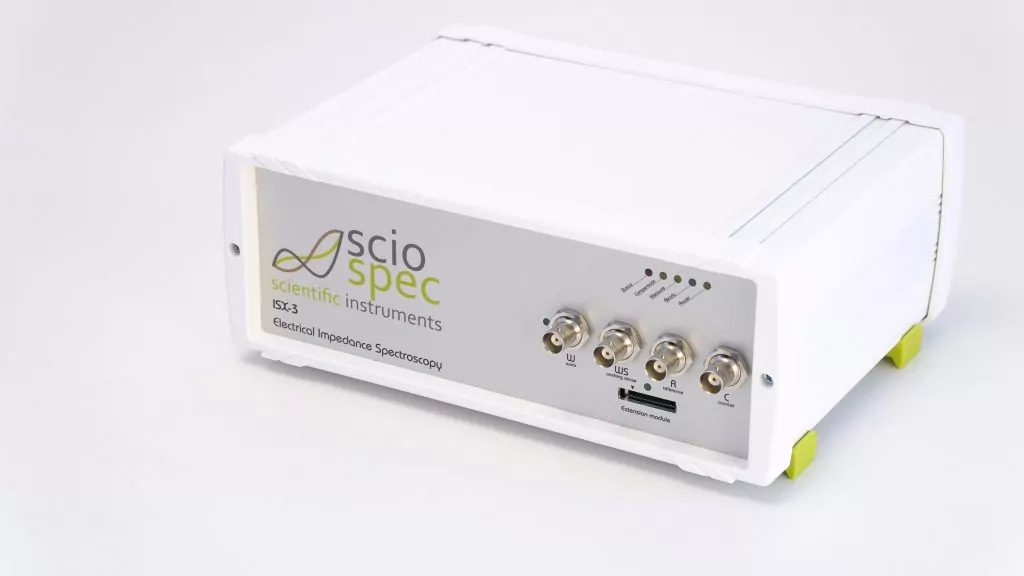
At Sciospec, we provide state-of-the-art impedance measurement technology, ideal for studies like this. Our solutions include the ISX-3 impedance analyzer, a trusted choice for advanced impedance measurement challenges, relied upon by researchers and engineers worldwide. In fact, the ISX-3 was the very instrument that enabled the groundbreaking research featured in this publication.The instrument’s combination of ultra-fast measurement speeds and high accuracy makes it perfect for electrodermal activity (EDA) and multi-frequency impedance measurement, highlighting advancements in stress monitoring and psychophysiological research.
By enabling accurate and reliable multi-frequency impedance analysis, the ISX-3 empowers researchers to refine EDA measurement techniques optimize sensor designs and develop high-performance biofeedback solutions.
For flawless integration into your application choose from our many sensor & chip adapters or talk to us for custom integrations. Need to scale up? No problem – we offer compatible multiplexers and multichannel impedance analyzers.
Need medical-grade safety features?
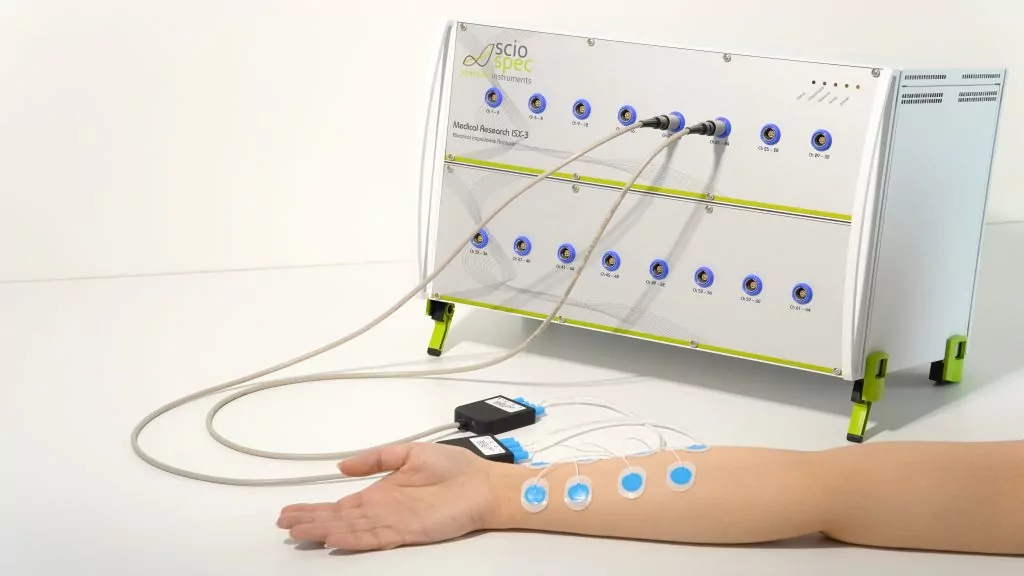
For applications requiring compliance with medical safety standards we offer the Medical Research ISX-3 impedance analyzer. This specialized variant of the ISX-3 provides:
- High-precision impedance measurements across a broad frequency range
- Medical grade safety features for ease of mind
- Adaptable setups for different research applications
- User-friendly software for seamless data processing
The study’s findings highlight the critical role of multi-frequency impedance measurement in stress research. The Medical Research ISX-3 impedance analyzer, with its high precision and adaptability is perfectly suited for advancing real-world applications in psychophysiological monitoring and wearable technology development.
Explore how Sciospec’s the Medical Research ISX-3 can revolutionize your research.

Want to dive deeper? Talk to our experts!
Our experts are ready to help you understanding how this technology works and how you can apply and integrate it into your work. Get in touch today to get a personalized consultation to enhance your work with our advanced solutions
Step into the Future with Impedance based EDA measurements
The future of stress monitoring and psychophysiological research is deeply connected to skin impedance measurement. As this study demonstrates, multi-frequency impedance analysis unlocks groundbreaking insights—leading to better stress detection, deeper emotional understanding, and advanced mental health applications.
At Sciospec, we are committed to empowering researchers with cutting-edge impedance solutions. Whether you’re developing wearable stress monitors, refining EDA research, or advancing biofeedback therapies, our technology can help.
🚀 Get in touch with Sciospec today to explore how our impedance solutions can power your research. Contact us now.
💡Curious for more? Check out our latest developments and products.
🧪Want to try it yourself? Contact us for more information
🚀Looking for a tailored solution? Our experts can help!
📢 Follow us on LinkedIn for more updates.
#Innovation #Sciospec #ImpedanceSpectroscopy #SkinConductivity #SkinImpedance #ElectrodermalActivity #Psychophysiological studies
Explore Related Research and Insights
explore by relevant keywords
…or just browse our most recent posts:
Get in touch with us
Frequently asked questions
How does multi-frequency measurement improve EDA analysis?
Multi-frequency impedance measurement improves EDA analysis by providing a more detailed and accurate representation of electrodermal activity. Unlike traditional single-frequency methods, multi-frequency measurement:
✔ Isolates different physiological components, allowing researchers to distinguish between sweat gland activity and electrode-skin interface effects.
✔ Enhances accuracy by identifying the optimal frequency ranges for reliable stress and emotion tracking.
✔ Reduces noise and external influences, leading to more consistent and reproducible EDA data.
💡 Sciospec’s ISX-3 impedance analyzer enables precise multi-frequency EDA measurement, ensuring high-resolution physiological insights.
What are the advantages of continuous impedance spectroscopy in EDA?
Continuous impedance spectroscopy (CIS) allows for real-time, continuous tracking of skin impedance changes, making it ideal for stress monitoring, affective computing, and psychophysiology studies. Compared to traditional methods, CIS:
✔ Provides real-time data, making it possible to detect momentary stress fluctuations.
✔ Minimizes signal distortions, ensuring more reliable and stable readings over extended periods.
✔ Enables wearable applications, offering continuous monitoring for biofeedback and mental health interventions.
💡 Sciospec’s impedance measurement technology ensures high precision and adaptability for CIS-based research and wearable sensor applications.
What is the frequency range for optimal skin impedance measurement?
The optimal frequency range for skin impedance measurement depends on the specific research goals and the physiological components being analyzed. Generally:
✔ Low frequencies (<10 Hz) provide insights into sweat gland activation and rapid changes in electrodermal activity.
✔ Mid-range frequencies (10 Hz – 100 kHz) capture skin conductance responses (SCRs) and baseline skin conductance levels (SCLs).
✔ Higher frequencies (100 kHz – 1 MHz) help differentiate between physiological responses and electrode-skin interface effects.
💡 Sciospec’s ISX-3 analyzer allows precise tuning across a wide frequency spectrum, enabling researchers to find the ideal frequency range for their EDA studies.
What is Continuous Impedance Spectroscopy (CIS)?
CIS is a technique that continuously measures skin impedance across multiple frequencies to provide deeper insights into electrodermal activity (EDA). Unlike traditional single-frequency EDA measurements, CIS helps differentiate sweat gland activation, electrode-skin interface effects, and other physiological responses.
💡 How does impedance spectroscopy improve CIS?
Sciospec’s multi-frequency impedance measurement technology allows for precise tracking of skin impedance changes over time, making CIS a more reliable method for stress and emotion monitoring.
What are Skin Conductance Responses (SCRs) and Skin Conductance Level (SCL)?
SCRs (Skin Conductance Responses) are rapid, event-driven changes in skin conductivity, often triggered by stress, cognitive load, or emotional stimuli. SCL (Skin Conductance Level), on the other hand, represents the baseline level of skin conductivity over time, reflecting an individual’s autonomic activity.
💡 How does impedance measurement enhance SCR & SCL analysis?
Traditional EDA methods often struggle with signal contamination from electrode placement or hydration levels. Multi-frequency impedance spectroscopy enables a more precise differentiation between true physiological responses and external noise, improving the accuracy of stress and emotion research.
Why is multi-frequency impedance measurement better than single-frequency EDA?
Traditional single-frequency EDA methods are prone to errors caused by electrode quality, skin hydration, and external interference. Multi-frequency impedance measurement addresses this by capturing frequency-dependent skin impedance changes, allowing researchers to:
✔ Distinguish between sweat gland activity and electrode-skin interface effects
✔ Identify the optimal frequency range for stress detection
✔ Improve accuracy and reliability in wearable technology and psychophysiological studies
How does impedance spectroscopy contribute to wearable stress monitoring?
Wearable devices require precise, real-time EDA tracking to provide meaningful insights into stress, emotions, and mental well-being. Multi-frequency impedance measurement enables:
✔ Differentiation between emotional responses & external factors
✔ Continuous monitoring for long-term mental health applications
💡 Sciospec’s ISX-3 is designed to support advanced impedance measurement in wearable research and stress monitoring applications.