Case summary
At a glance
Discover how the Sciospec EIT128 system and customizable phantom tank enable efficient, real-time imaging with minimal data transforming object localization and structural analysis.
Full reference article
Efficient Real-Time Imaging Powered by Sciospec EIT Technology
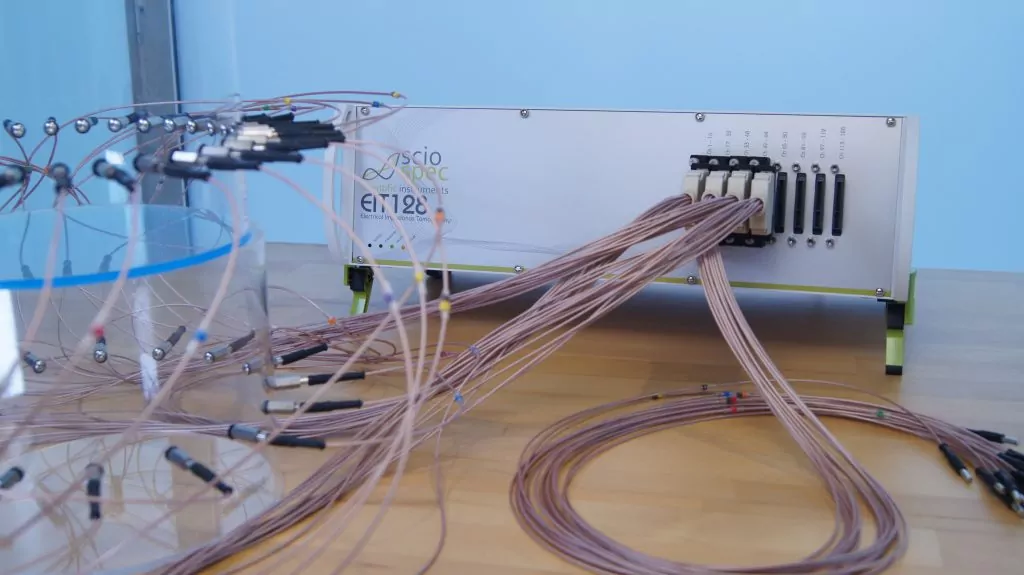
The study explores a parametric imaging method that reconstructs object size and position from a sparse set of measurement. This innovation points toward more efficient real-time imaging solutions for applications where traditional tomographic reconstruction can be slow or data-heavy. At the heart of this experiment was a Sciospec EIT system, enabling high-resolution, multi-channel impedance data acquisition.
🔍 Want to know more about how parametric EIT is changing imaging? Keep Reading or take a shortcut and ask us directly to discuss your use case.
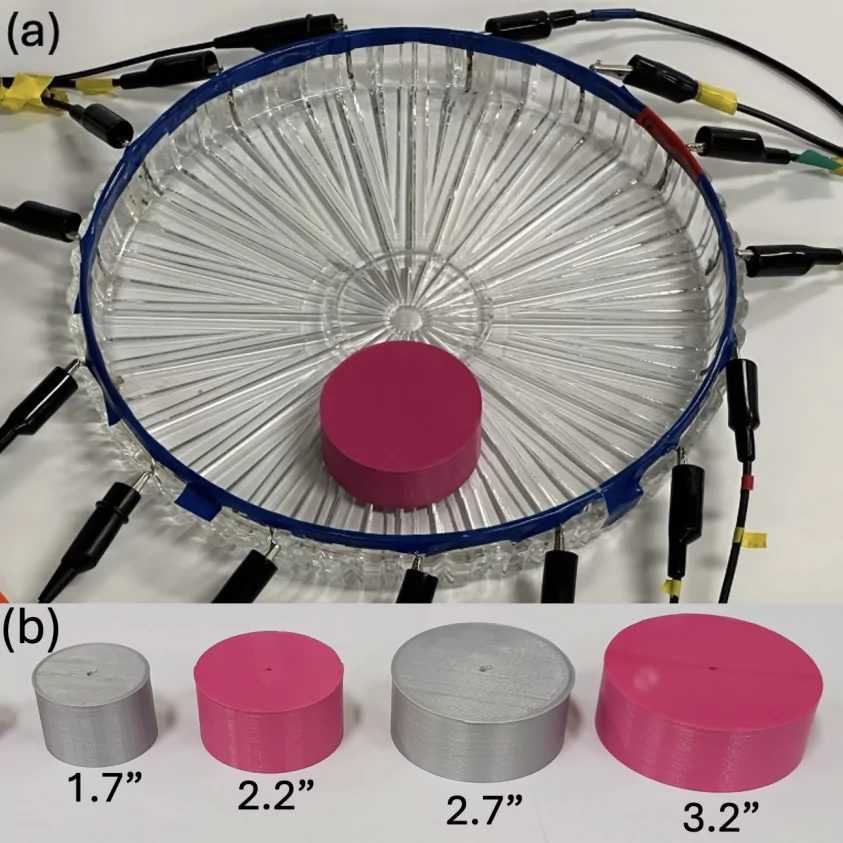
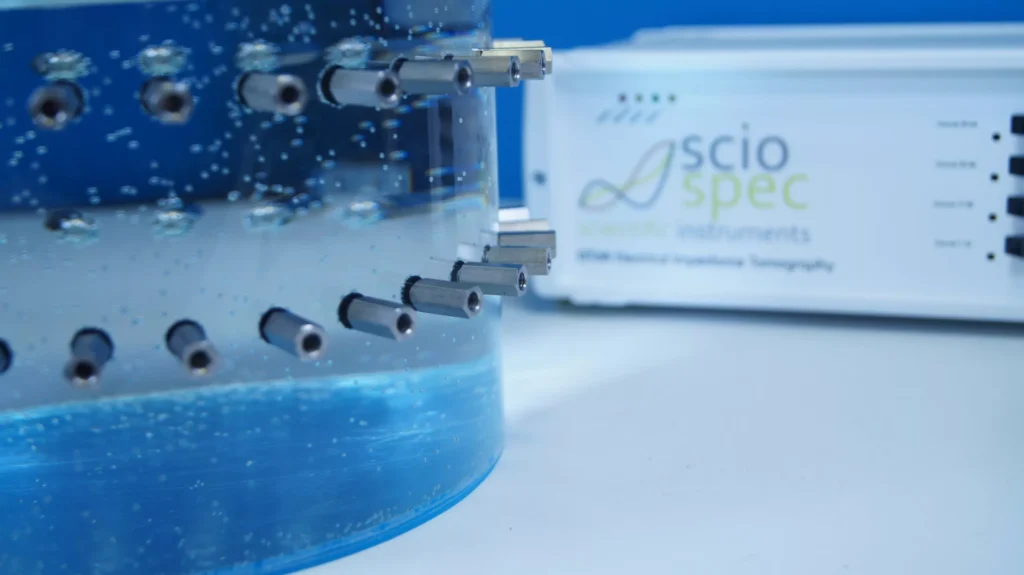
(a) Top view of saltwater tray phantom with 15 silver/silver chloride electrodes arranged circumferentially. (b) Test cylinders of varying diameters (1.7″, 2.2″, 2.7″, 3.2″) used for training and evaluation in parametric EIT imaging.
Why This Research Matters: Imaging with Fewer Measurements
Conventional EIT methods rely on generating full conductivity maps through dense datasets and significant computational effort. While effective, these methods can be inefficient, especially in cases where the anatomical or physiological structure of interest can be parameterized
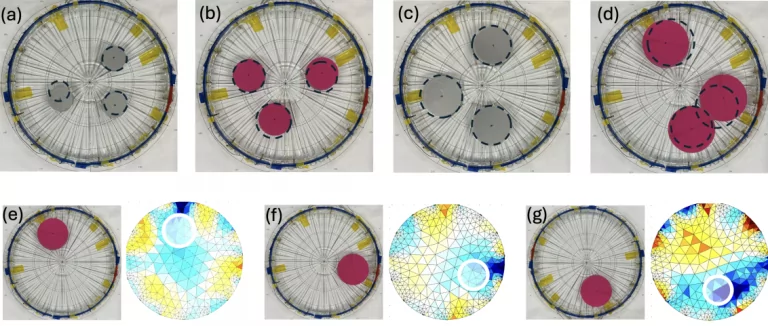
In the study, Sheflin et al. tested a model in which only nine optimized impedance measurements were used to determine the angular position and diameter of insulating cylinders placed in a saltwater phantom. Instead of reconstructing a full conductivity image the method directly inverted the data into a set of parameters describing the object’s size and position significantly reducing data requirements while maintaining high spatial accuracy.
The use of a Sciospec EIT128 system enabled real-time acquisition and precise signal capture across 128 channels, demonstrating how high-density impedance data can power a smarter, more efficient inversion model.
⚡Looking for more answers ? Check out our detailed FAQ section further down see how our EIT solutions are transforming Parametric Imaging
Sciospec’s Contribution: Enabling Advanced EIT Inversion with the EIT128
For this research, Sciospec provided the 128-channel EIT platform that formed the foundation for data acquisition and model validation. The experiment used true-parallel impedance measurements to collect high-fidelity voltage data from 15 electrodes placed around the imaging phantom. Thanks to our system’s capability for simultaneous sampling across all channels and flexible current injection configurations, the research team was able to:
- Collect high-accuracy data using just a fraction of traditional measurement sets
- Perform multi-frequency spectral measurements with sweeping from 100 Hz to 1 MHz
- Inject currents up to 10 mA peak amplitude accommodating a variety of conductivity scenarios
- Achieve frame rates up to 100 fps suitable for dynamic physiological processes
In parametric approaches where each measurement must be highly informative, this level of performance is essential
🚀 Ready to learn how our EIT device is driving advances in imaging applications?
👉 Explore our detailed publication on Electrical Impedance Imaging using the Sciospec EIT system and learn how it drives innovation in imaging technology: Electrical Impedance Imaging with Sciospec EIT System
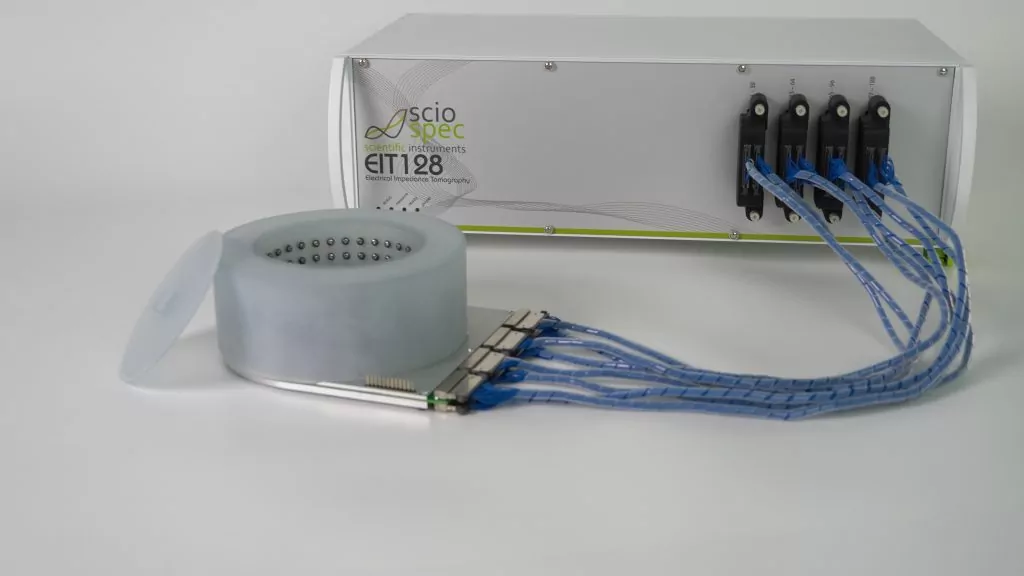
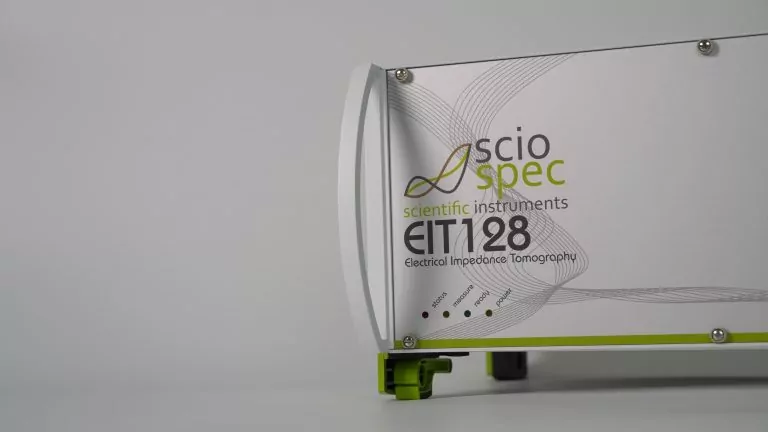
The EIT128 Sustem: Power, Flexibility, and Scalability for EIT Research
Sciospec’s EIT32/64/128 platform is designed to provide researchers with a flexible, scalable solution for innovative EIT applications. The device used in this study , the EIT128 ,offers full compatibility with various electrode configurations and is ideally suited for tomographic imaging tasks in constrained biological or physical systems.
Key advantages of the EIT128 system include:
- 💡 128 Channels Fully Parallel : Capture complex spatial patterns in real time with minimal signal lag.
- ⚡ 100 fps Frame Rate : Ideal for dynamic or time-sensitive imaging scenarios.
- 🔄 Flexible Current Injection & Voltage Sensing : Match any phantom or in-vivo setup without hardware modifications.
- 🧠 Open Integration : Use your favorite tools (e.g., EIDORS, MATLAB) or tap into our API for custom analysis.
Our EIT systems are accompanied by a range of accessories such as phantom tanks, cable sets, and chip adapters making it easy for research teams to get started quickly and focus on results.
This modularity and adaptability ensure that setups like the one used by Sheflin et al. can scale with research needs, transitioning from simplified phantom models to more complex anatomical structures or clinical applications.
⚙️ Looking to scale or customize? Explore the full range of Sciospec EIT solutions
Scalable Solutions for Evolving Research Needs
One of the standout features of the Sciospec platform is its scalability. The same base system architecture supports EIT16, EIT32, EIT64, EIT128, and even EIT256 configurations. In this study, researchers could begin with a modest channel count and scale up to full 128-channel operation without needing to change their entire setup.
This makes the platform ideal for:
- Feasibility studies and rapid prototyping
- In-vitro and phantom experiments
- In-vivo functional imaging in research contexts
- Development of clinical diagnostic tools
⚙️ Want to configure your perfect EIT setup? See the advantages of our EIT systems

Want to dive deeper? Talk to our experts!
Our experts are ready to help you understanding how this technology works and how you can apply and integrate it into your work. Get in touch today to get a personalized consultation to enhance your work with our advanced solutions
A Smarter Path Forward for EIT-Based Imaging
The work by Sheflin et al. showcases the potential of parametric inversion techniques in EIT to reduce data loads and speed up image interpretation. This is particularly promising for applications in which the structures of interest are known or constrained
Thanks to the precision, speed, and scalability of the Sciospec EIT128 system, this research was able to validate an efficient new approach to impedance imaging that may shape the future of real-time diagnostics. As researchers continue exploring smarter imaging strategies, we’re proud that our tools are helping them lead the way.
Looking to explore EIT for your own research or application?
📩 Contact us to configure your custom setup from early research to scalable OEM solutions
💡Curious for more? Check out our latest developments and products.
🧪Want to try it yourself? Contact us for more information
🚀Looking for a tailored solution? Our experts can help!
📢 Follow us on LinkedIn for more updates.
#Innovation #Sciospec #ImpedanceTomography #ElectricalImpedanceImaging #ParametricEITInversion #SparseModelSampling #Real-TimeImaging
Explore Related Research and Insights
explore by relevant keywords
…or just browse our most recent posts:
Get in touch with us
Frequently asked questions
What is parametric inversion in Electrical Impedance Tomography (EIT) ?
Parametric inversion in EIT refers to a technique where the internal conductivity distribution is modeled using a set of parameters, such as the size, shape, and position of anomalies. Instead of reconstructing the entire conductivity image, this method estimates these parameters directly from the measured data, leading to faster computations and reduced data requirement
What are the advantages of using parametric inversion in EIT ?
Parametric inversion in EIT focuses on estimating specific parameters (like size, position, or shape of an inclusion) rather than reconstructing full conductivity images. This approach reduces computational complexity, requires fewer measurements, and can offer faster and more robust solutions, especially in scenarios where the region of interest can be described with a limited set of parameters.
How does sparse model sampling improve EIT imaging ?
Sparse model sampling leverages the idea that many physiological structures can be represented with a limited number of parameters. By focusing on these key parameters and using fewer measurements, sparse sampling enhances imaging speed and efficiency without significantly compromising accuracy. This method is particularly beneficial in real-time monitoring applications.
What are the challenges associated with EIT reconstruction algorithms ?
EIT reconstruction algorithms face several challenges, including the ill-posedness of the inverse problem, sensitivity to measurement noise, and the need for accurate modeling of the measurement system. Addressing these challenges requires advanced mathematical techniques, regularization methods, and efficient computational algorithms to achieve reliable and accurate reconstructions.
How is EIT applied in biomedical imaging ?
In biomedical imaging, EIT is used for monitoring and diagnosing various physiological conditions. Applications include lung function monitoring, detecting breast tumors, assessing brain activity, and evaluating tissue perfusion. Its non-invasive nature, portability, and real-time imaging capabilities make EIT a valuable tool in clinical settings.
What is the role of multi-channel impedance measurement in EIT ?
Multi-channel impedance measurement is crucial in EIT as it allows simultaneous data acquisition from multiple electrode pairs. This capability enhances spatial resolution, improves signal-to-noise ratio, and enables real-time imaging, making it essential for dynamic monitoring and applications requiring high temporal resolution.
What are phantom models in EIT, and why are they important ?
Phantom models in EIT are artificial constructs that simulate the electrical properties of biological tissues. They are used for calibrating and testing EIT systems, validating reconstruction algorithms, and training purposes. Phantoms provide a controlled environment to assess system performance and improve imaging techniques before clinical application.