
Modular LCR meter
built to scale.
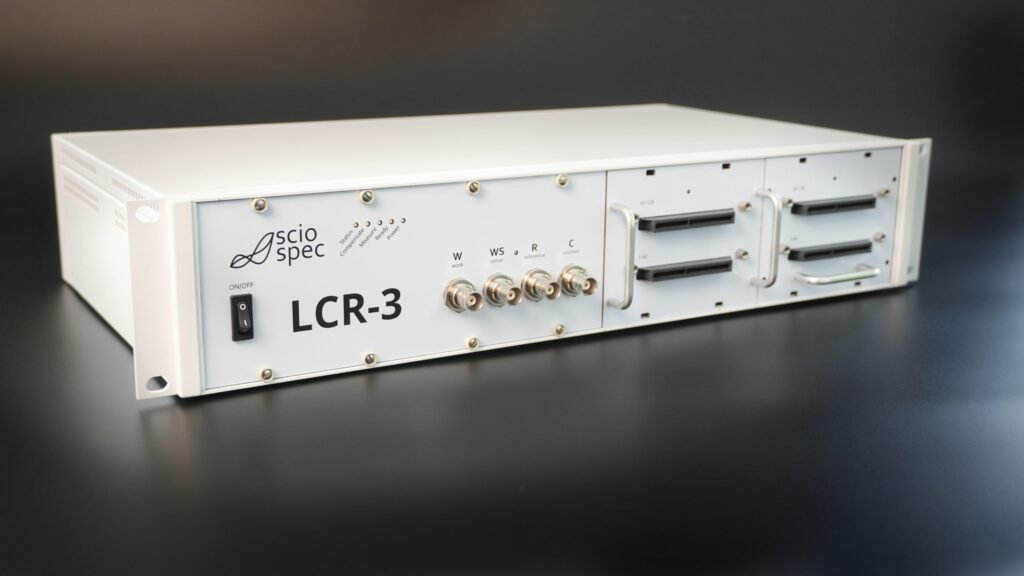
Professional-grade LCR measurements with a scalable, automation-ready design. Built on the same high-precision core as the compact LCR-1, the LCR-3 adds a configurable enclosure, optional integrated multiplexers and native support for automated multi-object testing.
- Same 0.01 % precision core as the LCR-1, on a modular platform
- Integrated multiplexing up to 256 ports — any-to-any mapping
- Desktop or 19″ rack-mount · SCPI, Python, C#, LabVIEW automation
100 µHz – 10 MHz
Frequency Range
0.01 %
Base Accuracy
up to 256 ports
Integrated MUX
Desktop / 19″ rack
Form Factor
A modular LCR platform — from R&D bench to production line
The LCR-3 takes the high-precision core of the LCR-1 and adds the things you need at scale: a configurable enclosure, integrated multiplexers up to 256 ports, and a software/API stack ready for automated multi-object testing.
High-precision core
0.01 % BASE ACCURACY
The same measurement core as the LCR-1 — wrapped in a modular platform
Whether the setup requires parallel electrochemical channels, sequential routing through a 64-port network, or a combination of both, the CSX-64 provides a flexible architecture for complex biosensor and multi-electrode measurement setups.
Integrated multiplexing
UP TO 256 PORTS
Built to scale — any-to-any switching with ultra-low parasitics
Optional integrated multiplexers handle 32, 64, 128 or 256 ports with true any-to-any functional mapping. Where traditional LCR meters limit you to one sample at a time, the LCR-3 was made for batch characterisation, end-of-line and inline QA.
Automation-ready
SCPI · PYTHON · C# · LABVIEW
Plug-and-play software with full external control
Guided workflows, live pass/fail visualisation, auto-ranging, batch logging and CSV/JSON/XML export — backed by SCPI and the Sciospec API with Python and C# code examples for scripted automation.
Technical Specifications
Core electrical parameters, multiplexing options and automation interfaces for the LCR-3 base configuration. Full datasheet available on request.
Parameter
Specification
Notes
GENERAL
Form factor
Desktop or 19″ rack-mount
Configurable enclosure
Electrode Configurations
2 / 3 / 4-terminal
Selectable per workflow
Connection interface
SC98 connector or coaxial BNC
Banana / custom on request
Interfaces
USB · Ethernet
Software & automation
MEASUREMENT
Frequency range
100 µHz – 10 MHz
Optional extension to 40 MHz
Base accuracy
0.01 %
Typical
Impedance range
1 mΩ – 1 TΩ
Auto / manual ranging
Measurement modes
L · C · R · Q · D · Z · ESR · phase
Standard parameter set
Compensation & averaging
Configurable
Integration time, averaging, compensation
MULTIPLEXING & AUTOMATION
Integrated multiplexer
32 / 64 / 128 / 256 ports
Optional · any-to-any mapping
Switching
Ultra-low parasitics
Reed-relay matrix
Software
LCR app · Sciospec API · SCPI
Python · C# · LabVIEW examples
Where the LCR-3 fits in
Wherever you need scalable, automation-ready LCR measurements — end-of-line testing, batch characterisation, inline QA, sensor arrays and high-throughput R&D — the LCR-3 brings impedance-analyzer-grade precision to multi-channel workflows.
Automated end-of-line testing
Multi-channel pass/fail testing on capacitors, inductors, resistors and ferrites at production speeds — driven by SCPI or the Sciospec API.
Batch characterisation
Characterise large sample batches in a single setup with up to 256 multiplexed ports and any-to-any switching, with logging and CSV / JSON / XML export.
Inline QA & high-throughput R&D
Bring high-precision LCR into automated QA stations and high-throughput research workflows without giving up measurement accuracy.
Sensor & material screening
Screen large arrays of sensors, samples or test cells with adapter sets for components, sensors and liquid / solid materials.
Configure your LCR-3
Choose the frequency range, multiplexer size, enclosure, connectors and software / adapter options that match your automated workflow.
Loading configurator…
Complete your setup
Combine the LCR-3 with multiplexer modules, connector sets, component / sample adapters and software add-ons to build the production or research workflow you need.
Integrated multiplexer modules
Plug-in MUX modules in 32 / 64 / 128 / 256-port configurations with any-to-any switching. [Product-specific accessory image needed]
Details
SC98, BNC & banana connector sets
Front-panel connector kits for SC98, coaxial BNC and banana — or custom layouts on request.
Details
Component test fixtures
THT / SMT fixtures and universal clamps for components in QA and end-of-line testing.
Details
Sensor & sample adapters
Adapters for sensor arrays, liquid samples and solid materials. [Product-specific accessory image needed]
Details
From a modular LCR-3 to your OEM LCR platform
When you move from a configurable LCR-3 to a product, we help migrate the measurement core into OEM hardware with tailored firmware, connectors and software branding for your target environment.
- 01
Pilot the LCR-3 in your workflow
Validate scalable LCR testing on a standard LCR-3 with the right MUX size, connectors and adapters for your line or lab.
- 02
Automate with SCPI & the Sciospec API
Integrate the LCR-3 into your QA station, MES or lab automation stack using SCPI, Python, C# or LabVIEW — with Sciospec code examples to get you started.
- 03
Embedded OEM LCR platform
For volume production, migrate the LCR measurement core into a dedicated OEM platform with tailored electronics, enclosure and white-labelled software.
Published reference
High-throughput cardiac safety screening with impedance measurements (shared measurement core)
Scalable precision, validated in industrial workflows
The LCR-3 shares its measurement core and OEM architecture with Sciospec systems cited in published work on CiPA-compliant cardiac safety screening and Organ-on-Chip TEER monitoring — both relying on simultaneous, multi-channel impedance readouts.
Challenge
Scale precision LCR / impedance measurements from 96 to 576+ channels for CiPA-compliant drug-safety screening and barrier-integrity monitoring.
SCIOSPEC ROLE
The same architecture used in OEM screening platforms powers the LCR-3 — bringing that scalable precision into a configurable LCR meter.
RESULT
Industrial-scale, non-invasive impedance monitoring with readout times under 30 seconds, trusted by partners such as Merck and Roche.
USER VOICE
- "The LCR-3 is Sciospec's standard solution for scaling LCR measurements in lab and industry environments. If you need excellent measurements in even higher channel count in your production line, please reach out to us!"
Paul Luutz
Paul Luutz
Additional published work covers Organ-on-Chip TEER monitoring, high-throughput cardiac safety screening and OEM EIS architectures — all sharing the Sciospec impedance measurement core.
Individual FAQ
Short technical answers to the questions we hear most often about the LCR-3.
What's the difference between the LCR-3 and the LCR-1?
The LCR-1 is a compact single-channel benchtop LCR meter. The LCR-3 is a modular, automation-ready platform on the same measurement core, with optional integrated multiplexers up to 256 ports and a desktop or 19″ rack-mount form factor.
How accurate is it?
0.01 % base accuracy across the impedance range 1 mΩ – 1 TΩ. Standard parameter set includes L, C, R, Q, D, Z, ESR and phase, with manual and automatic ranging and configurable averaging / compensation / integration time.
What frequency range does it cover?
100 µHz to 10 MHz standard, with an optional extension to 40 MHz at order time.
How many channels can it switch?
Up to 256 ports with integrated multiplexer modules (32 / 64 / 128 / 256), with ultra-low parasitics and true any-to-any functional mapping.
How is it automated?
Through SCPI for full external control and the Sciospec API, with Python and C# code examples plus LabVIEW integration. Software add-ons cover pass/fail testing, automated workflows and custom reporting.
Is the LCR-3 available as an OEM platform?
Yes. The LCR-3 is OEM-ready and fully customisable for product integrations and private labelling — including tailored electronics, enclosure and software branding.
How would you like to continue?
Choose the next step that fits where you are — from first conversation to scaling up to fully automated multi-channel LCR testing.
Tell us about your line or lab
Share your QA, end-of-line or research workflow — we’ll help scope the right LCR-3 configuration.
Configure your LCR-3
Choose frequency range, multiplexer size, enclosure, connectors and software options.
Need a compact bench LCR?
If single-channel benchtop LCR is all you need, the LCR-1 brings the same precision in a compact form factor.
Get in touch with us
Phone
Headquarters
Sciospec Scientific Instruments GmbH
Leipziger Str. 43b
04828 Bennewitz, Germany
Open in Google Maps