
Sciospec / Precision LCR Meters
Precision LCR Meters
High-end accuracy in a compact bench meter — and a scalable platform when you need automated multi-object testing with up to 256 ports. Built on the same measurement core as our impedance analyzers.
- 100 µHz … 10 MHz (extendable to 40 MHz)
- R: 1 mΩ … 1 TΩ · C: 10 fF … 1 kF · L: 1 nH … 1 TH
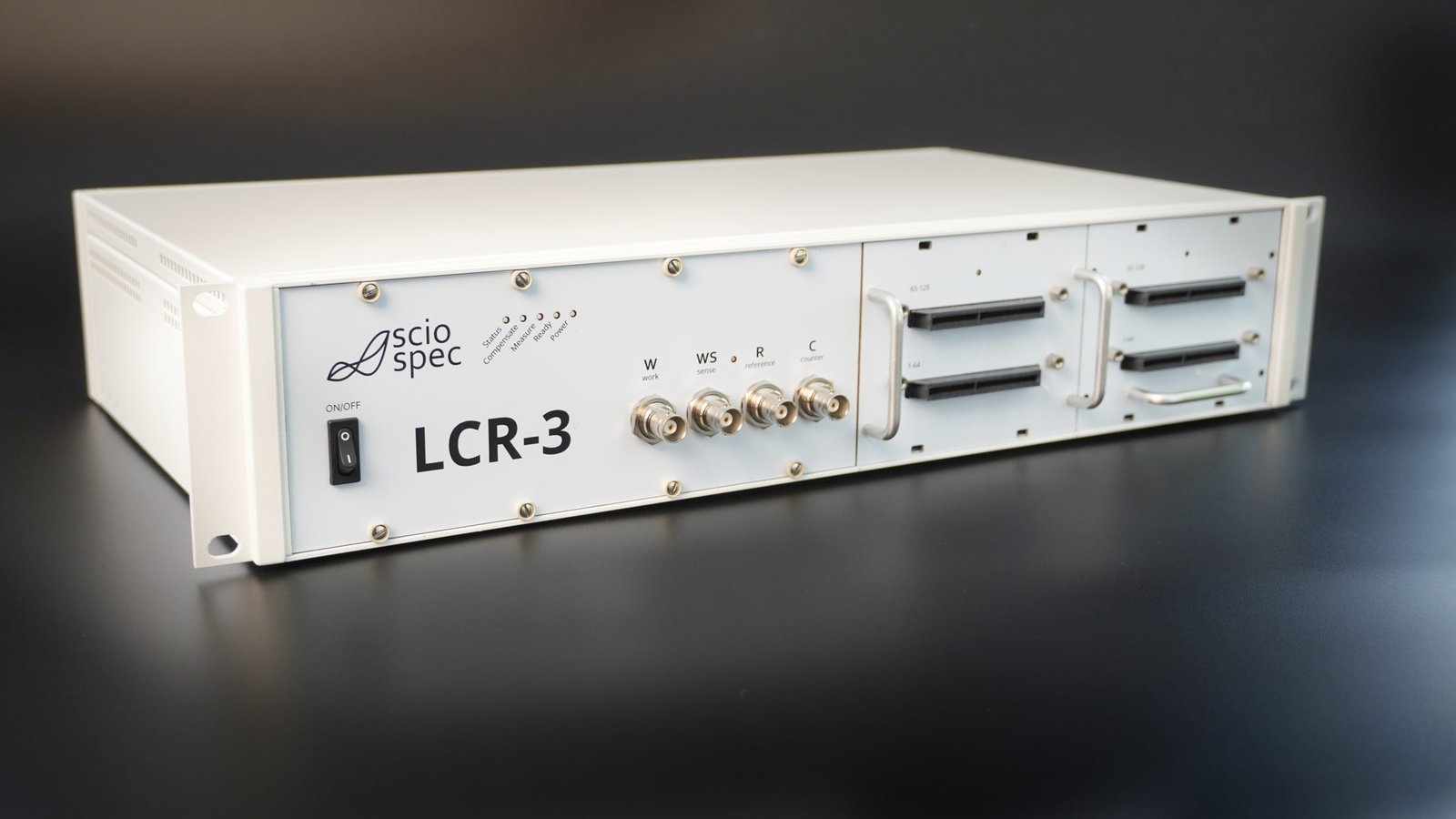
- Integrated multiplexers up to 256 ports (LCR-3)
- 0.01% base precision
- 2/3/4-terminal configurations
- SCPI + Sciospec API for full automation

Architecture & flexibility
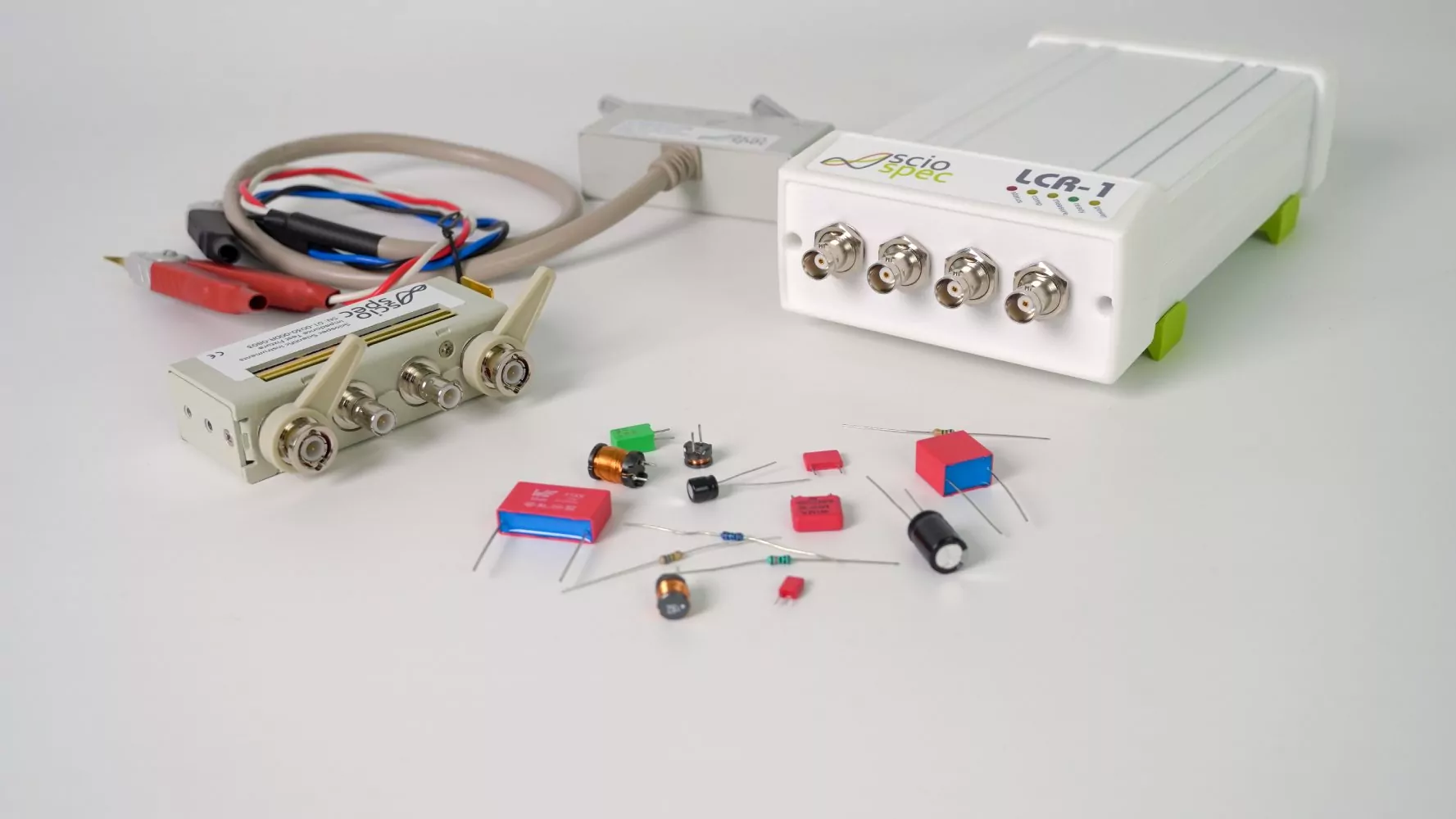
Built on the same precision core as the Sciospec impedance analyzers — the LCR-1 brings high-end accuracy to your bench, the LCR-3 brings it to your production line.
What is an LCR meter?
An LCR meter is a specialised electronic test instrument used to measure the inductance (L), capacitance (C) and resistance (R) of passive components and other test objects. In practice, real-world components are rarely ‘pure’ — most measurements characterise combinations like RC or LC series and parallel networks. The meter applies an AC stimulus to the device under test (DUT), measures the resulting voltage and current, and analyses the phase relationship between them. From magnitude and phase it derives the complex impedance and reports L, C, R, ESR, dissipation factor (D), quality factor (Q) and related parameters according to a selected equivalent-circuit model. More advanced instruments support multi-frequency sweeps similar to impedance spectroscopy, making them suitable for characterising frequency-dependent component behaviour beyond a single test point.
Equivalent-circuit models, ESR and Q
Precise characterisation requires the right equivalent-circuit model. The series model (Rs–Ls or Rs–Cs) is preferred for low-impedance parts where internal series resistance dominates losses; the parallel model (Rp–Lp or Rp–Cp) suits high-impedance parts where leakage dominates. Quality factor (Q) and dissipation factor (D) describe how efficient a part is at storing vs. dissipating energy, and ESR — equivalent series resistance — is often the deciding parameter in power electronics where it drives self-heating and ageing.
- Series model — for low-impedance DUTs (large caps, small inductors)
- Parallel model — for high-impedance DUTs (small caps, large inductors)
- D / tan δ — energy dissipated vs. energy stored
- Q — efficiency of an inductor (inverse of D)
- ESR — critical for capacitor lifetime in power electronics
Application scenarios — from R&D to production
LCR measurement spans the full lifecycle of a passive component — from material research to incoming QA, end-of-line testing and field troubleshooting. Sciospec LCR meters slot into all of these contexts thanks to programmable test conditions, automation interfaces and a wide range of fixtures and adapters.
- Component characterisation — caps, inductors, resistors, transformers
- Quality control & manufacturing — ATE integration, pass/fail binning
- Circuit design & troubleshooting — verifying parasitics in filters and networks
- Material & sensor testing — dielectric, MEMS, automotive sensors
- Academic & industrial research — characterising novel structures
What to look for in an LCR meter spec
Headline numbers rarely tell the whole story. Accuracy and speed both depend on frequency and on the absolute impedance of the DUT — most manufacturers specify across a very wide range but only achieve full accuracy inside specific zones of that range. The most useful artefact for comparing instruments is the accuracy-contour plot, which shows where in the frequency–impedance plane each accuracy class applies. Look for: 4-terminal Kelvin support, DC bias capability, sweep depth and point density, supported test fixtures, and remote interfaces (SCPI, API) for automation.
Technical specifications
Rule of thumb: choose an LCR meter when you need to qualify components at defined operating points; choose an impedance analyzer when the spectrum itself is the answer.
Embed Sciospec measurement into your product
Building sensitive analog hardware from scratch slows your roadmap. Embed our validated measurement core directly — tailored channel counts, custom form factors, specialised connectivity — and ship faster.
20+
years building measurement hardware
Custom
form factors & connectivity
OEM
white-label & private branding
ISO
9001 and 13485 certified
Related products
Frequently asked questions
01 What's the difference between an LCR meter and a multimeter?
A multimeter measures resistance with a DC signal and offers only rough capacitance via charge/discharge timing — useful for diagnostics but not for characterising components under realistic operating conditions.
An LCR meter applies an AC excitation at selectable frequencies, measures both magnitude and phase, and resolves inductance, capacitance, ESR, Q and D. Because L and C are inherently frequency-dependent, this is essential for any kind of design verification or production QA.
02 When should I use an LCR meter instead of an impedance analyzer?
Use an LCR meter for high-throughput production testing, incoming QA, and R&D scenarios where measurements at specific operating frequencies are sufficient. Choose an impedance analyzer when you need wideband sweeps, full Nyquist / Bode plots, equivalent-circuit fitting, or are investigating unknown resonances.
03 Which specs matter most when choosing an LCR meter?
Test frequency range, base accuracy, supported signal levels and bias, measurement speed, and the availability of 4-terminal Kelvin connections. For automation, look at remote interfaces (SCPI / API), trigger handling and supported test fixtures. The accuracy-contour plot is the single most useful chart to compare instruments.
04 Series vs. parallel measurement modes — what's the difference?
They refer to the equivalent-circuit model used to interpret the measured impedance. Series mode suits low-impedance DUTs where lead and contact resistance dominate losses; parallel mode suits high-impedance DUTs where leakage is the main loss path. Picking the wrong model gives you mathematically correct, physically misleading numbers.
05 How do open and short compensation work?
Compensation removes the residual impedance of your cables and fixture. An ‘Open’ measurement with the terminals disconnected captures stray capacitance and conductance; a ‘Short’ with a zero-impedance bar captures residual resistance and inductance. The instrument then subtracts these from every measurement. Skipping this step is one of the most common causes of bad data at high frequency or low impedance.
06 How does DC bias affect inductor and capacitor measurements?
DC bias lets you characterise components in something close to their real operating conditions. Inductors with magnetic cores can saturate under DC current — you’ll see inductance drop. Many MLCC capacitors lose significant capacitance under DC voltage. Without bias, you’re characterising the part on the bench, not in the circuit.
07 Can Sciospec LCR meters be integrated into ATE or OEM systems?
Yes. Both the LCR-1 and LCR-3 expose a full SCPI command set plus the Sciospec API with Python and C# examples. The LCR-3 is built for rack-mount and ATE integration with integrated multiplexers up to 256 ports, hardware triggers, and pass/fail logic. The core measurement engine is also available as an embedded OEM module.
08 How often should an LCR meter be calibrated?
Annual calibration is standard practice in professional labs. ISO/IEC 17025 is the global benchmark for calibration competence and traceability. Sciospec instruments ship factory-calibrated and can be re-certified through our service team.
Get in touch
Looking to embed precision LCR measurement into your product?
Building sensitive analog measurement hardware from scratch slows your roadmap. Sciospec’s validated LCR core can be embedded directly into your product — with tailored channel counts, specialised connectivity and custom form factors — so you can focus on your unique value proposition and ship faster.