Case summary
At a glance
Discover how the EIT LUNG Kit can enhance lung function monitoring during mechanical ventilation. 22 – 26 April 2024 @Lorentz Center, Leiden, NL
Full reference article
Addressing a Critical Challenge in Patient Monitoring
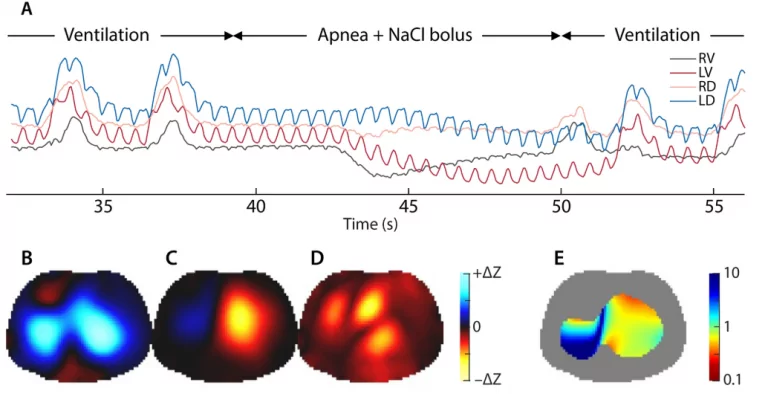
The study demonstrates that EIT-guided positive end-expiratory pressure (PEEP) titration significantly improves oxygenation in ARDS patients compared to conventional methods, addressing the ongoing challenge of balancing lung recruitment and avoiding overdistension in critical care. In addition to optimizing ventilation, the researchers used real-time EIT imaging to monitor changes in regional lung aeration and ventilation distribution.
By incorporating Sciospec’s high-precision impedance measurement technology, the research team was able to visualize regional lung ventilation in real time, allowing for precise ventilator adjustments that improved oxygenation while potentially lowering the risk of ventilator-induced lung injury.
Interested in optimizing mechanical ventilation with EIT? Explore our in-depth FAQ section to learn more.
Unlocking New Insights with Advanced Impedance Technology
This research highlights how electrical impedance Tomography (EIT) bridges the gap between non-invasive monitoring and real-time clinical decision-making. By providing a clear, spatially-resolved picture of regional lung function, EIT offers unique advantages:
- Continuous, bedside monitoring without invasive procedures.
- Enhanced detection of subtle fluid changes before they escalate into critical complications.
- Support for personalized fluid management strategies, optimizing care for individual patients.
- Potential reduction in reliance on more invasive monitoring tools, reducing patient risk ..
The researchers relied on Sciospec’s state-of-the-art EIT systems, to gather and analyze bioimpedance data across multiple frequencies. Our technology enabled the precise, multi-channel data acquisition that is essential for accurate and clinically meaningful EIT imaging in dynamic critical care environments.
Looking for more answers? Keep reading to learn more. We also have a detailed FAQ section further down. Or take the shortcut and directly reach out to us.
Sciospec's Role in Advancing Critical Care Research
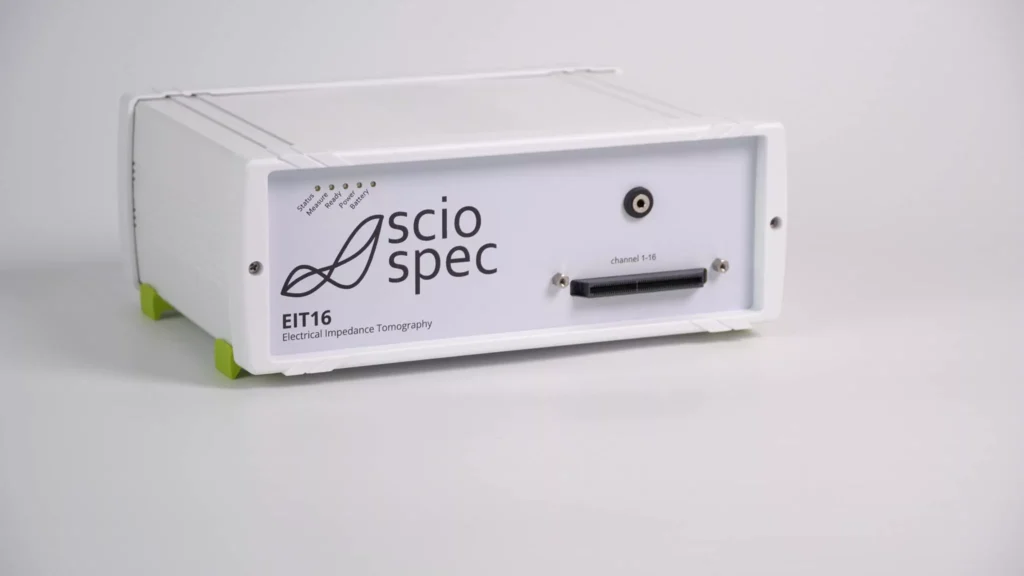
At Sciospec, we design highly adaptable, modular Electrical Impedance Tomography (EIT) systems tailored for advanced medical research. Our Electrical Impedance Tomography (EIT) systems, particularly suited for lung imaging applications, provide spatially resolved impedance data across the thoracic region.
These systems played a pivotal role in enabling groundbreaking research by offering unmatched precision and flexibility in capturing detailed lung function data with high temporal and spatial resolution. The Sciopsec EIT system’s ability to simultaneously measure up to 256 electrodes provides a comprehensive view of lung behavior during mechanical ventilation, crucial for developing personalized ventilation strategies and advancing our understanding of ARDS pathophysiology.
Explore Our Product Page to Learn More About Our EIT Systems
Advancing Lung Imaging Research
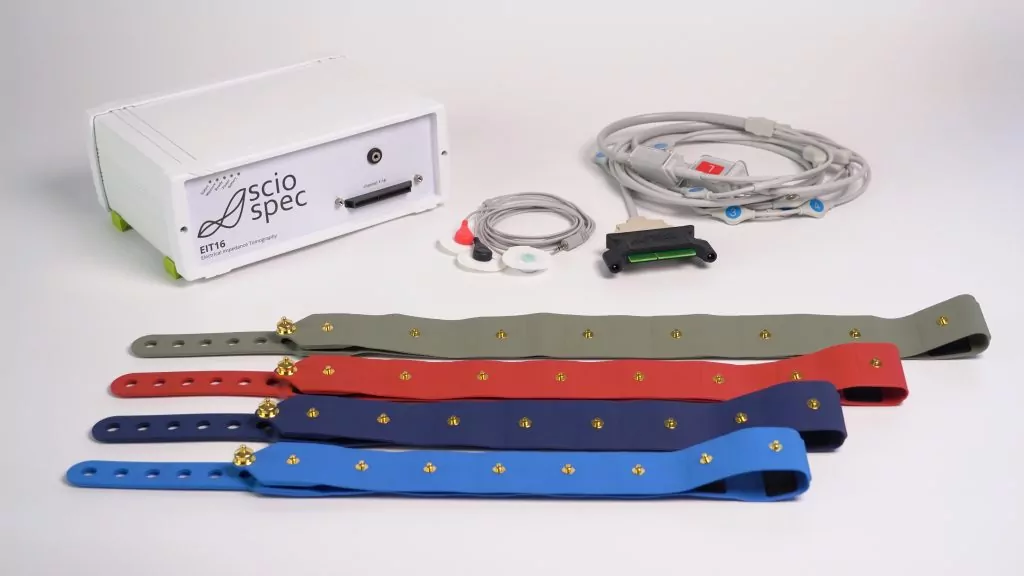
The LungEIT Kit is a game-changing solution for research teams venturing into lung imaging applications. This comprehensive bundle provides the easiest possible entry into EIT-based lung imaging, offering a ready-to-use system that simplifies both setup and application in clinical and research settings.
- Easy Entry into Lung Imaging – A ready-to-use solution combining research flexibility with medical-grade safety
- Medical-Grade Compliance – IEC 60601-1 certified for safe use in clinical settings.
- Multi-Channel EIT Imaging – Supports up to 256 electrodes for high-resolution lung monitoring.
- Real-Time Data Processing – Provides instant visualization of ventilation dynamics.
- Seamless Integration – Compatible with EIDORS & external respiratory sensors.
- Scalable & Customizable – Options to expand channel counts, sync with ECG signals

Want to dive deeper? Talk to our experts!
Our experts are ready to help you understanding how this technology works and how you can apply and integrate it into your work. Get in touch today to get a personalized consultation to enhance your work with our advanced solutions
Step into the Future with Impedance based EDA measurements
The integration of Electrical Impedance Tomography (EIT) into mechanical ventilation monitoring is redefining how clinicians manage respiratory function in critical care settings. As demonstrated by this recent research, real-time, non-invasive lung imaging is no longer a futuristic concept—it’s an essential tool for improving patient outcomes today.
At Sciospec, we are committed to driving innovation in biomedical impedance technology, providing researchers and clinicians with scalable, customizable, and high-precision solutions. Whether you’re exploring lung imaging for critical care, clinical research, or device development, our advanced EIT systems, including the LungEIT Kit, are designed to support your needs from concept to clinical application.
🚀 Curious about how EIT can enhance your research or clinical practice? Dive into our resources or reach out for expert consultation. Contact us Now
💡Curious for more? Check out our latest developments and products.
🧪Want to try it yourself? Contact us for more information
🚀Looking for a tailored solution? Our experts can help!
📢 Follow us on LinkedIn for more updates.
#Innovation #Sciospec #ImpedanceTomography #MechanicalVentilationMonitoring #ICU
#ARDS #Signal Processing
Explore Related Research and Insights
explore by relevant keywords
…or just browse our most recent posts:
Get in touch with us
Frequently asked questions
What is ARDS and how does it affect lung function ?
Acute Respiratory Distress Syndrome (ARDS) is a severe form of lung injury characterized by widespread inflammation and fluid leakage into the air sacs of the lungs. This leads to impaired gas exchange, causing hypoxemia (low blood oxygen levels) and stiffening of the lungs. The review article discusses how Sciospec EIT technology can be used to monitor regional ventilation distribution in ARDS patients, helping clinicians to optimize ventilator settings and avoid ventilator-induced lung injury.
How can EIT aid in the management of ARDS patients on mechanical ventilation ?
In ARDS patients, lung injury is often unevenly distributed. EIT can help visualize this regional heterogeneity in lung ventilation. This information can be used to optimize ventilator settings, such as PEEP, to improve ventilation in poorly aerated regions while avoiding overdistension in healthier areas of the lung.
➡️ Sciospec’s LungEIT Kit provides clinicians with real-time visual feedback, enabling them to make more informed decisions about ventilator management in ARDS patients.
What is PEEP and why is it used in mechanical ventilation ?
Positive End-Expiratory Pressure (PEEP) is the pressure in the lungs above atmospheric pressure at the end of expiration. During mechanical ventilation, PEEP is often applied to prevent the alveoli from collapsing at the end of each breath. This helps to improve oxygenation, reduce lung injury, and maintain functional residual capacity.
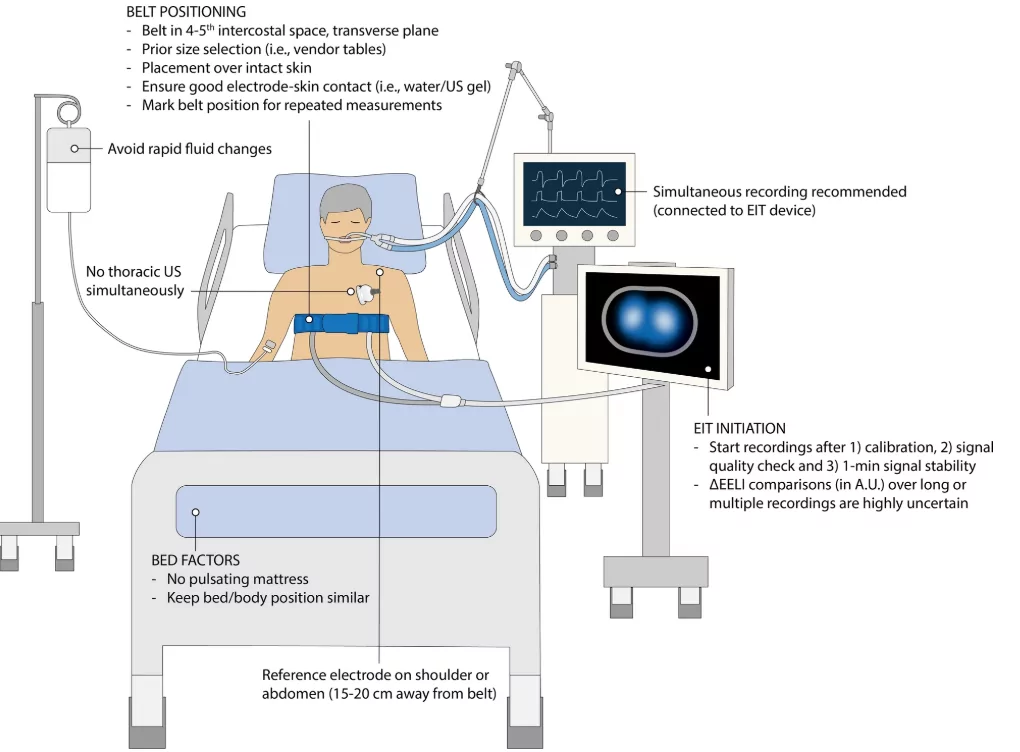
What is the recommended electrode belt placement for EIT in ICU patients, and why is it important ?
➡️ Sciospec’s LungEIT Kit includes guidance and tools to aid in accurate belt placement, helping ensure optimal data acquisition.
How does EIT differentiate between ventilated and non-ventilated lung tissue ?
EIT measures changes in electrical impedance within the thorax. During ventilation, the air-filled lung tissue causes changes in impedance. Regions with higher ventilation exhibit greater impedance changes compared to poorly ventilated or non-ventilated regions. By analyzing these impedance variations, EIT can create images showing the regional distribution of ventilation.
What are the potential artifacts in EIT measurements, and how can they be minimized ?
- Ensure proper electrode belt placement and consistent skin contact.
- Stabilize the patient’s position and minimize movement during measurements.
- Be aware of potential sources of electrical interference (e.g., pacemakers).
- Apply appropriate signal filtering techniques during data processing.
➡️ Sciospec’s advanced signal processing capabilities within the LungEIT Kit can help mitigate some of these artifacts and improve the accuracy of EIT measurements.
How can I synchronize EIT data with other physiological signals (e.g., respiratory waveforms, ECG) for better analysis ?
Simultaneous measurement of EIT with other physiological signals facilitates comprehensive analysis and interpretation. Recording data on a single device is recommended, using a device-specific connection or flow/pressure sensor attached to the EIT machine. While perfect synchrony is challenging, breath-hold maneuvers during acquisition can serve as useful references for offline synchronization.
How does electrical impedance tomography work for lung monitoring ?
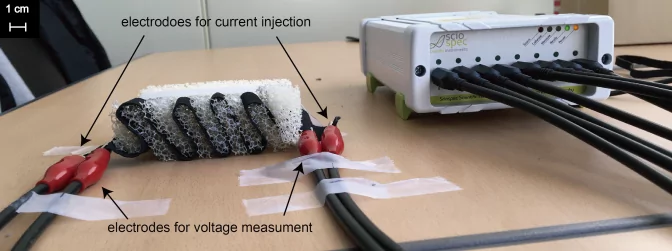
Electrical impedance tomography (EIT) works by injecting a small, safe electrical current through electrodes placed around the chest. The EIT system then measures the resulting voltage distribution. Since air and tissue have different electrical impedances, the voltage measurements can be used to create an image of the impedance distribution within the chest, reflecting the distribution of air in the lungs. Changes in impedance over time reveal how ventilation is distributed throughout the lungs during breathing.
What are the different clinical applications of EIT in mechanically ventilated patients ?
EIT has different clinical applications such as point-of-care evaluation of lung physiology and delivering of individualized mechanical ventilation and help monitor and assess the dynamic response to maneuvers (e.g. titration of positive end-expiratory pressure (PEEP) or prone positioning).