
Label-free sensing for Organ-on-Chip & Assays
Real-time, non-invasive impedance readouts for organ-on-chip, TEER barrier models, ECIS cell assays and lab-on-chip diagnostics — without dyes, labels or end-point compromise.
- TEER
- ECIS
- EIS
- Multichannel
- Organ-on-chip
- Custom adapters
Which situation fits your project best?
Every workflow starts somewhere different. Pick the scenario that matches what you’re trying to do — we’ll route you to the right hardware, adapter and reference design.
We already have a biochip or assay format in mind
You know the chip format, electrode layout, or TEER plate you want to use. You need measurement hardware that connects cleanly, scales beyond single wells, and produces a stable, comparable readout.
We're early — we just need to see if it works
You want a first feasibility setup to confirm that an electrical readout makes sense for your assay before committing to a platform. Quick to set up, easy to interpret, no full custom build.
We need to scale beyond manual measurements
Feasibility worked, but more channels, automation, and reproducibility are the next bottleneck. You need multichannel, multiplexed, or semi-parallel measurement architectures.
We're building a product around the readout
You need impedance measurement as a core function inside your own instrument — under your brand, integrated into your software, and validated for routine workflows.
Not sure which fits? Talk to an engineer — we’ll map your assay to the right hardware in one call.
Stop guessing between endpoints.
Start monitoring continuously.
Most cell assays force a tradeoff: staining destroys the sample, dilution disturbs it, and endpoint readouts collapse hours of biology into a single number. Impedance gives you a continuous, label-free signal in the same well — capturing dynamics that endpoint assays miss entirely.
Label-free
No dyes, no stains. The sample stays alive and intact for downstream analysis.
Non-invasive
Low-amplitude AC signals do not perturb cells. Measure repeatedly over hours or days.
Real-time
Continuous monitoring captures dynamics: barrier formation, attachment, response onset.
High throughput
Scale from single wells to multi-electrode arrays without changing the assay logic.
How EIS translates biology into data
The utility of impedance spectroscopy lies in scanning across a wide range of frequencies. Different biological structures respond to different frequencies, giving you a comprehensive “fingerprint” of your culture.
Low Frequencies
Current flows primarily around the cells, through the extracellular matrix and tight junctions. This is ideal for measuring Barrier Integrity (TEER) in epithelial or endothelial layers.
Application: TEER Monitoring
In Organ-on-Chip models involving gut, lung, or blood-brain-barrier (BBB) tissues, tracking the tightness of the cellular layer is critical. A drop in low-frequency impedance often signals barrier disruption due to a toxic compound.
High Frequencies
Current flows primarily around the cells, through the extracellular matrix and tight junctions. This is ideal for measuring Barrier Integrity (TEER) in epithelial or endothelial layers.
Application: Cell Viability & 3D Spheroids
Monitoring the high-frequency spectrum provides data on cell volume, viability, and internal morphology changes. This is particularly useful for 3D cell cultures and tumor spheroids where standard optical imaging fails to penetrate tissue depth.
Scalable TEER readout for Mimetas OrganoTEER®
Mimetas had already established its OrganoPlate® technology as a powerful organ-on-chip platform. The next challenge was making electrical barrier readout faster, easier to handle, and scalable enough for routine use.
Challenge
Scalable TEER readout had to become compatible with the existing organ-on-chip workflow instead of remaining a bulky external measurement add-on.
Sciospec role
Sciospec contributed the measurement electronics, interfaces, and integration expertise needed to turn impedance-based readout into a compact, multichannel platform solution.
Result
The readout became part of the platform logic, supporting broader adoption of functional, label-free barrier integrity measurements.
Why it matters
This is the kind of role Sciospec is built for: providing the measurement core behind scalable bioanalytical platforms, often under the partner's own brand.
Software Dashboard
From raw impedance signals to scalable biological readouts
For teams evaluating organ-on-chip, TEER, impedance, or sensorized cell-based platforms, the visible output may be simple. The measurement architecture behind it is not. This section explains the technical factors that influence whether an electrical readout becomes stable, interpretable, scalable, and useful in real workflows.
Covers: Electrode architecture & frequency strategy · Integrated electrical measurement architectures · Scaling readouts from feasibility to OEM platforms
From impedance spectra to reliable biological readouts
In advanced cell-based assays and organ-on-chip systems, the user-facing result is often simple: a TEER value, a barrier-integrity metric, a sensor response, a quality-control flag, or a trend over time. But the electrical behavior behind that result is rarely simple.
A measured impedance spectrum can contain contributions from the cell layer, culture medium, electrodes, membrane or substrate, cables, connectors, chip geometry, and the surrounding measurement setup. If these contributions are not understood, the final readout can become difficult to interpret. A signal change may reflect a biological response — or it may come from temperature drift, electrode polarization, medium exchange, geometry effects, or an unstable connection.
The goal is not simply to measure impedance. The goal is to define a readout architecture that turns complex electrical behavior into reliable biological information.
Key architecture factors
Electrode architecture
Integrated or external electrodes, two-electrode or four-electrode concepts, electrode material, geometry, polarization behavior, and connection strategy all influence what the system actually measures
Frequency strategy
Single-frequency readouts can be useful in simple cases, but multi-frequency impedance can provide more information about the cell layer, medium, electrode interface, and setup-specific effects.
Environmental stability
Temperature, media conductivity, incubation conditions, drift, and blank correction can strongly affect long-term cell-based measurements and must be considered in the workflow.
Output definition
The user may need a TEER value, impedance spectrum, barrier-integrity score, sensor response, QC flag, assay trend, or custom metric. The measurement architecture should be designed around the decision the output needs to support.
Scaling path
A readout that works once is not automatically ready for multiwell formats, automation, incubator operation, or OEM integration. Channel architecture, timing, multiplexing, parallelization, software control, and data handling should be considered early enough to avoid dead-end feasibility setups.
If your platform needs more than a signal — it needs a readout that users can trust, compare, and act on — we can help define the architecture behind it.
Beyond single-parameter readouts: integrated electrical measurement architectures
Advanced cell-based platforms rarely become stronger by adding more data indiscriminately. They become stronger when the right readouts are combined into a coherent measurement architecture.
For some applications, a robust TEER value is the central metric. For others, the full impedance spectrum carries important information about cell state, tissue maturation, adhesion, morphology, or dynamic response. In sensorized systems, electrochemical signals such as pH, oxygen, metabolites, or redox activity may be just as important as barrier integrity. In cardiac, neuronal, muscular, or other excitable models, electrophysiological activity and stimulation response can define the functional value of the assay.
The challenge is to combine these signals in a way that still fits the platform. Timing, synchronization, electrode usage, channel count, stimulation patterns, sensor interfaces, software control, and data handling all need to work together. Otherwise, multiple readouts can quickly become multiple sources of complexity.
Sciospec’s platform approach is built for this kind of integration. We can combine impedance spectroscopy, TEER, electrochemical techniques, electrophysiology, stimulation, multiplexing, synchronization, EIT, and software control into application-specific architectures that match the biological question and the intended workflow.
The result should not be a collection of disconnected measurements. It should be a usable readout concept: clear enough for routine operation, flexible enough for assay development, and scalable enough for future product generations.
If your platform needs more than one signal to explain what is happening biologically, we can help define how those signals should be measured, synchronized, interpreted, and integrated.
- TEER / EIS
- Electrochemistry
-
Electrophysiology /
Stimulation - Software Control
Integrated Readout Architecture
Scaling readouts from lab setup to real workflows
A readout that works in one experiment is not automatically ready for routine use. As soon as an assay moves beyond first feasibility, new constraints appear: more channels, more chips, more samples, shorter cycle times, automated handling, incubation, software integration, and reproducible operation across users and runs.
This is where Sciospec’s multichannel scalability becomes essential. A single-channel instrument, improvised connection, or first adapter may be enough to prove that a signal exists. It is usually not enough to support multiwell formats, multi-chip experiments, screening workflows, or OEM products.
Sciospec’s platform is built for this transition. Many projects start with a simple adapter, test fixture, or evaluation setup to validate the readout under realistic conditions. Once the value is proven, the same measurement concept can migrate toward scalable multichannel architectures — sequential, multiplexed, semi-parallel, or fully parallel — with integrated electronics, custom firmware, software interfaces, and eventually an embedded OEM module or complete partner-branded system.
This staged path matters. It lets you scale without making a full custom commitment too early — and without discarding everything learned during feasibility. The first setup becomes a stepping stone, not a dead end.
The right architecture depends on the trade-off your application requires. Some workflows prioritize highest signal quality. Others need faster cycle times, more channels, automated routines, or compact incubator-compatible hardware. In many cases, the challenge is not simply to add channels, but to scale channel count, throughput, and workflow integration without losing data quality or control over the measurement conditions.
That is why Sciospec treats multichannel scalability as part of the readout concept from the beginning. The goal is not only to measure more, but to make the measurement usable in the environment where the platform is meant to succeed: assay development, screening, customer-facing services, automated workflows, or partner-branded products.
If your current setup works scientifically but becomes difficult to scale in channel count, throughput, automation, or integration, we can help define the next architecture.
- Organ-on-chip platforms
- TEER barrier models
- ECIS cell-impedance assays
- Lab-on-chip diagnostics
Table of Contents
A useful biological readout is not just a measured signal. It is the result of electrode design, frequency strategy, environmental control, data processing, channel architecture, and workflow integration working together.
Frequently asked questions
Common questions from researchers transitioning to electrical impedance readouts.
What is the difference between TEER and ECIS?
TEER (Trans-Epithelial/Endothelial Electrical Resistance) measures the resistance of a confluent cell barrier — typically at low frequencies — to quantify barrier integrity. ECIS (Electric Cell-substrate Impedance Sensing) measures complex impedance across a frequency sweep on micro-electrodes underneath the cells, reporting on attachment, spreading, proliferation and morphology in addition to barrier function.
Do I need special consumables or specific well plates?
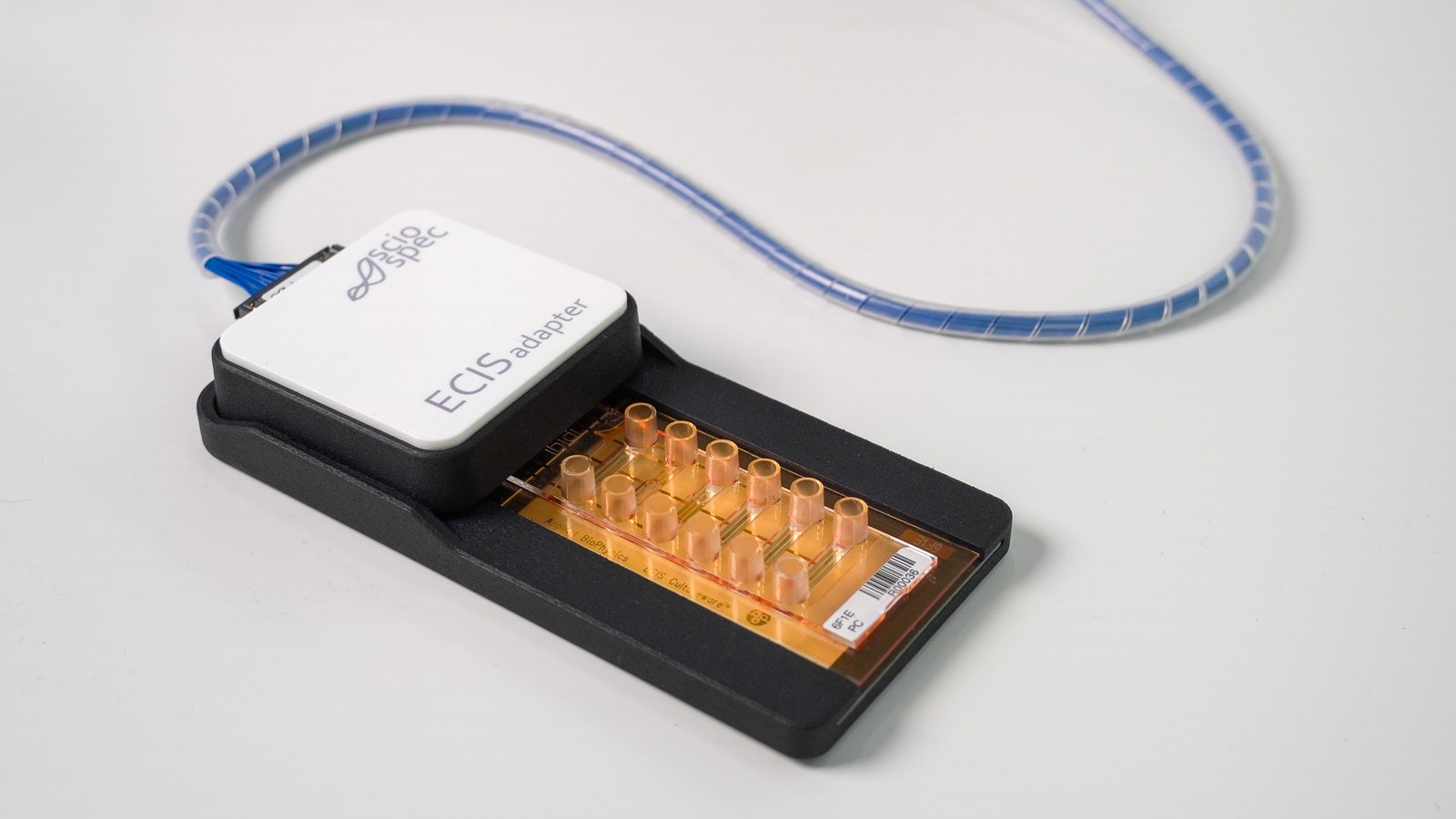
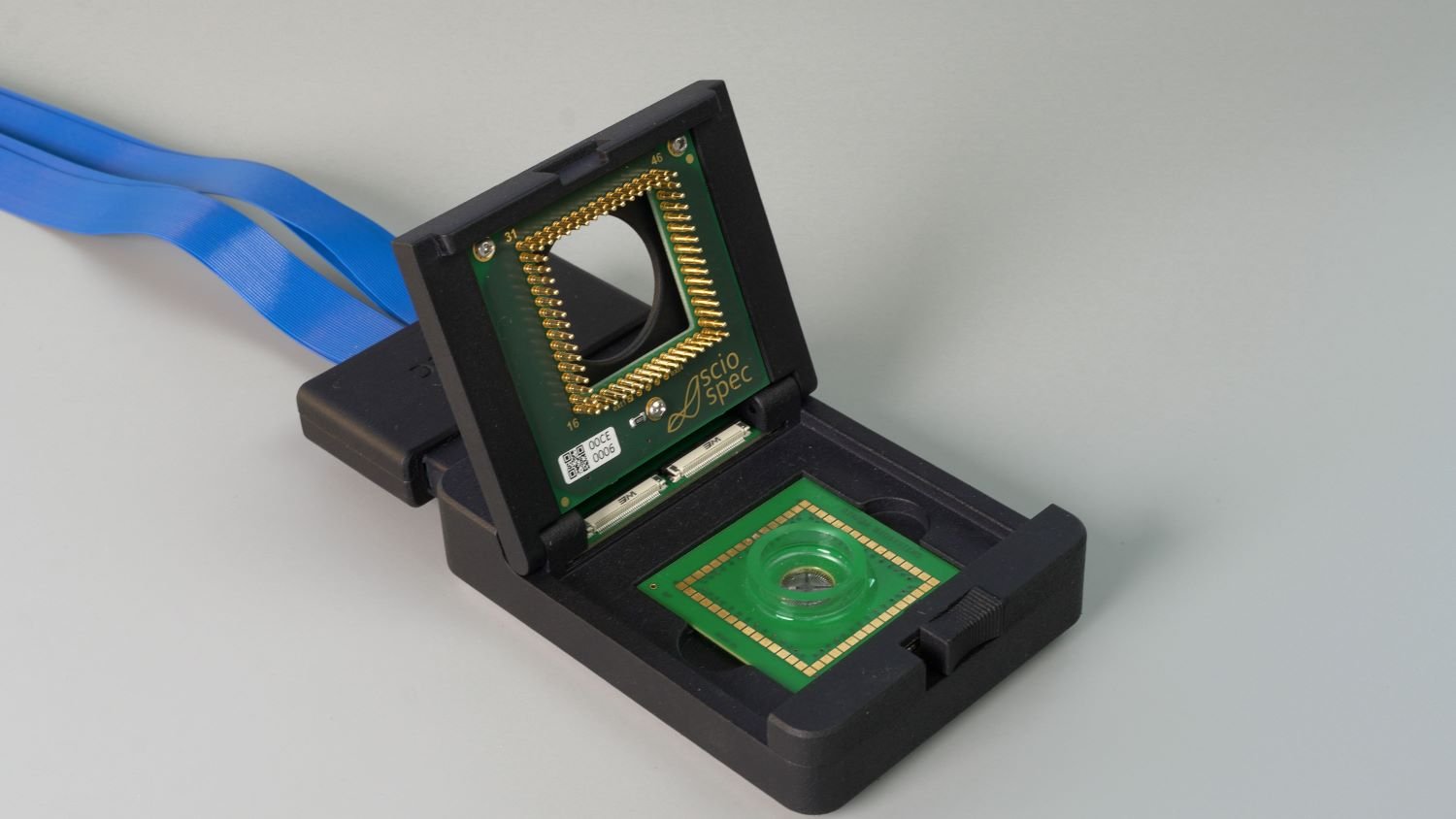
No. Sciospec instruments work with a wide range of commercially available TEER chambers, ECIS arrays, MEA chips and microfluidic organ-on-chip plates. Our adapter family (MEArack, ECISadapter and custom interfaces) makes it possible to use your existing chip format without switching consumables.
Can impedance spectroscopy replace my optical assays?
Often it complements them rather than replacing them. Impedance gives you continuous, label-free dynamics that optical endpoint assays miss, while optical methods still resolve spatial detail. Many labs run both in parallel and gain new information from the combined readout.
Discuss Your Assay Format
Whether you use standard transwell inserts, custom microfluidic chips, or complex multi-organ platforms — our application engineers can help you integrate impedance monitoring.
Get in touch with us
Phone
Headquarters
Sciospec Scientific Instruments GmbH
Leipziger Str. 43b
04828 Bennewitz, Germany
Open in Google Maps